7 Things to Look For in an AI Trading Agent Before You Trust It

AI trading agents are having a moment. In the past year, a growing number of AI trading agent platforms have started promising a new kind of investing experience: instead of manually checking charts, reading filings, comparing news, and building watchlists by hand, users can simply ask an AI agent to do the work.
That sounds compelling, but it also raises an obvious question: what actually makes an AI trading agent good?
The reality is that many tools in this category still behave more like polished chatbots than serious research systems. They can summarize obvious information, but often struggle with timeliness, data quality, reasoning depth, and practical decision support.
For investors, the difference matters. A strong AI trading agent can compress hours of market research into minutes. A weak one can create false confidence while adding very little edge.
If you are evaluating products in this space, here are seven things worth looking for.
1. Real-time data matters more than polished language
The first test is simple: where does the data come from, and how current is it?
A trading agent that sounds smart but relies on stale prices, outdated headlines, or incomplete company information is not very useful. In markets, timing and freshness matter. A delayed earnings update, a missing macro event, or an old quote can completely change the conclusion.
A serious AI trading agent should be able to work with live or near-real-time market data, current news, and up-to-date company information. It should also make it clear when data is delayed, estimated, or unavailable.
When evaluating a tool, ask it something time-sensitive. Try a current earnings reaction, a sharp price move, or a breaking macro event. If the answer feels generic or avoids specifics, that is a warning sign.
2. It should use tools, not just conversation
Many products call themselves “AI agents,” but what they really offer is a chat interface sitting on top of a large language model.
That is not enough.
A useful trading agent should be able to actually do things behind the scenes: pull quotes, scan filings, compare news coverage, inspect charts, screen assets, and combine multiple sources into one answer. The value of an agent is not in producing fluent text. The value is in coordinating research steps that a human would otherwise do manually across several tabs and platforms.
The key question is this: does the system merely answer, or does it investigate?
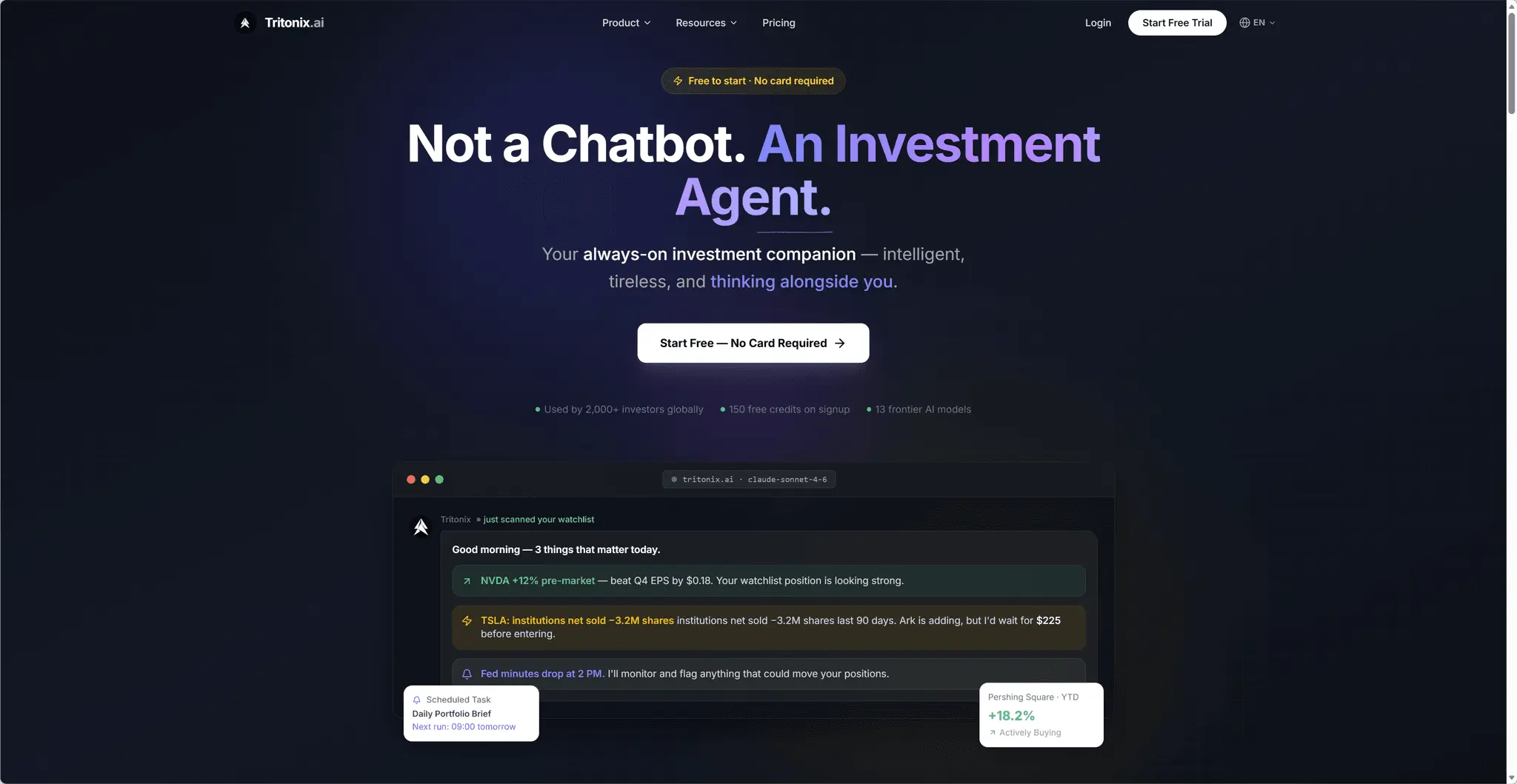
The best tools behave more like research assistants than chatbots. They break a question into smaller tasks, gather evidence, and then return with a conclusion supported by data. Some newer AI investment agent products are starting to move in this direction by combining live data, reasoning, and workflow automation in a single interface.
3. Explainability is not optional
In investing, a conclusion without a reason is close to useless.
A trading agent should not just tell users what looks bullish or bearish. It should explain why. Was the conclusion driven by earnings momentum, valuation, institutional buying, macro sensitivity, options flow, or technical breakdowns? Ideally, the answer should include evidence, logic, and source references that a user can verify.
This is especially important because AI-generated confidence can be misleading. Nicely written output often feels more reliable than it is.
A good AI trading agent helps users audit the reasoning. It should surface key signals, cite where facts came from, and distinguish clearly between data, interpretation, and opinion. Investors should be able to trace the path from raw information to final judgment.
4. Cross-source research beats single-source summaries
Markets are multi-dimensional. A stock is not just a chart. It is also earnings quality, management commentary, analyst expectations, sector context, macro sensitivity, and capital flows.
That is why single-source tools tend to disappoint. If an AI agent only summarizes news, it misses price action. If it only reads charts, it misses fundamentals. If it only analyzes filings, it misses what the market has already priced in.
The strongest products combine several research layers at once. They look across price, news, filings, sentiment, and market structure to form a more complete view.
This matters because investors rarely make decisions based on one signal alone. They look for alignment. A better AI trading agent should help surface that alignment faster.
5. “Smart money” context can be genuinely useful, if handled carefully
One of the more interesting developments in this category is the rise of tools that track institutional behavior. Hedge fund filings, portfolio changes, conviction shifts, and manager concentration can all provide useful context for individual investors.
Used well, this kind of information can help answer questions like:
- Are high-conviction funds accumulating this name?
- Has institutional ownership become more concentrated or more cautious?
- Is a new position likely part of a broader theme or just a small trade?
That said, smart money tracking is only valuable if the platform adds context rather than hype. Institutional data often comes with delays, reporting limitations, and survivorship bias. A trustworthy AI trading agent should acknowledge those limitations and help interpret them responsibly.
In other words, institutional tracking is best used as a layer of evidence, not as a shortcut to blind copy trading.
6. Automation should reduce workload, not increase it
One of the biggest promises of AI trading agents is that they can keep working when the user is not actively online.
This is where workflow design matters. A useful system should allow investors to set recurring tasks such as:
- monitor a watchlist every morning
- summarize earnings after release
- track changes in institutional positioning
- flag technical breakouts or thesis breaks
- deliver periodic research briefs
This kind of automation is more valuable than one-off novelty features because it creates a repeatable process. And in investing, process is often the real edge.
Many investors do not fail because they lack access to information. They fail because they cannot maintain a consistent research routine. An AI trading agent becomes more valuable when it helps turn scattered attention into a disciplined workflow.
7. The best products support judgment instead of pretending to replace it
Perhaps the most important test is philosophical.
A bad AI trading tool tries to sound certain about everything. A better one knows when to qualify, when to say the evidence is mixed, and when the best move may be to wait.
That may sound less exciting, but it is far more useful in practice.
Investors do not need another source of overconfidence. They need a system that helps them think more clearly, spot what matters faster, and stay consistent under uncertainty. The best AI trading agents do not replace human judgment. They improve the quality and speed of that judgment.
That is the standard worth using when evaluating any product in this space.
Final thoughts
AI trading agents are likely to become a permanent part of the modern investing toolkit. But the category is still early, and the gap between marketing and actual utility remains wide.
When reviewing a platform, focus less on whether it can produce impressive text and more on whether it improves real decision-making. Does it use current data? Does it investigate instead of merely chatting? Does it show its reasoning? Does it reduce research friction? Does it help build a repeatable process?
Those are the questions that matter.
For readers who want to see how these workflows appear in the wild, it can also be useful to browse examples of public trading ideas to compare how different platforms present market theses, chart setups, and trade rationale.
The future of investing may involve AI agents, but the best tools will not be the loudest. They will be the ones that quietly help investors make better decisions, more consistently, with less wasted effort.