Deploy AI Agents with Confidence and Ease

Autonomous coding and ops agents — Claude Code, OpenAI's Codex, Cursor — have crossed from novelty to daily tooling. Stack Overflow's 2025 developer survey found 84% of developers using or planning to use AI tools, and Gartner predicts that 40% of enterprise applications will embed task-specific AI agents by 2026, up from under 5% a year earlier.
But there's a gap between adoption and confidence. That same survey shows only about a third of developers actually run autonomous agents yet, and Forrester expects fewer than 15% of firms to switch on the agentic features they already own in 2026 — held back, in Forrester's words, by ROI and governance complexity. Teams aren't hesitating because agents can't do the work. They're hesitating because they can't answer a simple question: what, exactly, did the agent do — and what could it have done?
This piece is about closing that gap: the practices that let you ship agents to production with confidence instead of crossed fingers.
Why "just review every command" doesn't scale
The instinct is to keep a human in the loop on everything.
That works for a demo and collapses in production — an agent
can issue hundreds of operations an hour, and the friction of
approving each one is exactly why teams reach for flags like
--dangerously-skip-permissions. Once you do, the agent
inherits the full access of whoever launched it.
The deeper issue is architectural. As AWS's security team put it in 2026, "LLMs are probabilistic reasoning engines, not security enforcement mechanisms" — you can't prompt or fine-tune your way to a guarantee. Their guidance is to "assume an agent can do anything within its granted entitlements" and to enforce security through "deterministic, infrastructure-level controls external to the agent's reasoning loop." The warning worth sitting with: an agent that takes an unintended action does so "at machine speed, before a human can intervene."
OWASP reached the same conclusion from the other direction. Its 2025 Top 10 for LLM Applications elevated "Excessive Agency" — damage caused by too much functionality, too many permissions, or too much autonomy — and in December 2025 it published a full Top 10 for Agentic Applications. OWASP's prescribed fix isn't smarter prompts; it's complete mediation: enforce authorization in the downstream systems, not by asking the model whether an action is allowed.
The five practices that earn confidence
You don't need to slow agents down to trust them — you need the right controls in the right place. Confident teams converge on five:
Give the agent its own identity and least privilege. Don't run agents on a human's admin credentials. Issue a dedicated machine identity scoped to the specific actions and resources the job needs —
s3:GetObjecton one bucket, nots3:*. AWS recommends differentiating agent-initiated from human-initiated actions and applying distinct rules to each, calling least privilege "as important — if not more so" for agents than for people.Authorize every action downstream, deterministically. This is OWASP's complete-mediation principle. "Is this tool call allowed?" should be decided in a layer the agent can't talk around — not in the agent's own config (editable and skippable), and not in the prompt.
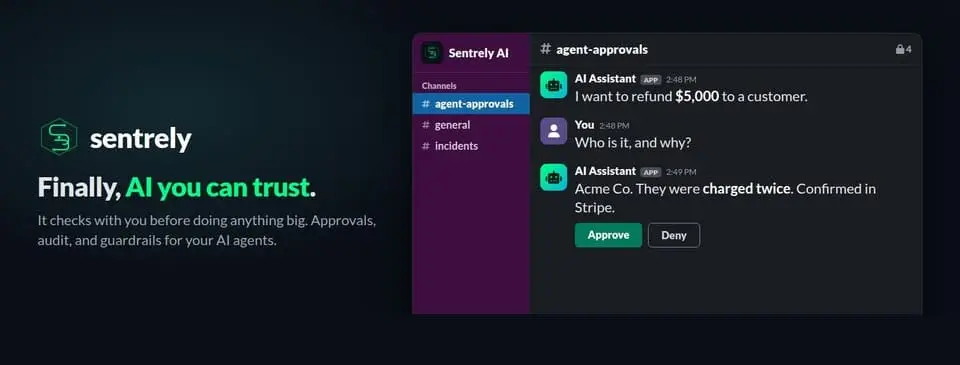
Gate high-impact actions on a human. Reading a file is reversible;
terraform destroy, dropping a table, or emailing 10,000 customers is not. OWASP explicitly recommends human-in-the-loop approval for high-impact actions. The trick is gating only the few operations where "no" is a realistic answer, so approvals stay meaningful instead of becoming rubber stamps.Log everything, immutably. Anthropic's own docs are candid that "no system is completely immune" and that "Claude Code only has the permissions you grant it" — you're accountable for what it does. That accountability is only real with a tamper-proof, per-action record tied to a specific agent identity and session. API usage logs show tokens consumed; they don't show the commands run.
Put a control plane between agents and infrastructure. The first four are hard to bolt onto each agent individually, which is why the recommended pattern is a single enforcement layer all agent traffic routes through. It matters especially with the Model Context Protocol: as Microsoft notes, MCP standardizes how agents discover and call tools but "doesn't define a control plane that can decide whether a specific tool call should be allowed before it runs." You have to add that checkpoint. Managed options exist — Sentrely is one example built around this pattern — and teams also assemble their own from IAM, a proxy, and audit tooling. Either way, the architecture is the point.
Confidence is an architecture choice
The reason "deploy with confidence" feels out of reach isn't It's that the oversight layer hasn't been wired up. Put a deterministic policy boundary, human approval on the risky few percent, and an immutable audit trail between your agents and your infrastructure, and the scary question — "what did the agent do last Tuesday?" — gets a boring, one-screen answer.
That's what confident deployment actually is: not trusting the agent, but no longer needing to.