How to Sell Cars on Facebook Marketplace as a Dealer in 2026: Rules, Limits, Photos and Automation

Facebook Marketplace is the largest free classifieds channel a car dealer has, and most dealerships still run it the slowest possible way: one salesperson, one listing at a time, phone photos against a chain-link fence. This guide covers how to sell cars on Facebook Marketplace as a dealer in 2026, what the rules for selling cars on Facebook Marketplace really say, and how the best-performing stores are using inventory sync, AI car photo editing and Facebook Marketplace automation to keep a whole lot listed without burning out a rep or an account.
The numbers in this article come from The Facebook Marketplace Used-Car Report 2026, an open dataset computed from 196 U.S. dealerships and 10,850 vehicles posted to Marketplace. I build AutoLander, the software that generated it, so read the recommendations with that in mind. The data itself is CC BY 4.0 and you can check every figure.
Can dealers still sell cars on Facebook Marketplace?
Yes, with two caveats that trip up almost every new store.
First, the channel changed in 2023. Business Pages lost vehicle-listing access in several major markets, so dealer inventory now goes out through personal profiles of the people who work at the store. In practice that means each salesperson runs their own Marketplace presence, and the dealership's job is to make those listings consistent, accurate and fast.
Second, Meta applies listing limits that it never publishes in one place. The current standard most dealers observe is five new vehicle listings per calendar month and 20 new listings total per account. Marketplace is intended for consumers, so an account that behaves like a bulk-posting bot can have listings removed or lose Marketplace access altogether. Any tool that promises to "bypass the limit" or "guarantee account safety" is selling you something no one can deliver.
Those constraints are the whole game. A store with 80 units and six salespeople does not need a way around the limit; it needs a repeatable Facebook Marketplace listing process that keeps every eligible unit posted, priced correctly and pulled down the moment it sells.
What a dealer listing needs to include
A Marketplace car listing that converts has the same anatomy every time:
- Correct category. Cars and trucks go under Vehicles; travel trailers, fifth wheels and motorhomes belong in RV/Camper. Miscategorized RVs are a common reason listings disappear.
- Accurate year, make, model, trim, mileage and VIN-level details. Buyers cross-check against CarGurus and Cars.com. A listing that disagrees with your own website loses trust instantly.
- A defensible asking price. Marketplace buyers are price-first. The report's median dealer asking price was $28,295, with the middle 50% of units between $19,199 and $42,000, and 45% of dealer inventory posted above $30,000. You are competing with private sellers, so the price has to be explainable in the first message.
- Eight or more photos, hero shot first. Exterior three-quarter front, rear three-quarter, both sides, dash, front seats, rear seats, odometer, wheels. Skip the photo of the dealer's promo frame.
- A description that answers the first three questions. Is it available, what is the price, and what is the next step (test drive, appointment, financing).
Get all five right on every unit and you are already ahead of most of the feed.
The photo problem, and what AI actually fixes
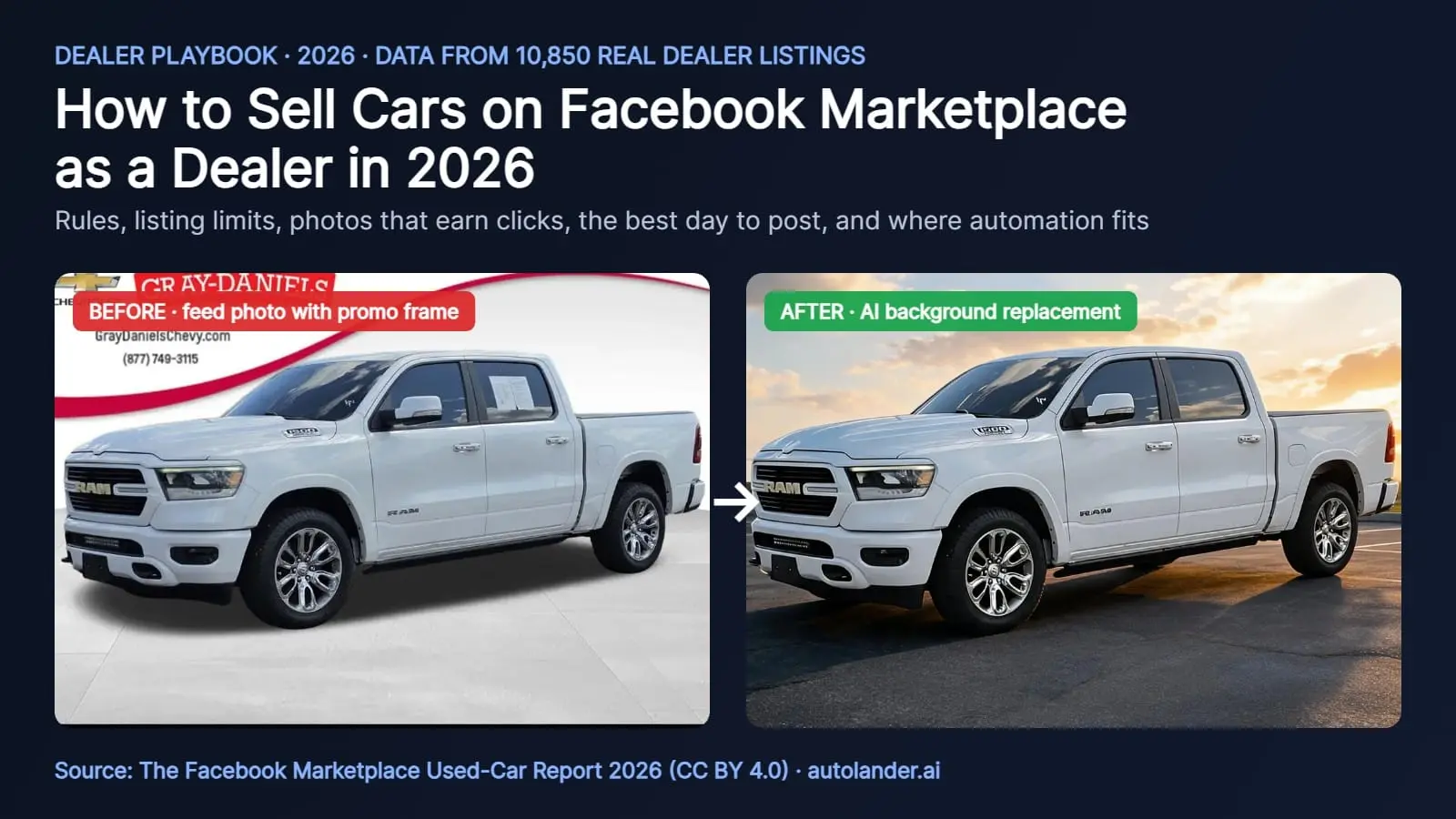
Photos decide clicks. Most dealer feed photos are shot on a lot, with other cars, power lines, snow or a syndication frame in the shot. The standard fix used to be a photo studio or a $200-per-month image vendor.
An AI car photo editor does the job differently. The good ones cut the real vehicle out of the original photo and composite it onto a clean showroom, outdoor or branded-storefront backdrop. The paint, wheels, trim and any visible damage stay exactly as they were. That distinction matters legally and commercially: car background replacement that makes a listing cleaner is fine; a "regenerated" image that hides a scratch or shifts a color is a misrepresentation that costs you the deal at the appointment.
Across the 196 stores in the dataset, more than 94,000 listing photos went through AI background replacement in the report period. Anecdotally, the biggest lift comes on inexpensive units photographed badly, not on the $60,000 truck that already looked good. If you try one tool, test it on your ugliest photos first. You can see before-and-after examples on the AI car photo editor page.
When to post, according to 17,778 real dealer posts
Dealers post like they work: heavily Monday through Thursday, then it falls off a cliff.
| Day | Share of dealer posts | Posts (90 days) |
|---|---|---|
| Monday | 16.4% | 2,919 |
| Tuesday | 16.3% | 2,902 |
| Wednesday | 17.0% | 3,017 |
| Thursday | 17.5% | 3,118 |
| Friday | 15.9% | 2,830 |
| Saturday | 11.5% | 2,036 |
| Sunday | 5.4% | 956 |
Thursday is the most crowded day. Sunday sees 3.3 times fewer new dealer listings than Thursday, while consumer browsing on Marketplace does not drop the same way. That is the open lane: a store that spreads posting across the weekend competes with a fraction of the dealer inventory it fights on Thursday.
The other number worth knowing is 22.6%: the share of dealer listings whose price changed after posting. More than one in five units was re-priced, which means that if your Marketplace listing does not update when your lot price does, one in five of your listings is wrong at any given time. Stale prices generate exactly the kind of "is this still available at that price?" messages that waste a rep's afternoon.
Which vehicles dealers list most
If you are deciding what to push to Marketplace first, the report's top ten by listing volume is a decent proxy for what buyers there expect to see:
- Ford F-150 (370 listings)
- Chevrolet Silverado 1500 (304)
- Ram 1500 (283)
- Jeep Wrangler (194)
- GMC Sierra 1500 (185)
- Toyota Tacoma (144)
- Ram 2500 (141)
- Jeep Grand Cherokee (141)
- Chevrolet Equinox (141)
- Toyota Camry (139)
Trucks dominate. Median mileage across all dealer units was 50,534 and the median model year was 2023, so this is not a beater channel; it is where late-model retail inventory gets discovered by local buyers who never visited a third-party listing site.
Manual, VA, extension, or software: the four ways dealers run Marketplace
Every dealership ends up in one of four operating models.
Manual posting by salespeople. Free, and it works at ten units. At 60 or more units it becomes 40-plus hours a month of copy-paste, and prices and sold status drift within days.
A virtual assistant. Usually $300 to $800 a month. Faster than a rep, but a VA re-types data from your website, which is how a 48,000-mile car gets listed at 84,000 miles.
A browser extension. Auto-fills the listing form from your feed. Cheap and quick to set up. The risk is architectural: the extension typically runs inside your session with your credentials and posts as fast as you click, which is the behavior Meta's systems flag.
Dedicated Facebook Marketplace automation software. Connects to the inventory feed you already maintain (CarGurus, Cars.com, or a DMS export from vAuto, DealerCenter, HomeNet, Frazer, CDK or Tekion), builds a review queue, enhances photos, paces posting, syncs price changes and removes sold units. Pricing across the category runs from about $39 a month to $249 a month, with some vendors on custom quotes. A comparison of the current tools is a reasonable place to start if you are evaluating.
What separates the good software from the risky software is not features; it is where it runs. Tools that execute from the dealer's own computer, inside the dealer's own logged-in session, at a human pace, behave like the salesperson they replace. Tools that post from a vendor's cloud servers, on many accounts at once, do not.
A weekly Marketplace routine for a dealership
Whatever model you choose, this is the cadence that keeps a lot healthy:
- Monday: reconcile. Every unit sold over the weekend comes down. Every new arrival gets photographed (or its feed photos get enhanced) and queued.
- Tuesday through Thursday: post the queue at a steady pace, within the account's limits. Never dump 20 listings in an hour.
- Daily, all week: answer every Messenger inquiry within minutes, and move the conversation to a phone number or an appointment. Marketplace leads go cold in hours, not days.
- Friday: audit prices against the lot. One in five will have moved.
- Saturday and Sunday: post into the open lane while competitors are dark.
- Monthly: look at attribution. Which posts produced conversations, which conversations produced appointments, which appointments produced sold units. If you cannot answer that, you cannot decide how much of a rep's time Marketplace deserves.
The honest summary
Selling cars on Facebook Marketplace as a dealer in 2026 is a process problem, not a hack problem. The rules are real, the limits are real, and the stores that win are the ones that keep every eligible unit accurately listed, with clean photos and current prices, seven days a week, without turning a salesperson into a data-entry clerk. Automation and AI photo editing are worth it when they remove that clerical work while keeping a human in control of what gets posted and who answers the buyer.
If you want to see what the whole loop looks like from feed to live listing, AutoLander starts at $39 a month with five free posts and no card, and the full report data is free to download and reuse.
Michael Garber is the founder of AutoLander LLC, a Tampa-based company building Facebook Marketplace software for U.S. car dealerships, and the author of The Facebook Marketplace Used-Car Report 2026.