Startups are buying their way to a user base. The smarter move costs nothing.

Look at where tech companies are putting their marketing money right now.
Some goes on AI visibility. Tracking whether your brand shows up in LLM search, then paying to improve where you land. AEO and GEO are the terms, and the problem is a genuine one, though the attribution is still catching up with the spend.
Some goes on influencers, where rates in a decent B2B niche now run into four figures for a single post, and the return is difficult to predict before you have paid it.
Some goes on paid social, where a small budget struggles to get out of the learning phase at all, and you are bidding for the same buyer as companies with far more to spend.
And a great deal goes on content and SEO, which is now squeezed from both ends. Every competitor has the same AI tools you do, so the web is filling with AI-generated content faster than anyone can read it, and you are competing against all of it for the same keyword. Then, when you do rank, the assistant summarises your page in its answer and the click never arrives.
Four doors, one bet. PR, events and the rest sit on the same spectrum. Every one of them is you paying an intermediary for access to an audience somebody else owns, and every one of them is getting dearer and less distinctive, because AI has made it trivial to produce more of whatever each channel runs on.
There is another door. Almost nobody uses it, and it is free.
Leverage an audience instead of buying one
Somewhere out there is a company that does not compete with you but sells to exactly the person you sell to. They have spent years earning the trust of customers who look precisely like your customers.
You could spend two years and a great deal of money assembling that same audience yourself. Or you could ask them to introduce you.
That is the trade. They put you in front of their customers, you put them in front of yours. Both of you arrive as a recommendation from a company the buyer already relies on, rather than as an interruption they have learned to scroll past.
It does not have to be a newsletter. A joint webinar, a bundled offer to each other's customers, a podcast swap, an in-app mention, a shared piece of research. The mechanism varies. The principle does not. You are leveraging trust somebody else has already built, and they are leveraging yours.
Cost of media: nothing.
Not a new idea. But it has evolved.
Co-marketing is as old as marketing. What changed is the arithmetic around it. When attention was cheap you could afford to buy it. Now that every paid channel is dearer and less differentiated than it was two years ago, the channel that costs nothing but coordination stops being a nice-to-have.
The numbers back it. Partnership-led acquisition runs roughly a third cheaper than paid, and co-marketing is repeatedly named the most effective way to grow an audience. Most founders nod at that and go back to buying ads.
Because finding the partner is the hard part
Not because it does not work. Because the finding does not scale.
You trawl LinkedIn. You send cold emails that go nowhere. You build a spreadsheet of maybe-partners, then discover half of them quietly compete with you on a product line you had not noticed. You have no way to tell whether their customer base is real, whether it genuinely overlaps yours, or whether they are even open to partnering.
Land one, and you spend a fortnight chasing copy, dates and links.
Weeks of work for a single campaign. Launching a paid ad takes an afternoon. So people launch the ad. The better channel loses on friction, not on merit.
Co-marketing 2.0
That is what GoHalves is for.
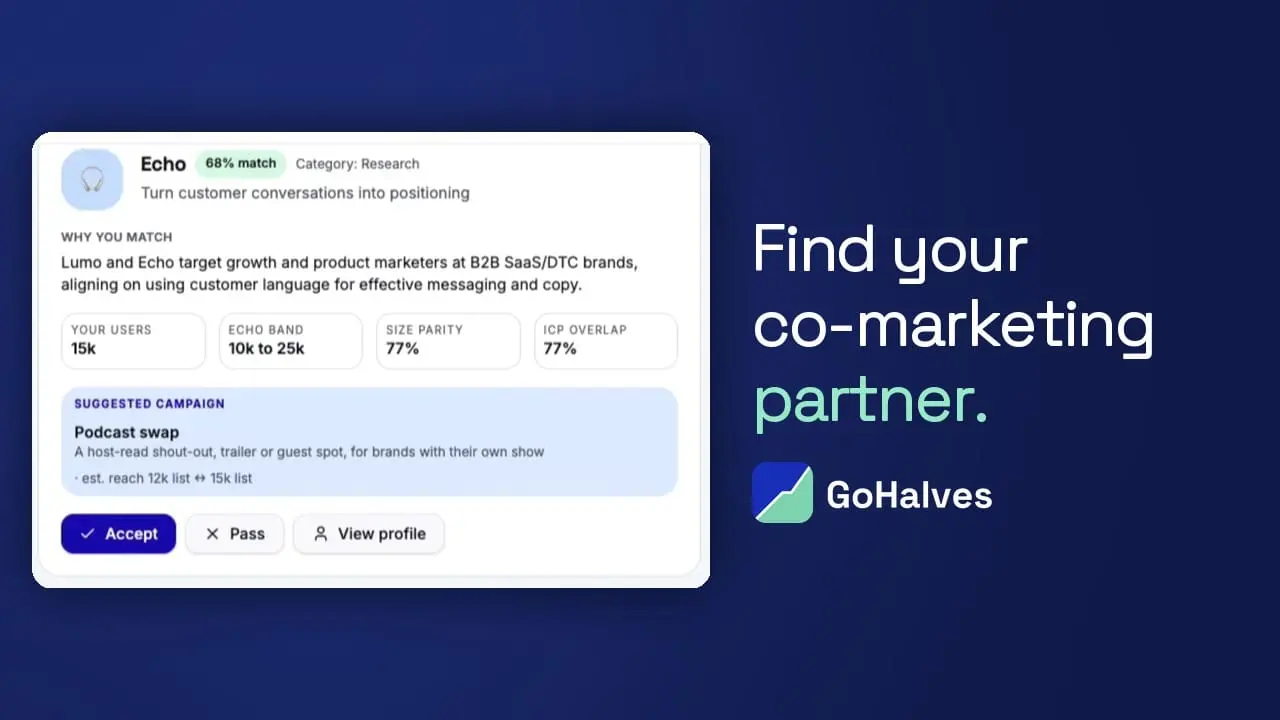
Every company on it already wants to co-market, so there is no cold pitch. We match on shared goals and audience fit, and the match card shows its working. How far your ICPs actually overlap, how close your two audiences are in size, and how different your products are. If two companies turn out to be building the same thing, they never see each other at all.
When both sides accept, we open the thread with a proposal already drafted from both profiles, in each brand's voice, with dates, whatever each side needs to run its half, tracking links and a dashboard that reports per side.
Nobody has to make the first move. That is the whole trick.
Worth being precise about where the AI sits in that. We do not use it to generate more content into an internet already drowning in it. We use it for the matching itself, which means reading two companies' positioning and working out whether their buyers are the same buyers. That is a comparison problem, and it is the part a person cannot do at scale.
Routing around the flood rather than adding to it.
What people are missing
Every paid channel is getting dearer and less distinctive at the exact moment AI made content infinite. Trust is the scarce thing now. And the highest-trust distribution available to a small company is a recommendation from a company its buyers already rely on.
That was always true. What has changed is that co-marketing is now practical at speed, because finding the right partner no longer depends on who you happen to already know.
Founding places are open
GoHalves is taking founding members now, and joining the waitlist is free.
We are starting with tech companies, and opening other industries as the pool grows.
The cheapest distribution available to you right now is an audience another company has already spent years building. Go and ask for it.
Heshaam Hague is the founder of GoHalves, co-marketing matchmaking for tech brands. Trade audiences, not ad budgets.