
Crisphive
Constraint-based deterministic scheduling for field ops

claude mcp add --transport http crisphivehttps://crisphive.com/mcpDetails
- Follow on
- Categories
- Target Audience
- Pricing
- Freemium from $79
 Housecall Pro alternatives
 ServiceTitan alternatives
 Jobber alternatives
Discovery signals
How AI and people discover Crisphive on PeerPush
About Crisphive
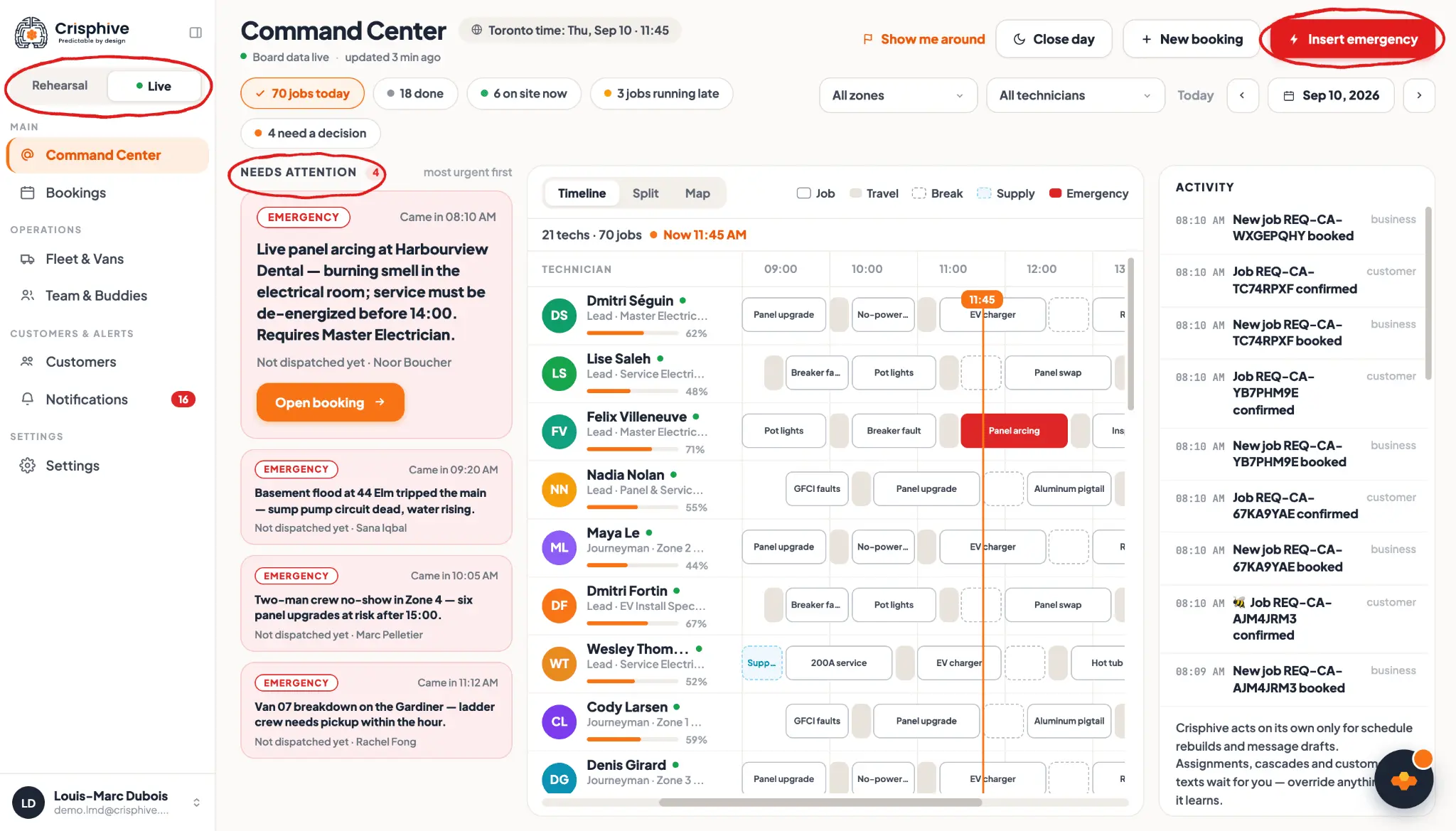
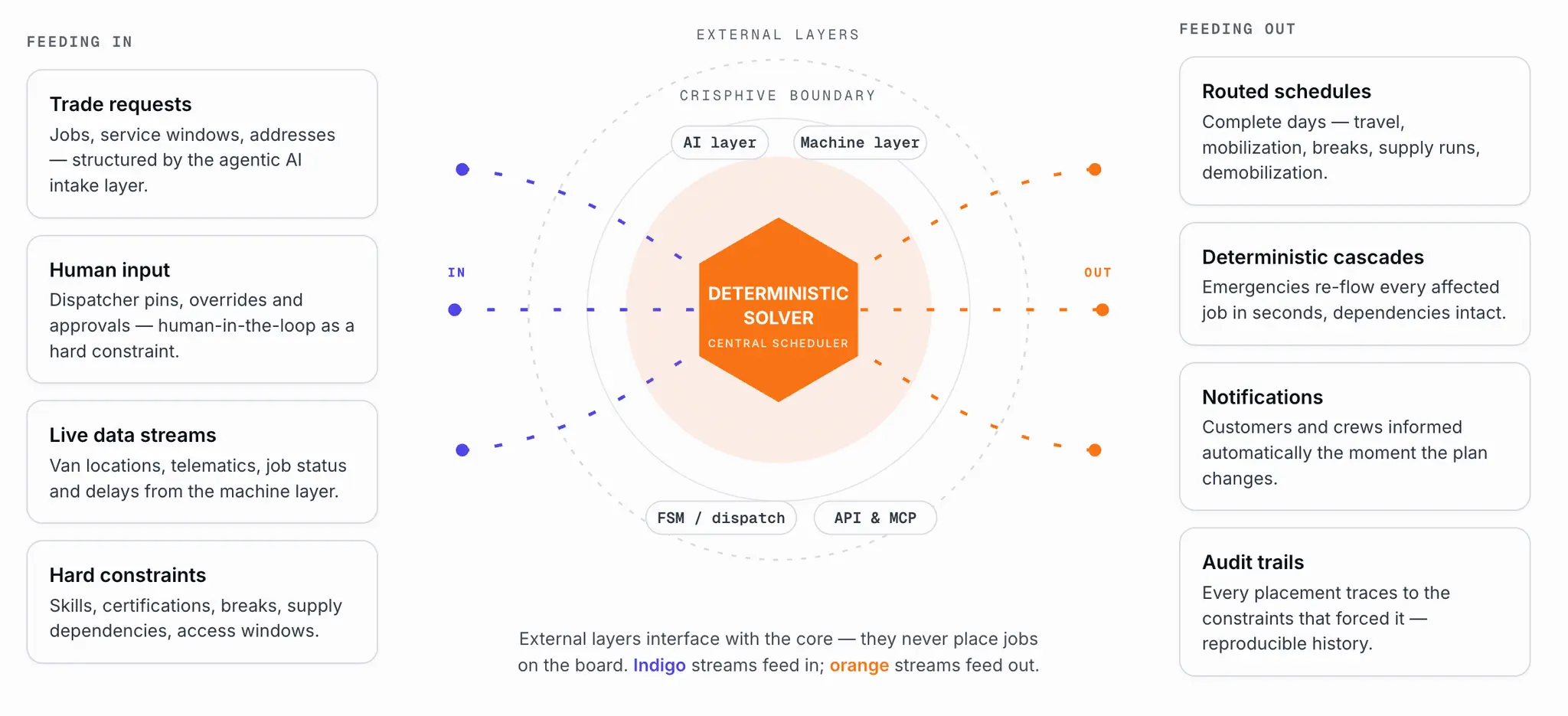
Crisphive — Constraint-Based Scheduling Infrastructure for Field Ops The scheduling tool your agents call. Crisphive is deterministic scheduling infrastructure for field operations teams running 10+ crew members. It is not an AI dispatcher guessing at a good-enough plan. It is a constraint solver: a mathematical engine that takes your real-world rules — skills, locations, availability, travel time, mob/demob, breaks, supply runs, job dependencies — and computes a schedule that provably satisfies all of them. Every time. The same inputs always produce the same answer, and every answer comes with a reason. LLMs never inside the math Most "AI scheduling" products put a language model in the middle of the decision. Crisphive puts the LLM at the edges — intake and explanation — and keeps a deterministic solver at the core. Your agent (or your dispatcher, or your customer) talks to Crisphive in plain language through MCP or the REST API. The solver does the math. The result is a schedule you can audit, replay, and trust, because it was computed, not generated. The request path is simple and inspectable: Agent → MCP → API → Solver → FSM. Five layers, no black box. What the solver actually solves Match. Every job is assigned to a crew member who actually holds the required skills and certifications, is inside the right service area, and is genuinely available — not "probably free," available against their real calendar of sessions, time off, and buddy constraints. Route. The day is sequenced against real travel times, mobilization and demobilization windows, mandated breaks, and supply runs. The solver doesn't stack jobs back-to-back across town and hope; it builds a day a human can physically drive. Cascade. When one thing changes, everything downstream is affected. Crisphive's dependency-aware cascade rescheduling re-plans the entire day — every affected crew member, every dependent job — in under 3 seconds. This is the hard part of scheduling, and it's the thing Crisphive was built to do. When the day breaks — and it always breaks A schedule that only works when nothing goes wrong isn't infrastructure. Crisphive is designed around the moments dispatchers dread: A crew member calls in sick at 6:40 AM. Their whole day of confirmed jobs is suddenly orphaned. Crisphive identifies every affected job, ranks re-staffing candidates by skill match, service area, and real availability, and previews the full cascade — who takes what, what moves, what the new day looks like — before you commit a single change. Preview first, commit second: nothing is written to the live schedule until you approve the plan. A P0 emergency comes in. A burst pipe, a downed line, a no-heat call in January. Crisphive ranks which crew members could realistically take the emergency right now, computes the least-disruptive insertion point, and cascades the reschedule across everyone affected — including notifying downstream jobs that shift. What takes a dispatcher forty minutes of phone calls takes the solver under three seconds. A job runs long. The 2-hour install becomes a 5-hour install. Downstream appointments don't silently become lies to your customers. The cascade re-plans the remainder of the day and surfaces exactly which arrival windows change. A truck breaks down. A part doesn't arrive. A customer reschedules. Every disruption is the same class of problem to the solver: constraints changed, recompute the feasible plan. Deterministically. With an explanation. In every case, the pattern is identical: preview the cascade, see the consequences, then commit. Your dispatchers stay in control; the math does the labor. Built like infrastructure, priced like it Crisphive is modeled on Stripe: a composable primitive that developers wire into their own products and workflows. It ships as a deterministic solver core, an MCP server (so Claude and other agents can book, quote, move, and reschedule jobs directly), a REST API, and SDKs. Rehearsal mode lets you pressure-test schedules against a simulated fleet before anything touches the live board — no real data required before your aha moment. It works out of the box across HVAC and trades, last-mile delivery, facilities, infrastructure and utilities, government and municipal, healthcare, and industrial operations — each with its own vocabulary of crews, skills, and emergency scenarios. Pricing: Free to start · A Smidge $29 · Launch $99 · Scale $299 · Enterprise for large fleets. See your own chaos, solved Run a Shadow Schedule Audit: we take a real day from your operation, run it through the solver, and show you side-by-side what your board did and what the math would have done — drive time saved, emergencies absorbed, jobs that never should have been booked where they were. Your schedule is a constraint problem. Stop solving it with a whiteboard and a group chat. Crisphive. Match. Route. Cascade — in under 3 seconds.
Screenshots

Reviews (0)
No reviews yet. Be the first to rate this product!
Comments (0)
No comments yet. Be the first to share your thoughts!