
Decispher Memory
Persistent context for all your AI coding tools

npx decispher@latest initDetails
- Follow on
- Categories
- Target Audience
- Pricing
- Freemium from $9
Discovery signals
How AI and people discover Decispher Memory on PeerPush
About Decispher Memory
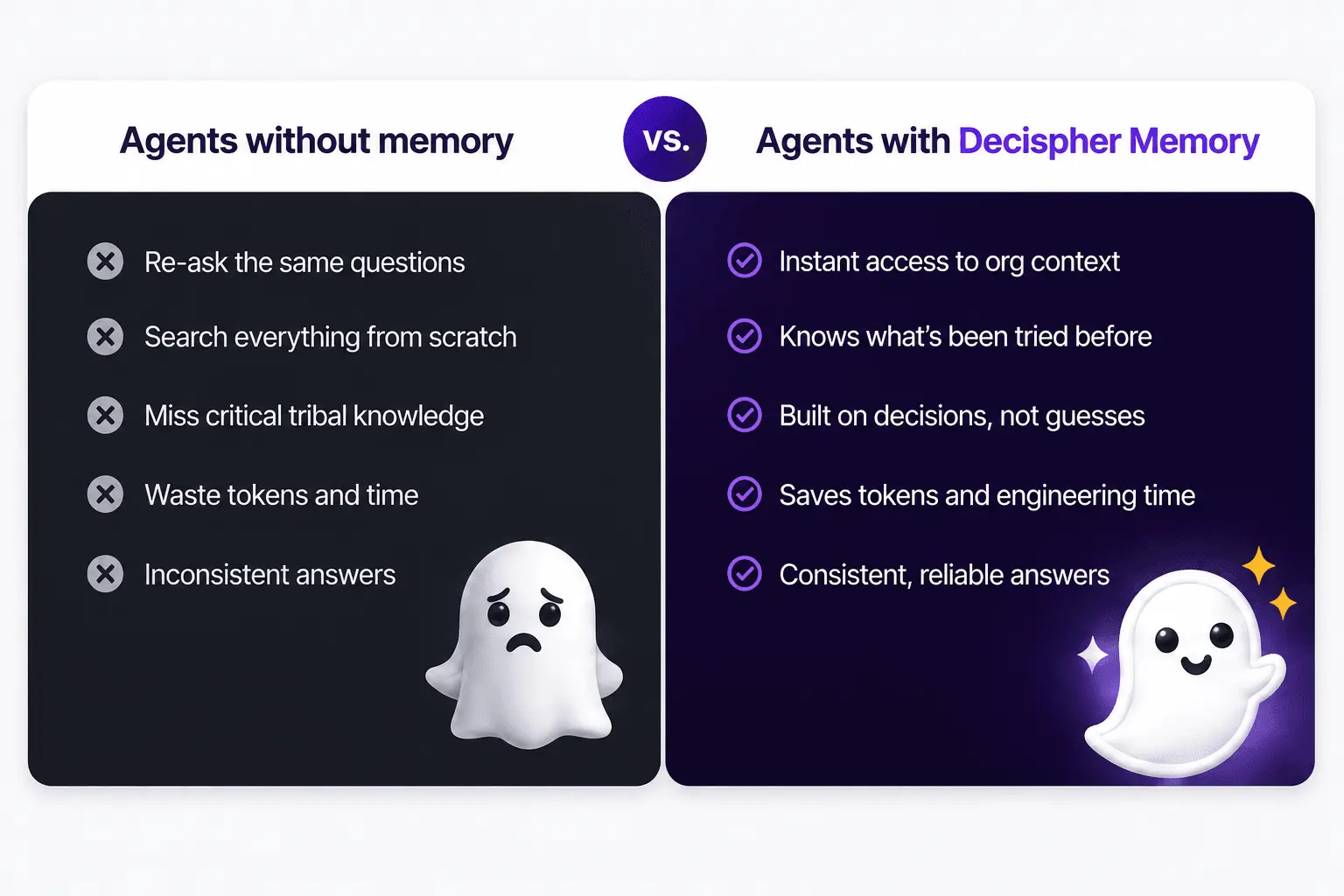
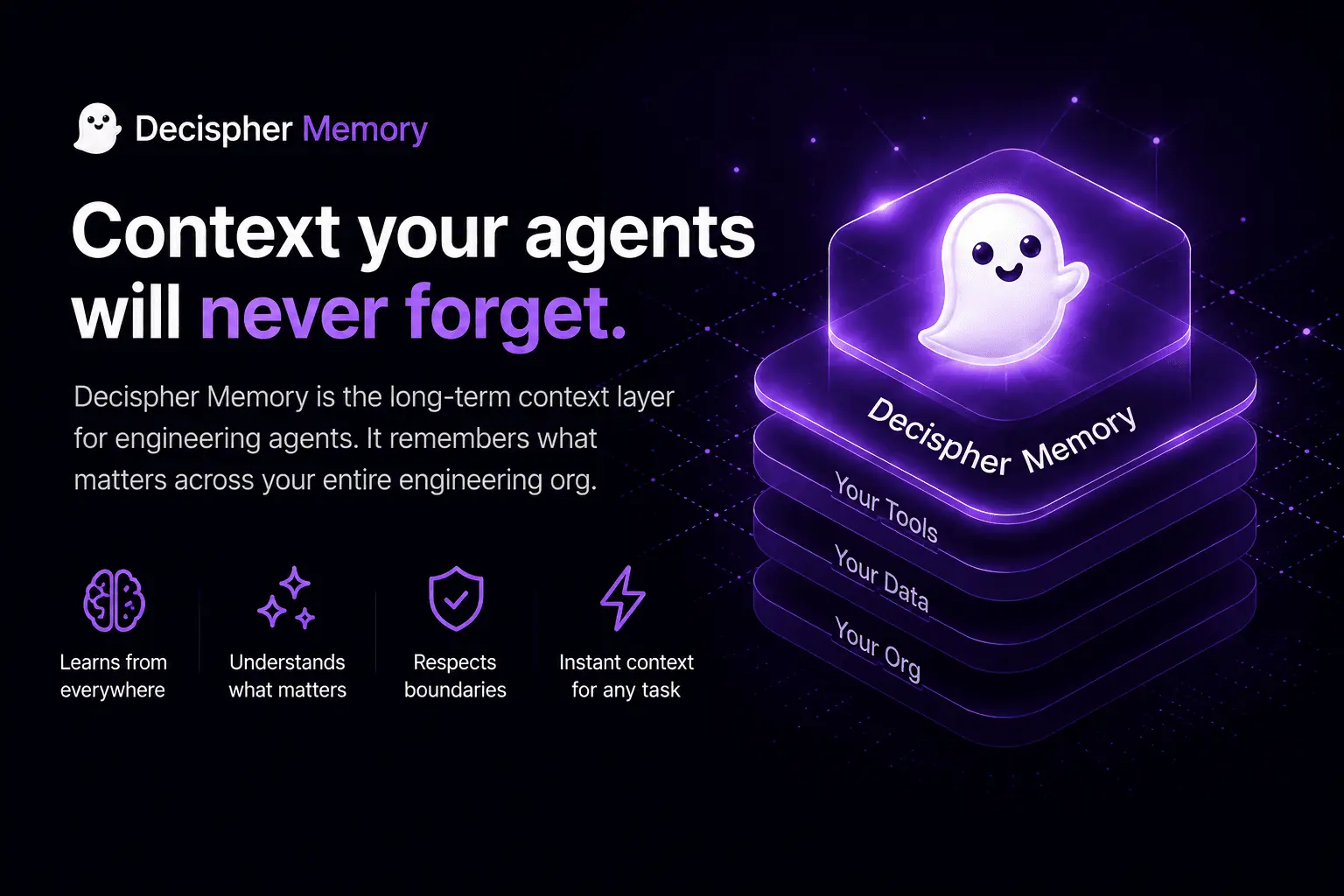
Decispher Memory : Persistent memory for AI coding, without the repetition Stop re-explaining your stack to every new session. Decispher Memory captures your engineering context once and injects it into every session, on every AI coding tool you use, so your agent starts already aligned with how your team works. What it does 1) Define once, applies everywhere. Say that this repo uses pnpm, that staging runs on 3001, that migrations are never squashed. Every session after that already knows. 2) Cross-tool by design. The same memory serves Claude Code, Cursor, Codex, Copilot, VS Code, the CLI, and anything that speaks MCP. Your context is not locked inside one vendor's plugin. 3) Yours to control. Read, edit, or hard-delete any memory at any time. Deletion is deletion, not a hidden tombstone. Key features 1) Three scopes, with governance. Personal memory travels with you. Project memory belongs to the repo. Company memory holds everywhere. 2) Promotion between scopes runs through review, so a personal shortcut never becomes team policy by accident. 3) Supersession, not accumulation. When a fact changes, the new one retires the old. Last quarter's port number stops coming back. 4) A receipt for every injection. See exactly what was served, to which session, and why. Exportable and auditable, which is the version a security review can actually read. 5) Agents write back. A session that learns something durable contributes it to the record, deduped and routed through review rather than silently appended. 6) Bring your history. Import an existing ChatGPT or Claude export and start from the preferences you have already stated. 7) Two modes. Engineering mode is tuned to how engineers state a preference: package managers, ports, branch and migration conventions, test and deploy constraints, and the things a team has ruled out. General mode is the same memory, scoping, receipts, and controls for agents doing support, research, or ops work. Mode is set per company and changes what gets extracted, never what you keep. What makes it different 1) It is scoped and governed, not one personal blob. Assistant memory has exactly one scope: you. Engineering facts have three, and conflating them is how conventions nobody agreed to end up enforced on everyone. 2) It handles the update case, which is the one that actually bites. Retrieval systems return everything that ever matched and let the model choose. We retire the stale fact, and we measure ourselves specifically on that. 3) It is auditable by construction. Per-injection receipts mean you, your customer, or your security reviewer can see what an agent was told. No other memory layer in this category hands you that. 4) It is bidirectional. Agents read from the record and write back to it, so the asset compounds with use instead of decaying between the rare moments someone remembers to update a rules file. 5) It is cheap to serve. Roughly 3,200 tokens handed to the agent where the raw history is roughly 124,000. More memory does not mean a bigger bill or a less focused model. Real outcomes 1) No setup preamble. The first prompt of a session is the actual task. 2) The wrong-tool class of error disappears. No npm in a pnpm repo, no port you stopped using in March. 2) Superseded facts stay dead. When something changes, it changes once. 3) Onboarding compresses. A new engineer's agent knows the project's conventions on day one, because the project remembers them, not the person who left. 4) Materially lower context cost. 38x less context served for the same answer. Benchmarks Measured on LongMemEval, the standard benchmark for long-term memory across multi-session recall, temporal reasoning, and knowledge updates. Judged automatically over 500 questions. 1) 38x median token reduction. Median 38.5x, floor 24.9x, and 100% of questions above 10x. About 3,200 tokens served against about 124,000 tokens of raw history. 2) 88.5% on knowledge-update, the slice where a previously stated fact later changed. This is the failure mode a hand-written rules file has no answer for. 3) 84.0% overall on the oracle split and 81% on stricter version (GPT-4.1 mini as extractor and reader), which supplies the correct sessions and therefore measures reading rather than retrieval.
Screenshots
Reviews (0)
No reviews yet. Be the first to rate this product!
Comments (3)
Super relevant for me, since I run Claude Code and Codex side by side and keep a shared memory folder between them by hand. Does it sync automatically when one tool learns something new, or do you add memories yourself?
Per-injection receipts and retiring superseded facts address two real audit problems. When personal, project and company memories conflict, is precedence explicit and visible in the receipt?
With Decispher Memory, memory can stay personal, be shared with a project, or live in team sets so useful context can become shared without making private context visible to everyone.