EarChord
Get the chords out of an audio file, in your browser
Details
- Use Cases
- Pricing
- Free
- Platforms
- Featured in
Discovery signals
How AI and people discover EarChord on PeerPush
By AI reads among Education & Learning tools
700 AI reads since launch, ranked against every Education & Learning tool listed.About EarChord
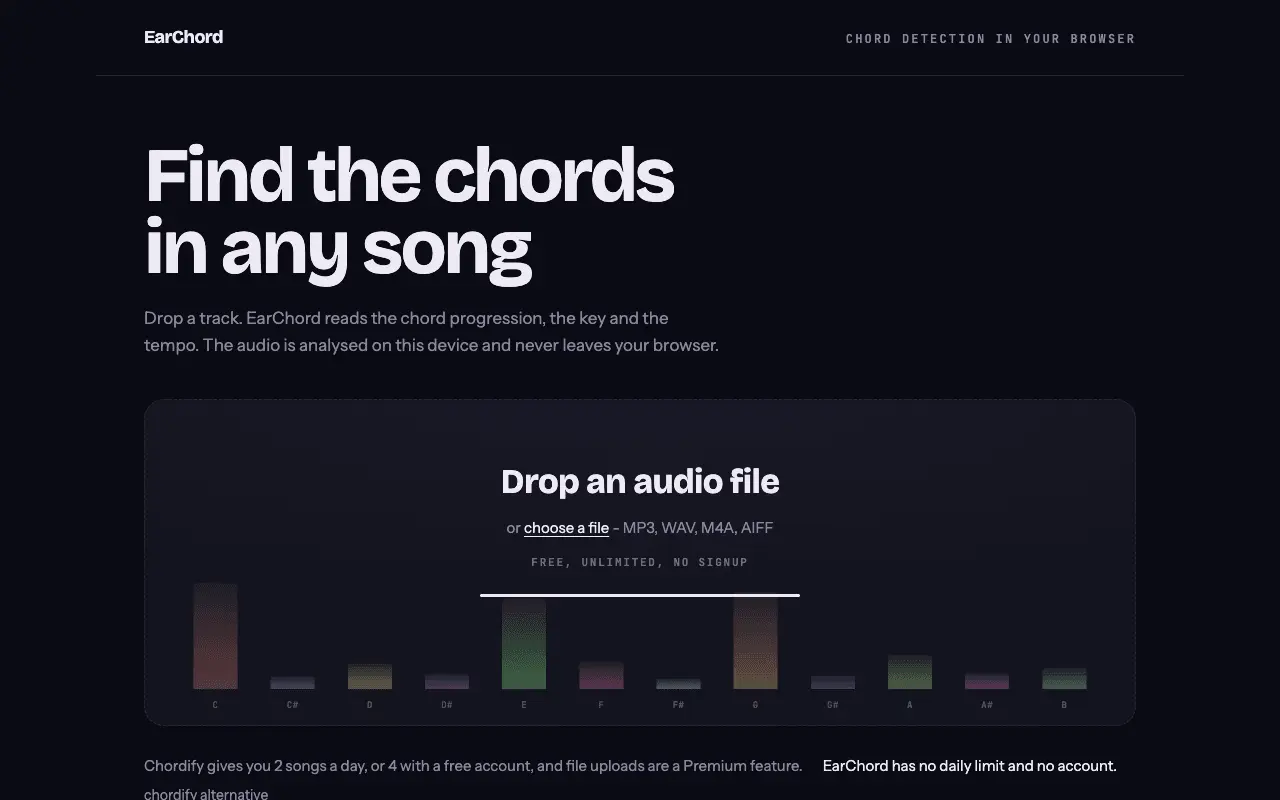
EarChord is a chord finder for audio files that runs entirely inside the browser. Drop in a track you already have and it returns the chord progression along the timeline, the key of the song and the tempo in BPM. There is no account, no daily limit and no upload step: the browser decodes the file and the analysis runs on your own processor inside a Web Worker. That is also why it can be free and unlimited. Most chord-finding sites fetch and analyse audio on their own servers, which costs bandwidth and compute per song, and daily limits follow from that arithmetic. Running the analysis on the visitor's machine removes it, and the privacy property people notice first - that recordings never leave the machine - is a consequence of the same decision. The analysis is classical signal processing in about three hundred lines of TypeScript, with no machine learning and no third-party audio library: the audio becomes a chromagram, each frame is matched against twenty-four major and minor triad templates, the key comes from the Krumhansl-Schmuckler profiles and the tempo from the onset envelope. The chord vocabulary is twenty-four major and minor triads, so sevenths, suspensions and inversions are reported as the nearest triad - stated openly on the site. A Chrome extension shows the chords under a YouTube video as it plays, reading audio the player is already producing through the Web Audio API.
Screenshots
Reviews (1)
Average 4.0 out of 5
Based on 1 review

Approachable ear training for chord recognition. Exercises are short enough to do daily, and difficulty ramps up sensibly.
Comments (2)
A chord finder for audio files that runs entirely inside the browser means you can drop in a track and get the chords without installing anything.
Ear training for chords is something many musicians skip, so making it approachable is great. Progress stats would motivate practice.