
ParancU
Evidence retrieval for questions, not just semantic similari

Details
- Use Cases
- Target Audience
- Pricing
- Free
- Platforms
Discovery signals
How AI and people discover ParancU on PeerPush
About ParancU
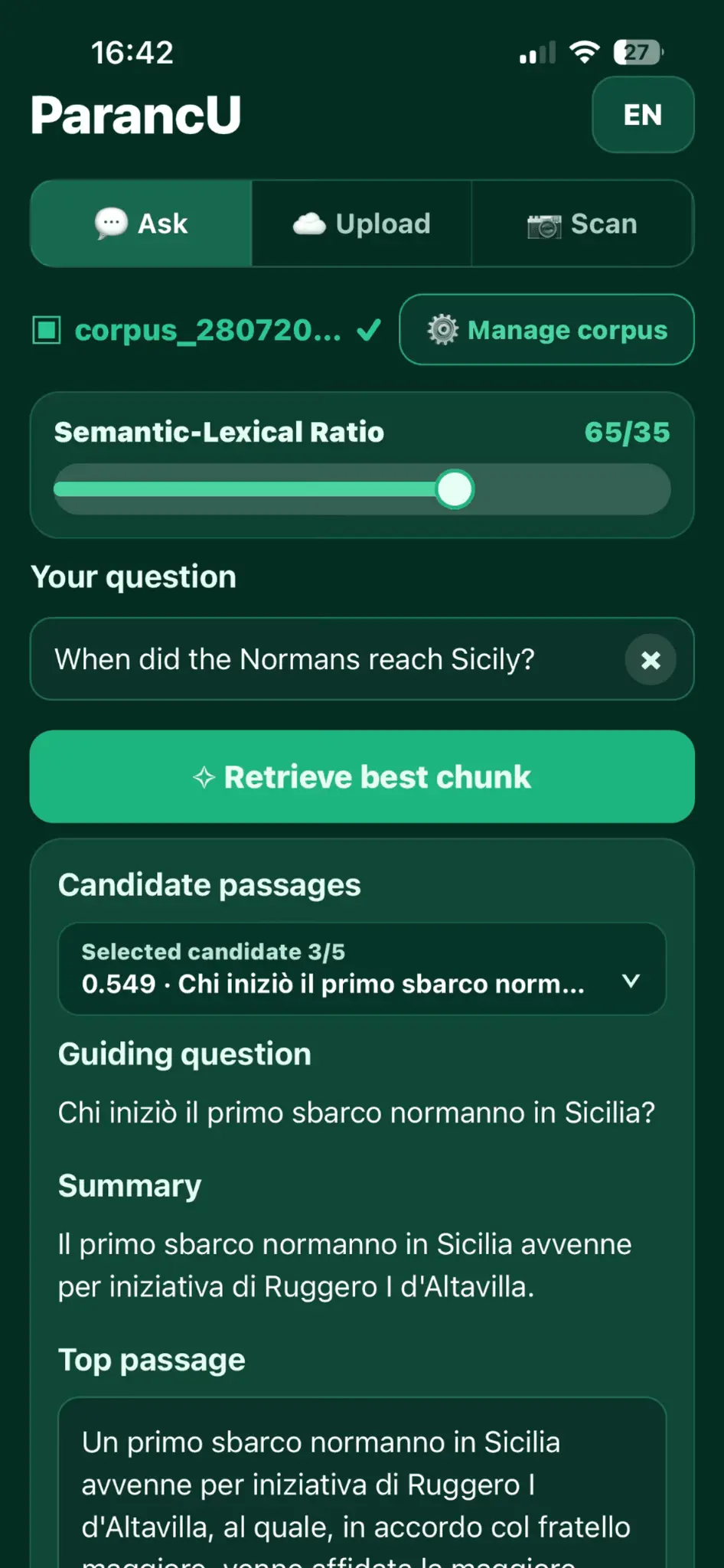
ParancU is an iOS evidence-retrieval app designed around a simple idea: semantic similarity does not necessarily mean that a piece of content contains the answer to a question. Instead of ranking content only by similarity to the query, ParancU uses an intermediate representation of the questions that each piece of content may answer. The goal is to retrieve the evidence supporting an answer, rather than generate a human-like answer. ParancU runs retrieval locally on the device using multilingual E5 embeddings through ONNX Runtime. The current version is available on the App Store. I am also working on ParancU 2.0, where I am exploring non-generative ways to represent the interrogative space of a piece of content. ParancU is an iOS evidence-retrieval app designed around a simple idea: semantic similarity does not necessarily mean that a piece of content contains the answer to a question. Instead of ranking content only by similarity to the query, ParancU uses an intermediate representation of the questions that each piece of content may answer. The goal is to retrieve the evidence supporting an answer, rather than generate a human-like answer. Retrieval runs locally on the device using multilingual E5 embeddings through ONNX Runtime. Users can search their content with natural-language questions and inspect the passages most likely to contain the supporting evidence.
Screenshots


Reviews (2)
Average 4.5 out of 5
Based on 2 reviews


Amazed, thanks for providing this!
Comments (5)
Retrieving by the questions a passage can answer rather than raw semantic similarity is a really interesting angle on search. Running the retrieval locally on iOS is a big plus for privacy.
@nckbrz Thanks! That's exactly the idea: move beyond semantic similarity toward answer-oriented retrieval, while keeping retrieval entirely on-device.
Returning supporting passages instead of inventing an answer is a useful distinction. Can ParancU explicitly show that no passage contains enough evidence, rather than always returning the nearest match?
@GeneralManager_Getatext Not yet. ParancU 1.1 retrieves the closest matches but doesn't assess evidence sufficiency. That's precisely what we're exploring with ParancU Decision Lab.
Running E5 through ONNX Runtime on the phone is a nice call for keeping notes private. How do you generate the candidate questions per passage, at import time on device too, or does that step run elsewhere?
@stackshortlist Thanks! Candidate questions are generated through OpenAI during corpus preparation. Once prepared, retrieval runs entirely on-device using E5 and ONNX Runtime.
'Similar' and 'actually answers the question' are often different things, so indexing the questions each passage could answer is a thoughtful twist. Returning evidence instead of a generated answer, run on-device, is refreshing.
@TSUTSU Thanks! That's exactly what motivated ParancU. Semantic similarity doesn't guarantee answerability. The goal is to retrieve evidence rather than generate answers.
I built ParancU to explore a simple question: can retrieval focus on whether content actually contains the evidence for an answer, rather than only on semantic similarity?