
Reptor
Reputation monitoring across news, search and AI answers

Details
- Follow on
- Target Audience
- MarketersAgenciesEnterprises
- Pricing
- Subscription
- Platforms
- Web
- Featured in
- Best News & MediaBest Brand Monitoring ToolsBest News Monitoring ToolsBest Public Relations Tools
- Alternatives
 Mention alternatives
Discovery signals
How AI and people discover Reptor on PeerPush
By AI reads among Analytics & Monitoring tools
1,218 AI reads in the last 30 days, ranked against every Analytics & Monitoring tool listed.About Reptor
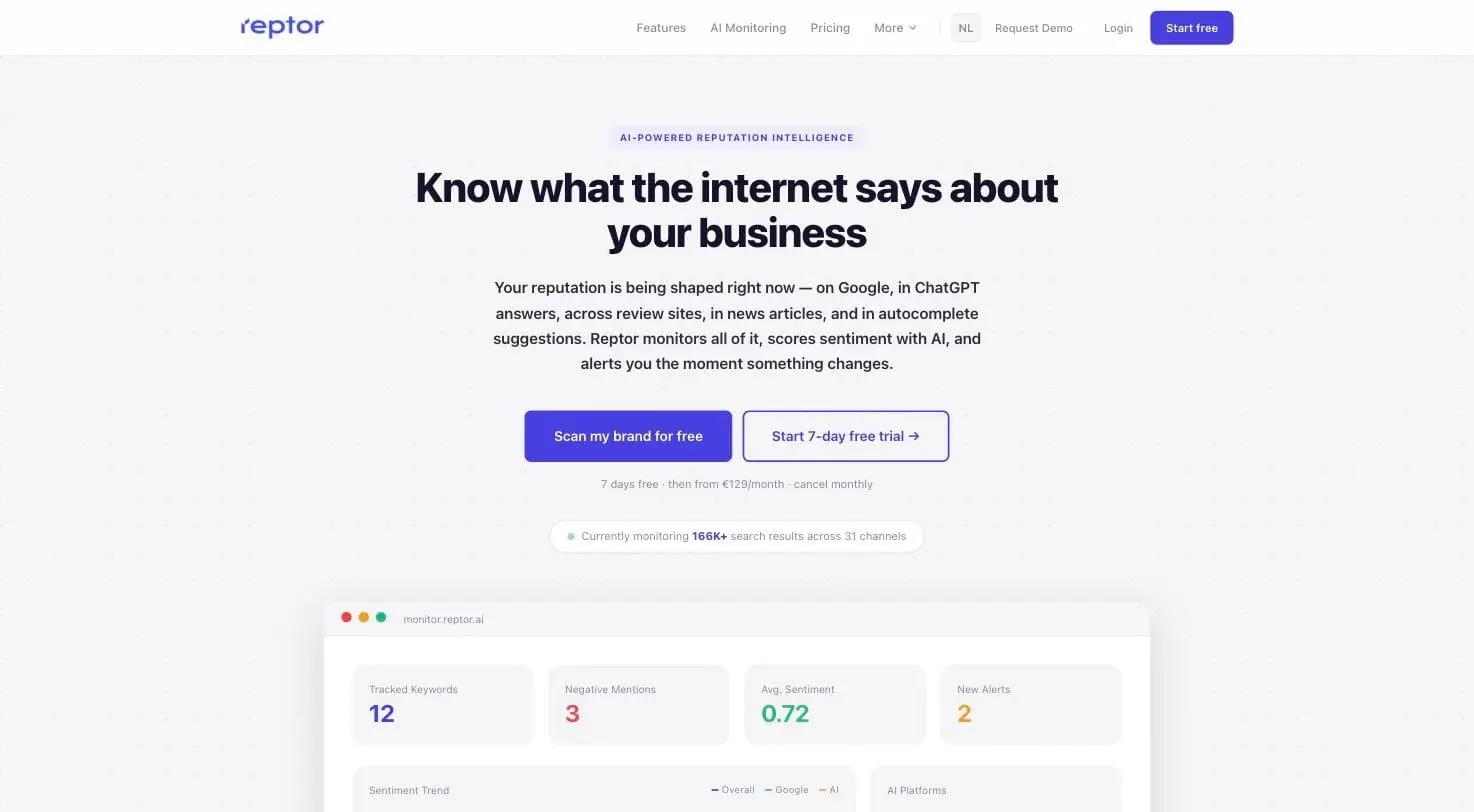
Type a company name into Google and you get more than ten blue links. You get the autocomplete suggestions, the questions other people asked, and an AI summary sitting above the results. Ask the same question of ChatGPT and you get a single answer, assembled from sources most readers never click. That screen is the reputation, and Reptor records what is on it. Underneath it sit the channels that produce the picture, and Reptor follows them together rather than one by one: news outlets and the journalists behind them, social channels, review platforms, positions in search, and broadcast on radio and television. Alongside those it queries the language models continuously across ChatGPT, Gemini, Perplexity, Grok, Google AI Mode, Google AI Overviews, Claude and Copilot, and stores both the answers and the sources they cite. That citation record is the measurement side of GEO and AEO: it shows which kinds of sites a model leans on, so it becomes clear where a brand's visibility comes from and where work on it pays off. Social monitoring runs across thirteen platforms, each with its own connector, among them X, LinkedIn, Facebook, Instagram, TikTok, YouTube, Reddit, Threads, Snapchat, Telegram, Bluesky and Wikipedia. Posts are deduplicated on the platform's own post id rather than on their text, so the same item arriving through three different routes stays one item and the volume on screen is the real volume. Much of what is said about an organisation is never typed out. When a post carries an image, a vision model describes what is in the frame, including the text printed on it, so a claim made inside a graphic is searchable next to the caption. When a post is a video, the spoken audio is transcribed and folded into the item before it is weighed for sentiment and relevance, and where a platform publishes its own subtitle track that track is read as well. The same transcription pipeline covers broadcast. Radio streams are captured continuously and cut into fragments on speech detection, so airtime without speech never reaches the transcriber. Television is read from the subtitle track inside the live stream, and every match carries a timecode, so you land on the moment itself rather than on the programme. Podcasts are discovered through feed indexes, transcribed the same way, and a hit arrives with a deep link to the second it was spoken. The platform is built AI-native. Specialised agents collect the mentions, classify them by channel, weigh sentiment and relevance, rank what needs attention and summarise what is going on, with an alert the moment something moves. Each organisation gets a knowledge profile that keeps growing: the people connected to it, the related entities, the outlets that cover it more often. The judgements sharpen the longer the system watches, and it starts to catch coverage where the name is never spelled out. Reptor is based in Amsterdam, keeps its data on European servers, and offers European AI processing on request. Plans start at 129 euro per month and include a seven day trial. It also runs white-label for communications and PR agencies.
Product Video
Watch a video demo of Reptor.
Screenshots

Reviews (0)
No reviews yet. Be the first to rate this product!
Comments (1)
Reptor follows news, social channels, reviews, search results and AI answers in one place, and records which sources the models cite. Built in Amsterdam, data on European servers.