The Nest: A Launch Board That Keeps Counting After Launch Day

Most product launch boards work the same way. You pick a day, rally everyone you know, and hope to land near the top of the list before midnight. By the next morning, the board resets and your launch is history, regardless of whether people kept signing up, using, and talking about your product.
The Nest takes a different approach. It still ranks launches on their launch day, but it doesn't stop there. Every product keeps a daily Momentum score for as long as it's listed, so you can see which launches are still gaining traction weeks and months later, not just which ones had the loudest 24 hours.
How launch day works
Each launch day runs midnight to midnight Pacific time. The Today board ranks that day's launches with a simple, published formula:
launch-day score = votes + 0.5 × followers
A few rules keep that number honest:
- Votes from brand-new accounts count less. Accounts under three days old count as a quarter of a vote, which blunts last-minute account farming.
- Manipulation doesn't count. Votes identified as part of a vote ring are excluded entirely.
- Website visits don't affect launch-day rank. They don't require an account and are the easiest signal to fake, so they're left out of the launch-day score.
Voting also doesn't close at midnight. People can upvote a product on any day while it's on The Nest, and each vote feeds that product's Momentum on the day it's cast.
Momentum: the part that doesn't end
Every night, The Nest totals what happened for each launched product that day, including new votes, new followers, visits to the product's site and maker updates. It adds verified traction from tools the maker chooses to connect, such as Stripe for revenue activity and GitHub for development activity. Public signals are factored in as well, such as Hacker News and Bluesky discussion, news coverage, and search and domain authority data.
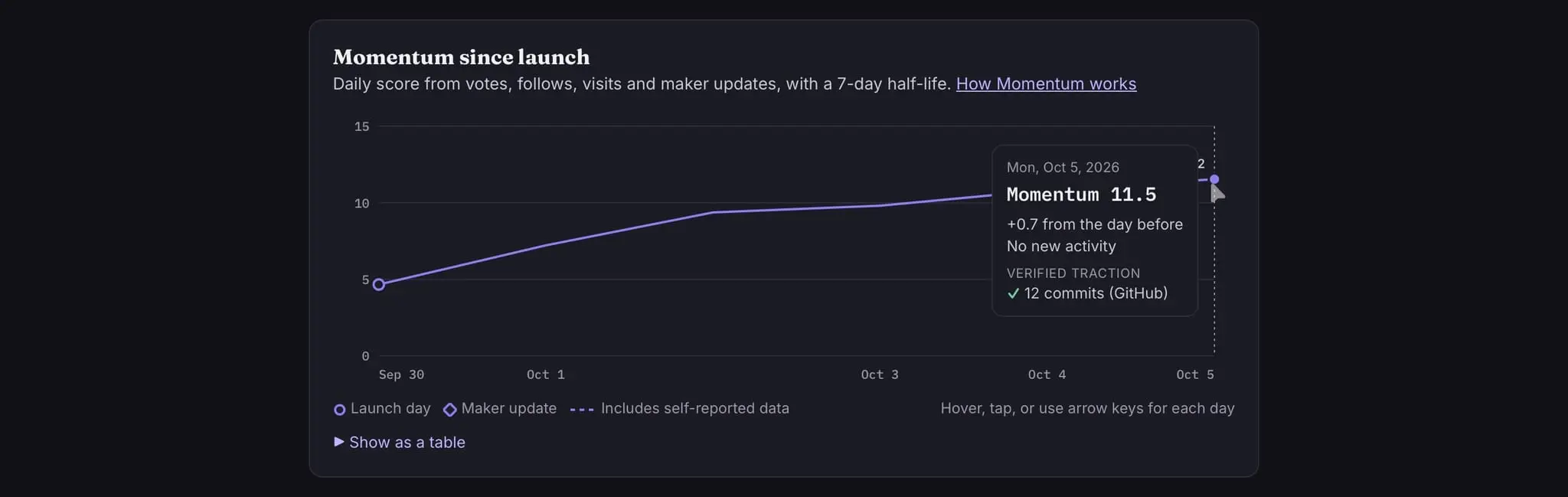
That daily activity is added to a running score with a seven-day half-life. Yesterday's Momentum fades by a fixed amount, and today's activity stacks on top. A square root is applied to the core signals so one enormous launch day can't drown out everything that comes after it.
The result is a score that rewards staying power. A product that quietly keeps adding customers and shipping updates can overtake one that peaked on day one and went silent. The Momentum and Rising tabs make that visible, and each product page shows a chart of its Momentum over time with a day-by-day breakdown of where the points came from.
Built for makers who are short on time
Submitting a product is meant to take minutes, not an afternoon:
- Fill with AI. Paste your URL and The Nest drafts your profile from your site, including a tagline, description, features and strengths. You can edit everything before submitting, and again after you're approved.
- Honest weaknesses. The AI also notes a few weaknesses it finds on your site. Makers can't edit these, but they can appeal any they believe are wrong, and a person reviews the appeal.
- Human review. Every launch is checked by a person before it reaches the board, usually within a day.
- Room to be seen. Each launch day is capped at a small number of products, so a launch isn't buried under hundreds of others.
- A real link. Approved launches get a normal, followed link to the maker's site.
Makers can also embed launch and Momentum badges on their own sites. Badges are optional, and no badge or backlink is ever required to be listed.
Paid boosts, always labeled
Launching on The Nest is free. Makers can optionally buy a boost to their Momentum for 3, 7, 14 or 30 days, and the rules around boosts are deliberately strict:
- Launch-day rank is never for sale. Boosts affect Momentum only, never the Today board.
- Boosts are always disclosed. Boosted products carry a visible "Boosted" label, boosted days are shaded on the product's chart, and the breakdown shows boost points separately from votes and follows. A boosted product's outbound link is also marked as sponsored.
- Boosts taper. A boost starts strong and steps down each day, so Momentum rises, peaks and eases back down instead of propping a product up indefinitely.
- Every boost has a cooldown. After a boost ends, the product must rest for as long as the boost ran before it can be boosted again. Nobody can pay to stay on top.
Who it's for
The Nest is aimed at indie founders, small startup teams and solo builders, including the growing number of people shipping products with AI coding tools, who want a launch that keeps working after day one. It's also useful for anyone hunting for new tools. Because Momentum reflects ongoing activity, the board surfaces products people are still using and talking about, rather than whichever team had the biggest audience on one particular day.
The bottom line
Launch day matters, but it's one day. The Nest treats it as a starting line rather than a finish line, and it publishes exactly how both of its rankings are calculated in its How Momentum works guide.
If you're preparing a launch, you can submit your product for any date from tomorrow up to 90 days out.