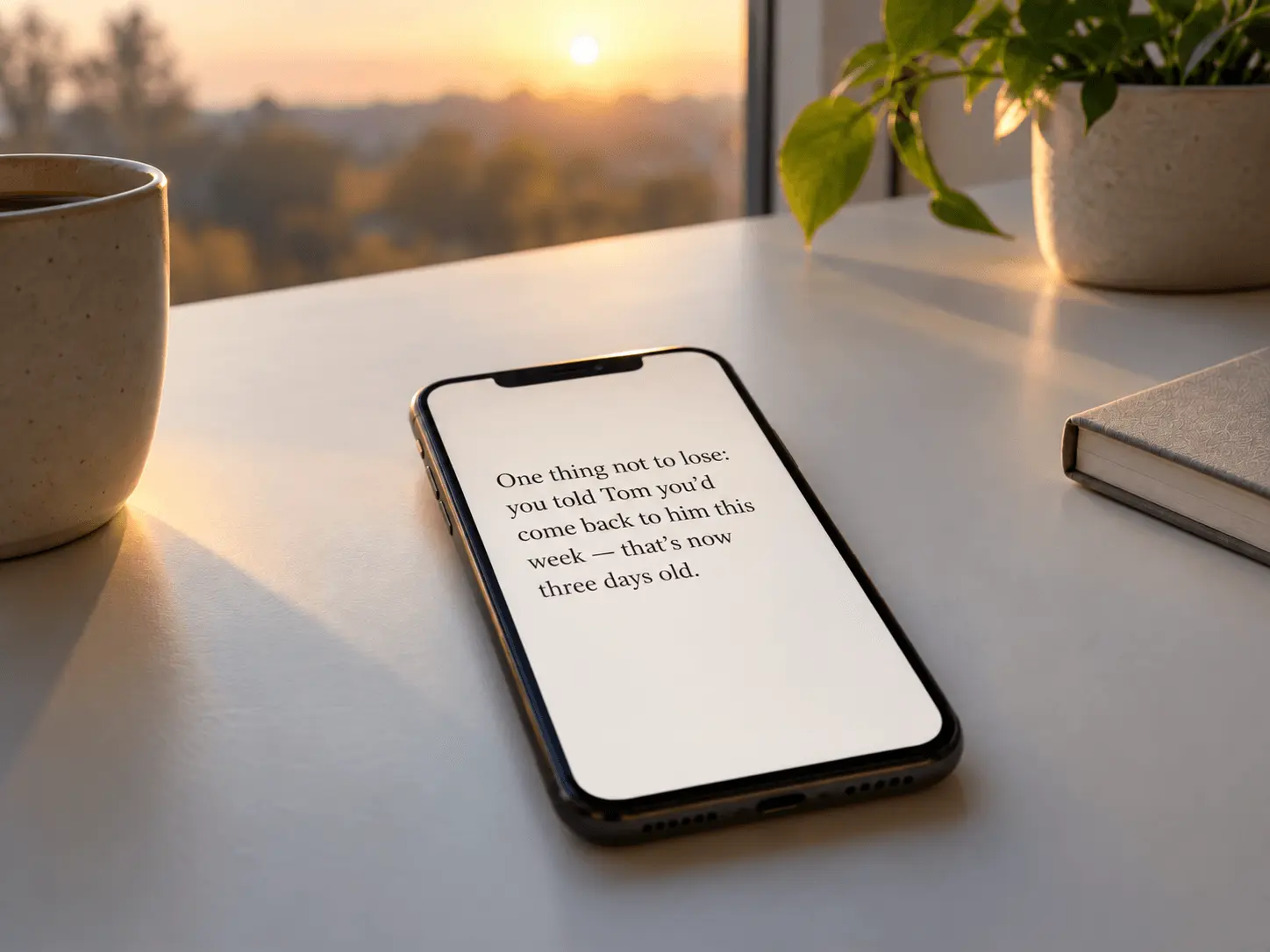
I built an assistant that listens instead of watching. Here's what changed in my mornings.

You already have an AI that knows your plans. You told ChatGPT about the launch you're preparing, the hire you're not sure about, the deadline you keep moving. Then you opened a new chat and it was gone, or buried under forty other conversations about regex and dinner.
The other kind of tool asks for everything. Connect your calendar, your inbox, your Slack, and it will "figure out what matters". I tried a few. They knew everything about my week and nothing about what I cared about. A dentist appointment and a meeting that could change my year were the same rectangle. They could tell me who had emailed, never which email I was dreading.
So I built Athena around one decision. It works from what you tell it, in your own words, and it never guesses your priorities from your behaviour.
Why that works
When you say "I need to close the Nick deal by the 14th and I still haven't reviewed Aryan's draft", you've already done the hard part. You filtered a thousand things that happened into two that matter, and you attached a deadline and a person to each. No amount of inbox scanning produces that sentence. The assistant's job should be to remember it, connect it to what you said last week, and come back at the right moment with a view. That's the whole product: one short briefing every morning on what matters today, and one question in the evening about how it actually went.
I think of this as listening instead of watching. The watching kind collects more and understands less, because it only ever sees what you did. The listening kind only knows what you decided was worth saying, which turns out to be exactly the material you want a judgment made on. Connecting a source is still your call. Today you can send a thought straight from a ChatGPT or Claude conversation; it arrives as a proposal you approve or discard, never as something silently filed.
How it works
Capture is wherever you are: type it, say it, send a voice note from your phone, ask Siri, or reply to the evening email. A small model extracts memories, commitments and dates from whatever you said. A larger one writes the briefing and answers questions against everything you've told it. There is nothing to organise, no tags, no weekly review you will skip by week three.
The stack, for the curious: React PWA, Express, Postgres on Supabase with soft-delete everywhere, Anthropic models for reasoning and for extraction, ElevenLabs for voice. Audio is never stored. Everything exports, and one tap deletes the lot.
What 149 strangers taught me
The first unknown users arrived this month through Show HN and a directory listing. I read the data rather than my hopes, and it was blunt: most people never had a second active day. There was no slow fade over a week. You either touched the daily loop in the first 24 hours or you were gone. The ones who stayed were the ones who told Athena something real on day one and got a briefing that reflected it back.
That read changed the product. Capture alone wasn't a reason to return, so the next thing we built was the goal conversation. You tell Athena something you're considering, it talks it through with you, outlines a plan in words, and only when you agree does it become a goal with milestones and dates. From then on the mornings know about it. The first step shows up in the next briefing on the date you agreed to, and when you clear it, Athena says so. That part I resisted for a long time, until I noticed that nobody comes back to a tool that never acknowledges a win.
Where it is now
Athena is free while it's small. It runs on your phone or your laptop, works in 23 languages, and asks for nothing at signup except an email. It's built by one person who uses it every morning before work, so the bugs you hit are bugs I hit first.
Try it for a week. Tell it what's on your plate tonight. See what it says tomorrow morning.