
CatchHook
Debug and inspect webhooks in real time
Details
- Follow on
- Categories
- Use Cases
- Target Audience
- Pricing
- Subscription from $8
- Platforms
Discovery signals
How AI and people discover CatchHook on PeerPush
By AI reads among Analytics & Monitoring tools
1,797 AI reads in the last 30 days, ranked against every Analytics & Monitoring tool listed.About CatchHook
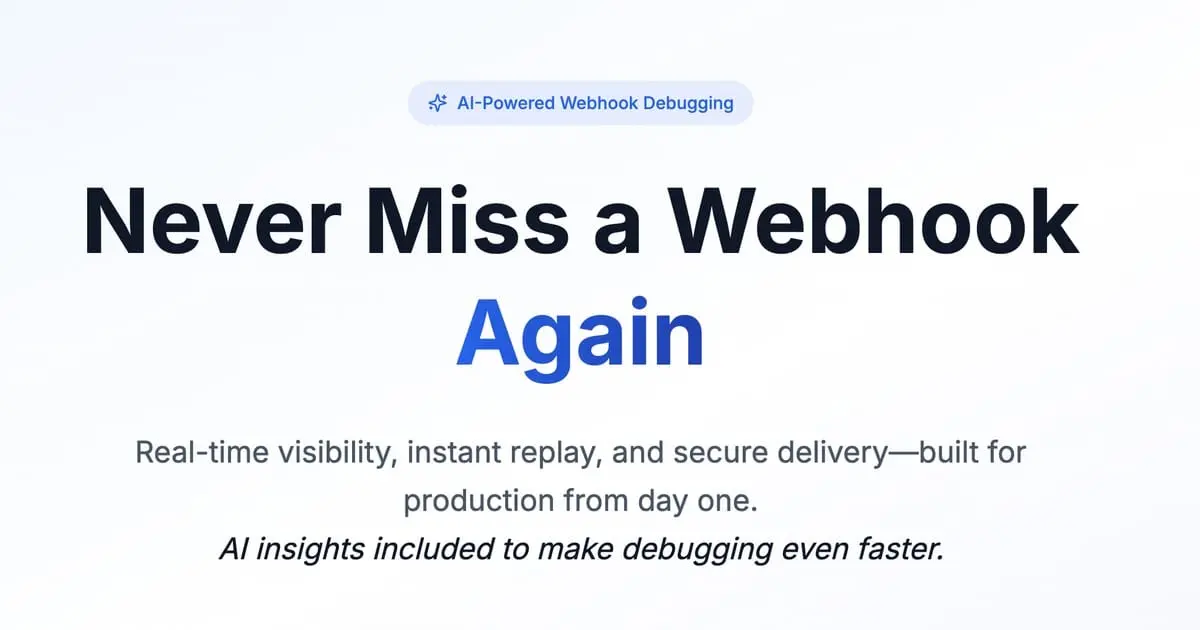
Catchhook is a webhook testing, debugging, and development platform built for developers and engineering teams working with event-driven integrations. It gives you a dedicated endpoint where you can capture webhook requests in real time, inspect headers and payloads, understand failures, replay events, forward traffic to local or remote environments, and reproduce tricky integration behavior without digging through scattered logs or rebuilding test requests by hand. Instead of stitching together a temporary request bin, a tunnel, provider dashboards, application logs, curl commands, and custom scripts, Catchhook brings the full webhook workflow into one place. Catchhook is useful throughout the integration lifecycle: • During development, you can receive webhooks before your application endpoint is ready, inspect the exact payload a provider sends, and forward requests to localhost while you build. • During testing, you can replay captured events, modify requests, verify signatures, compare behavior across environments, and test how your application responds to different payloads or delivery conditions. • During debugging, you can see the complete request timeline, including headers, body, response details, retries, and related activity, making intermittent or environment-specific failures much easier to diagnose. • During collaboration, teams can share captured events, preserve debugging context, organize requests, and avoid passing sensitive webhook payloads around in screenshots or chat messages. Catchhook also includes provider-aware tooling for services such as Stripe and GitHub. These integrations understand provider-specific webhook behavior, signatures, event types, and testing workflows, giving developers more useful context than a generic request inspector alone. Additional features include reusable replay tools, request forwarding, endpoint actions, team workspaces, retention controls, secure payload handling, and MCP access that lets supported AI coding tools inspect webhook activity and help troubleshoot integrations using real request data. Catchhook is designed for SaaS developers, API teams, agencies, platform engineers, and technical founders who build or maintain products that depend on webhooks. It is especially valuable when webhook failures are difficult to reproduce, requests pass through multiple systems, or developers need a reliable shared record of what was sent, received, and returned. The goal is simple: make webhook development less opaque. Catchhook turns asynchronous requests from invisible background plumbing into something developers can inspect, understand, replay, and fix.
Screenshots
Reviews (3)
Average 5.0 out of 5
Based on 3 reviews


You described my actual workflow in the intro. Request bin, tunnel, provider dashboard, logs, curl, all open at once. It works, but it is five tools doing one job.

Comments (0)
No comments yet. Be the first to share your thoughts!