Code Swan
AI Codebase intelligence for Software Development

Details
- Follow on
- Categories
- Developer Tools
- Use Cases
- Code DevelopmentAI Integration
- Target Audience
- Software Developers
Discovery signals
How AI and people discover Code Swan on PeerPush
About Code Swan
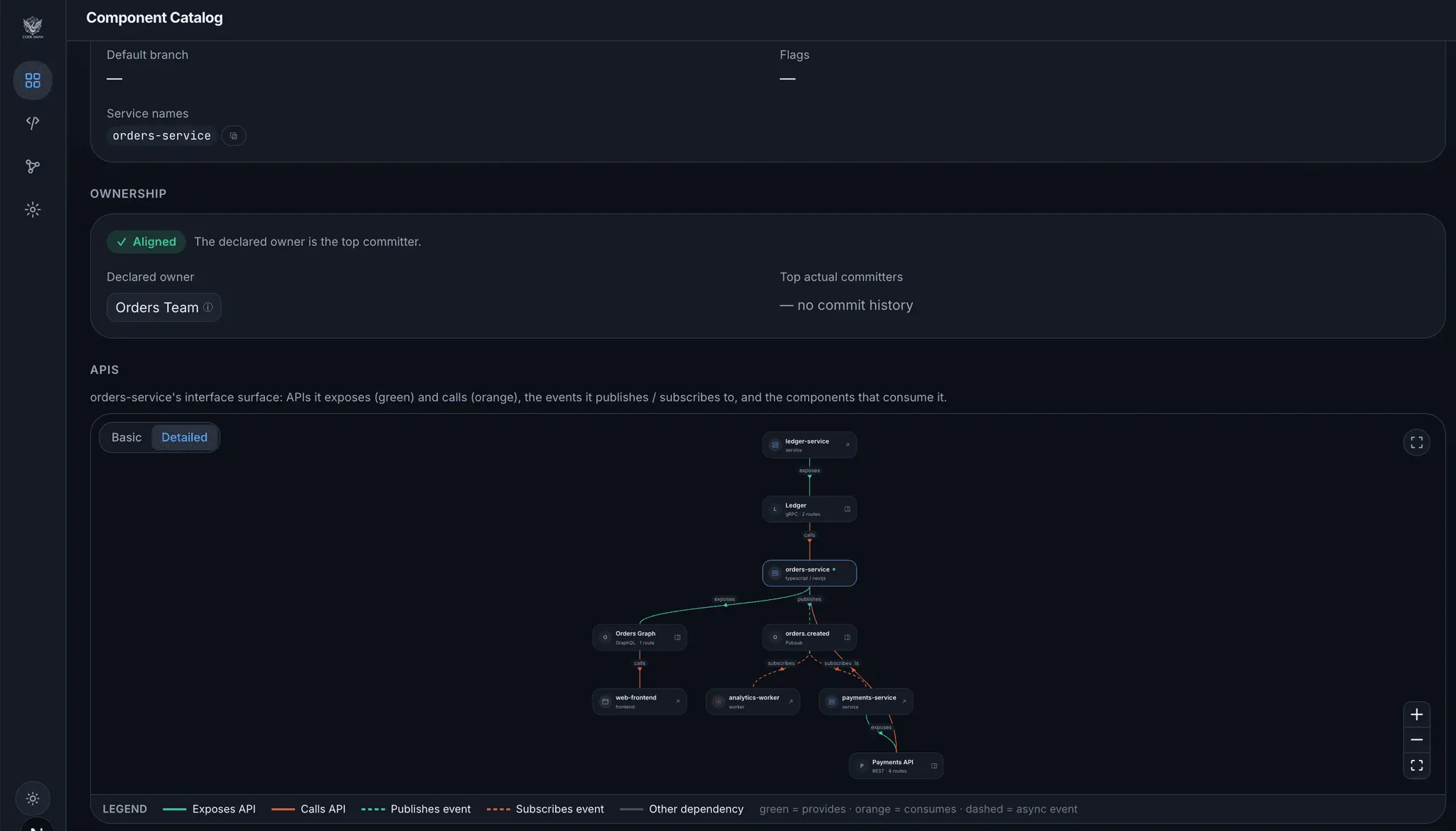
Code Swan provides deep codebase intelligence to your AI coding tools through the Model Context Protocol (MCP). By mapping every API, cloud resource, architecture boundary, and ownership assignment, it ensures engineering teams have AI that understands the actual system. It bridges the gap between raw code and infrastructure reality. Most AI coding tools work one file at a time. They can read what's in front of them, but they don't know how your services connect, what a change will break, or which team owns the code they're editing. The gap isn't intelligence — it's context. Code Swan closes it by statically analyzing your source across GitHub, GitLab, and Bitbucket to build an always-current, queryable model of your whole system, then serving that model to Cursor, Claude, GitHub Copilot, and any MCP-compatible tool. What it maps - API Surface Intelligence — Every REST, gRPC, GraphQL, and async API your services expose and consume, including who calls what and where a breaking change will cascade. - Cloud Resource Topology — Every database, queue, bucket, and event bus your code touches, across any provider — mapped from source, with no cloud credentials required. - Architecture Auto-Detection — Bounded contexts, service ownership, and domain boundaries extracted from real code, with C4 diagrams regenerated on every scan. - Living Software Catalog — A single, self-maintaining record of every service, API, owner, and business capability. No entries to write. None that go stale. - Business Semantic Search — Ask questions by intent ("which service owns checkout?", "where is customer PII handled?") and get answers drawn from your actual system. - Blast Radius Analysis — Every dependency and consumer surfaced so your AI can reason about impact before a line ships. What makes it different Code Swan reads only your source code — no runti cloud access, no changes to your repos. Because it's derived from code, it's always current: you're grounded in your real system, not the wiki that hasn't been updated since Q2. Scanned once and cached centrally, so your wlayer instead of each tool burning tokens rediscovering the same system. What you can expect - Deploy with confidence — see blast radius before merge and turn "I hope nothing breaks" into predictable releases. - Onboard in hours, not weeks — new engineers anll system on day one, no tribal knowledgerequired. - Lower AI token costs — shared, cached context the codebase. - Trustworthy AI output — suggestions grounded in how your system actually works, not plausible guesses. Impacting all company personas: Here is a concise summary of the core impact for each persona: Development — High-Precision AI & Risk-Free Execution:** Gives engineers and AI agents full multi-repo context so code compiles on the first try, while making blast radius, code search, and onboarding instant and predictable. QA — Targeted, Topology-Driven Quality:** Replaces outdated manual scripts with production-accurate E2E tests generated from your real system map, ensuring coverage zeroes in on actual risk and hidden API contracts. Product — Fast Feasibility & Safe Prototyping:** Allows PMs to pressure-test ideas, detect duplicates, and "vibe-code" integrations against real-system context before wasting engineering hours or token budgets. Customer Success — Autonomous Technical Clarity:** Enables client-facing teams to self-serve system knowledge via plain-language search, instantly mapping customer issues to the right services and engineering teams without interrupting developers. Security — Credential-Free Attack Surface Control:** Maps PII, cloud infrastructure, and API contracts directly from source code with zero cloud credentials, automatically catching boundary violations at the PR stage. Management — Frictionless Scaling & Living Governance:** Eliminates organizational debt with a zero-maintenance system catalog, automated PR routing, and the guardrails needed to scale AI adoption safely across the company. Set up in under five minutes: add the hosted MCP server's URL and token to your AI tool's settings. No code changes, no agents to run.
Screenshots
Product Updates (7)
Every AI tool on your team is paying to learn the same codebase, over and over 🦢
Here's a cost nobody puts on a dashboard: every time someone opens Cursor, Claude, or Copilot and asks about your system, the tool starts from zero. It crawls files, greps around, follows imports, and burns tokens reconstructing how your services fit together — just to answer one question. The next engineer opens a different tool, and it does the whole thing again. Even teams who've done everything right pay this tax. Say your docs and context files are genuinely up to date — great. Your AI still reads all of them into a fresh session, from scratch, every time. Perfect docs don't save the token bill; you just pay to re-load the right answer instead of reconstructing it. Code Swan scans your system once. It statically analyzes your code across GitHub, GitLab & Bitbucket, builds an always-current map — services, APIs, events, resources, owners, dependencies — and caches it centrally, indexed so a tool can query the exact slice it needs. Then it serves that map to every AI tool through one MCP server. What that changes: - Scan once, share everywhere — built a single time, reused by Cursor, Claude, Copilot, and any MCP tool - Query, don't dump — indexed data means the AI pulls the one edge or owner it needs, not a wall of docs into context - Lower token spend — answers handed over, not re-crawled or re-loaded every session - Faster + more accurate — no crawl step, and a shared static map beats each tool's partial guess - Always current — refreshed on scan, so "shared" never means "stale" Reads source only — no runtime access, no repo changes. Setup under 5 min: drop the MCP URL + token into your tool's settings. How many AI tools are crawling your codebase right now — and do you know what that's costing you?
Comments (0)
No comments yet. Be the first to share your thoughts!
New in Code Swan: run it fully self-hosted, inside your own perimeter 🦢
We hear the same thing from teams of every size: "This is exactly what we need — but our source code cannot go to a third party. Not for scanning, not for metadata, not ever." For plenty of companies, where the code lives isn't a preference. It's a hard line, written into a contract, a policy, or a regulation. So we built the answer: Code Swan now runs fully self-hosted, inside your own perimeter. Same living catalog. Same architecture graph, API intelligence, cloud topology, semantic search, and MCP server your team already wants. Deployed on your clusters, in your cloud account, under your controls — not ours. How it stays inside your network: - Your clusters, your control — runs entirely in your own infrastructure, with no outbound connection to us and nothing leaving your perimeter - Bring your own model — scanning runs on your LLM keys and your existing provider contract, so only the provider you already trust ever sees your code - Source never leaves — repos are scanned in place, only metadata is built, and no repository data is sent to Code Swan - Your identity, your audit boundary — authenticates through your own SSO / SAML, keeping everything in your region and under your controls - The full product, nothing held back — self-hosted is a deployment choice, not a stripped-down tier Why it matters: teams whose code legally can't move now get the same AI-ready map of their whole system — API edges, async event flows, resource topology, ownership, C4 diagrams — grounded in their real system, without a single line of source crossing the boundary. Three steps, all in your environment: deploy to your cluster → connect your repos read-only → point it at your LLM keys. We work with your platform team to stand it up.
Comments (0)
No comments yet. Be the first to share your thoughts!
Your architecture diagram was wrong the moment someone hit merge 🦢
Every team has one: the Confluence page with the boxes and arrows, drawn in a workshop 8 months ago. It was accurate for about a week. Then a service got split, an API got deprecated, a new queue showed up, someone left the company — and nobody redrew it. Now it's a museum piece everyone quietly ignores, and the "real" architecture only lives in five people's heads. Your AI inherits that problem. Point it at a stale diagram or a README from last year and it confidently plans against a system that no longer exists. Code Swan kills the drift. It reads your source across GitHub, GitLab & Bitbucket and rebuilds the map on every scan — services, APIs, events, resources, owners, and C4 diagrams — so the picture is generated from the code that actually shipped, not the code someone remembered in a meeting. No diagram to maintain. No doc to update. It's just always right. What you get: - Living architecture — C4 diagrams regenerated from source on every scan, never hand-drawn, never stale - Real ownership — who owns each service and bounded context, straight from the code, not a spreadsheet - Complete dependency map — sync API edges and async pub/sub edges, tagged with the topic they travel on - Full resource topology — every database, bucket, queue & secret each service touches, across any cloud - True blast radius — what a change breaks, surfaced before merge, not discovered at 2am Why it's different: reads source only — no runtime access, no repo changes. Scanned once, cached centrally, and served to Cursor, Claude, Copilot, and any MCP tool — so every assistant plans against the same current truth instead of a guess. Setup takes under 5 minutes: drop the hosted MCP server's URL + token into your AI tool's settings. When did you last trust your own architecture diagram?
Comments (1)


@ukokuja it depends on the configuration, from once every few days to immediately ..
Your codebase isn't organized the way your product actually works.
You don't ask "what's in the payments repo?" You ask "how does checkout work?" And checkout isn't a repo. It's a feature that lives across six services, three databases, and a couple of async events nobody remembers wiring up. Real context isn't a folder. It's a domain, and the dataflow running through it. That's the part that breaks you: a message published here, consumed three services away, feeding a flow you didn't know you were part of. Your AI can't see it. Most catalogs can't either. They stop at the service boundary. Code Swan maps the whole flow. Not just "service A calls service B," but the feature it belongs to, the domain it serves, and every hop the data takes, including the async messages between them. So when your AI reasons about a change, it sees the feature, not just the file. That's the difference between an assistant that guesses and one that actually understands your system. What's a feature at your company that secretly spans way more services than anyone admits?
Comments (0)
No comments yet. Be the first to share your thoughts!
Here's the thing about context: you don't just need it when you're writing code.
You need it when you're planning ("does this already exist?"), when you're reviewing a PR ("what does this actually touch?"), when you're testing ("what's the blast radius?"), when you're deploying ("what breaks downstream?"), and on day one onboarding ("who owns this and how does it connect?"). Same question at every step: how does my system really fit together? And your AI is guessing at all of them. That's the old way. The new, smarter way to run software development is one source of truth that every AI tool can tap into, at every stage. That's why we built Code Swan as one MCP server, not five plugins. Connect it once, and the same always-current map of your whole system (services, APIs, dependencies, owners) flows into Cursor, Claude, and Copilot across the entire SDLC. Plan, code, review, test, ship. Same source of truth, wherever you're working. One integration. Under 5 minutes. No docs to maintain, nothing that goes stale. Just a modern, smarter way to build software. Which SDLC step does your AI help least with today?
Comments (1)
Your AI can see the API call. It can't see the event that breaks three services downstream 🦢
Synchronous calls are the easy part. When service A calls service B's REST endpoint, it's right there in the code. But the dependencies that cause 2am incidents are the async ones — a service publishes an event to a queue, and somewhere else, something you've never heard of is subscribed to it. Your AI coding assistant can't see that edge. Neither can most catalogs. That invisible coupling is exactly where "this one-line change is totally safe" turns into a cascading outage. Code Swan maps it — statically, from source. We don't just resolve who-calls-whose-API. We trace publisher → subscriber over the actual queue or topic, and put the topic name right on the edge — so your AI knows a change to a publisher will land on every subscriber, before it ships. No runtime tracing, no cloud credentials. Just your code. What it maps: - Sync API edges — every REST, gRPC & GraphQL call, matched to the provider that serves it - Async event flows — every pub/sub edge, tagged with the topic/queue it travels on - Resource topology — every database, bucket, queue & secret each service touches, across any provider - Architecture & ownership — bounded contexts and owning teams, with C4 diagrams on every scan - Full blast radius — sync and async dependents surfaced together, so impact analysis is complete, not half of it Why it's different: it reads only your source across GitHub, GitLab & Bitbucket — no runtime access, no repo changes. Always current, scanned once and cached centrally, then served to Cursor, Claude, Copilot, and any MCP tool — so they stop burning tokens rediscovering the same system. Setup takes under 5 minutes: drop the hosted MCP server's URL + token into your AI tool's settings. 👉 https://peerpush.com/p/code-swan What's the worst async dependency that's ever bitten you?
Comments (0)
No comments yet. Be the first to share your thoughts!
🦢 Your AI coding tools are brilliant on one file but theyare blind to the rest of your system 🦢
Code Swan statically analyzes your code across GitHub, GitLab & Bitbucket to build an always-current map of every API, cloud resource, owner, and dependency and then serves it to Cursor, Claude, Copilot, and any MCP tool. The result: AI that knows how your services actually connect and what a change will break before it ships. Why it matters: - Trustworthy AI output: grounded in your real system, not plausible guesses - See blast radius before merge: turn "I hope nothing breaks" into predictable releases - Onboard engineers in hours, not weeks: no tribal knowledge required - Lower token costs: context is scanned once and shared, not rediscovered by every tool ✅ Reads source only — no runtime access, no repo changes ✅ Always current, cached centrally ✅ Setup in under 5 min — just add the MCP URL + token Would love your feedback! 🙌
Comments (1)

Reviews (3)
Average 5.0 out of 5
Based on 3 reviews
This is the new era of Software Engineering. Everybody are part of it and it make things much easier and smarter!
Love it!

Smart solution for giving AI coding assistants real architectural context. As more engineering work moves through Cursor and Claude Code, those tools are flying blind on what services exist, who owns them, and what depends on what. CodeSwan builds that catalog automatically from the code itself and serves it over MCP.
Great idea and execution! Well done
Comments (4)
congrats
Automatic component discovery is the right bet here. Manual catalogs always drift; scanning the code directly is the only version that stays true. The MCP piece is what makes it more than a dashboard.
@shirhen23 exactly. This is one of the biggest challenges when maintaining software catalog - keeping it up to date.
This is really awesome! I would love to use this in my company!
@ukokuja - sure, lets talk!
This is really exciting! We are sure this is a game changer for the industry!