
EBMSovereign Energy Guard OS
Site offlineProtect AI from prompt injection and data exfiltration

Details
- Follow on
- Categories
- Target Audience
About EBMSovereign Energy Guard OS
You can secure your AI implementations with the Energy Guard OS, a specialized security layer designed to prevent malicious prompt injection and unauthorized data exfiltration. This platform offers real-time monitoring and protection, ensuring your large language models remain safe and compliant without compromising performance. With its impressive response time of under 200ms, you can maintain seamless user experiences while significantly hardening your AI infrastructure against emerging cyber threats.
Screenshots
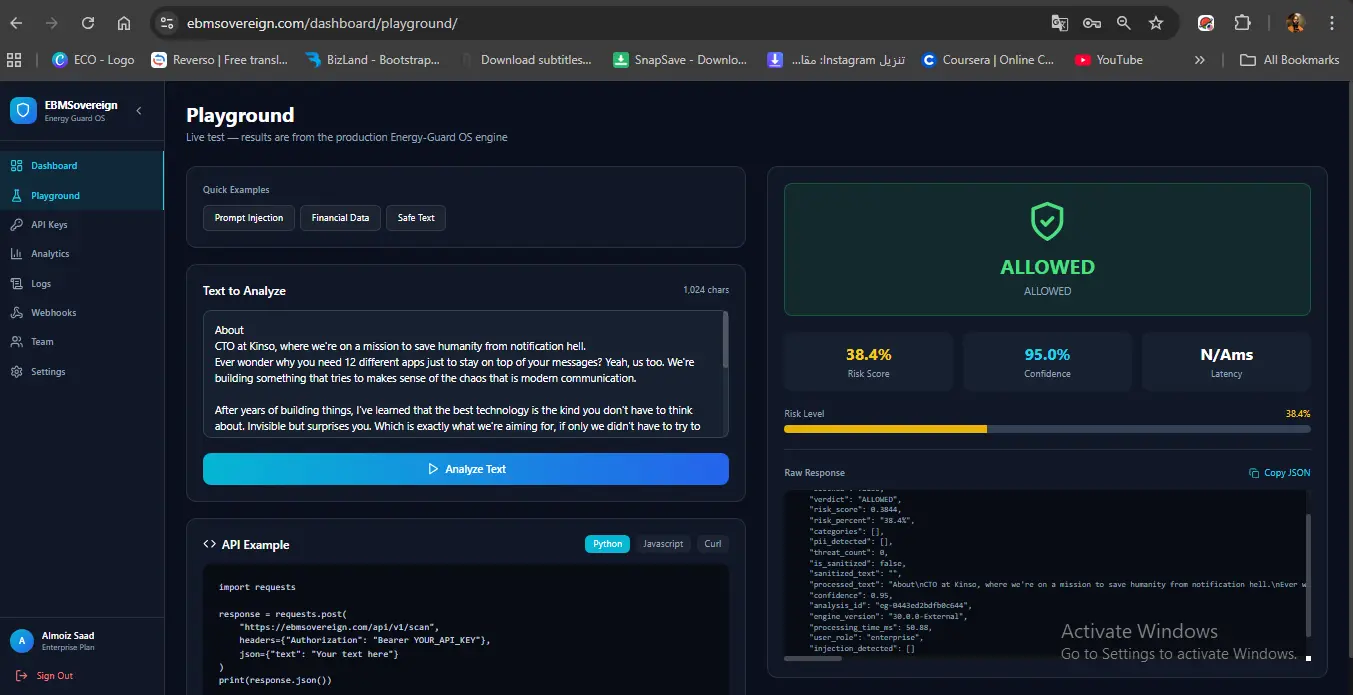
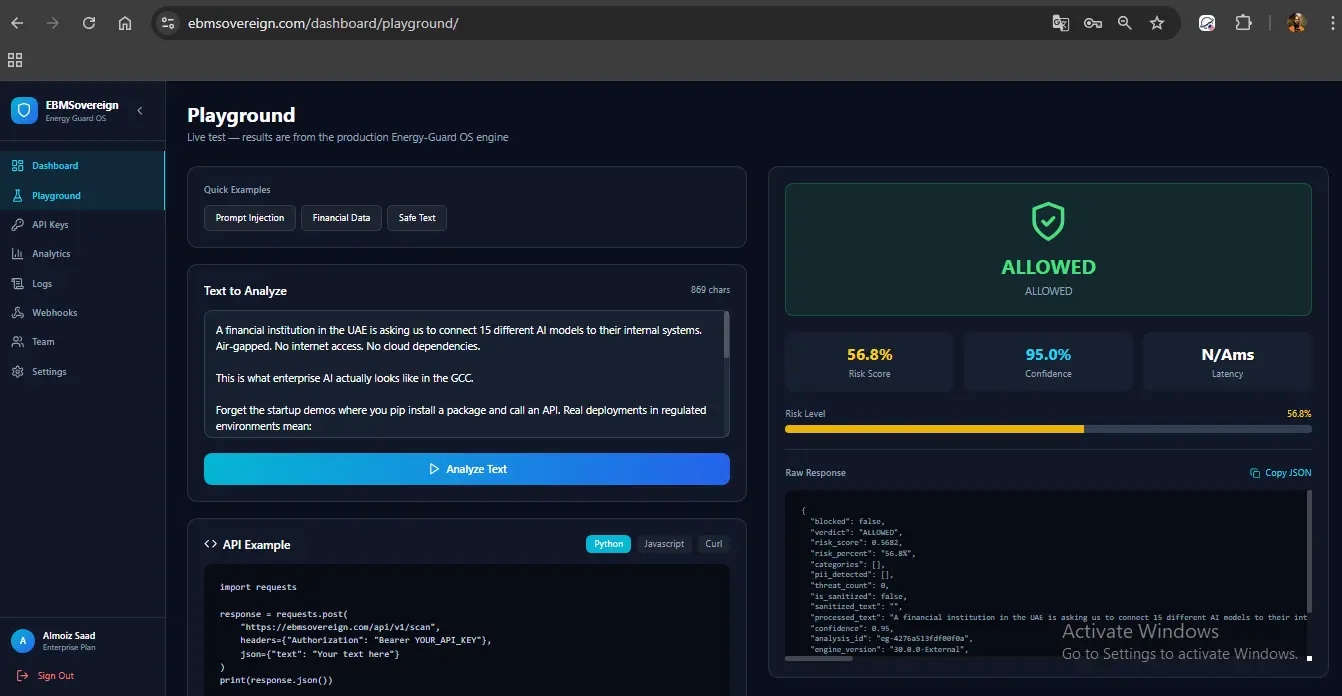
Product Updates (1)
Live Public Endpoint
Energy-Guard OS, a sovereign AI security gateway designed to solve a specific problem: most LLM guardrails (like LlamaGuard or Azure Prompt Shield) are either too slow, require expensive GPUs, or force you to send data to the cloud. In the wake of the recent shifts in the AI security market, we realized that enterprise-grade security needs to be as lightweight as a network firewall but as "intelligent" as an LLM. What makes this different? Performance: It’s CPU-native. We’ve achieved kernel latency between 4.1ms and 13ms. Efficiency: The entire engine runs in 411 MB of RAM. No GPU required. Throughput: Processes ~9,500 words per second. Security Depth: It doesn't just look at text; it features an 8-layer evasion decoding engine (Base64, Unicode, etc.) and is the only gateway we know of that detects OT/SCADA threats within LLM prompts. The Benchmark Release: Today, I’m open-sourcing our Sovereign Master Test Suite (v10.2) which contains over 10,000 test cases (OWASP Top 10 for LLMs, MITRE ATLAS) and our independent benchmark scripts. I want the community to stress-test our claims. Links: Hugging Face (Model & Data): https://huggingface.co/almoiz/Energy-Guard-OS-Security-Bench... GitHub (Test Suite & Scripts): https://github.com/almoizsaad/Energy-Guard-OS-Security-Bench... Live Public Endpoint: http://ebmsovereign.com/v1/process
Comments (1)


@CliqSpy Thank you! We've worked hard to ensure the performance remains lean—keeping that kernel latency between 4.1ms and 13ms was a major priority. Appreciate the support!
Reviews (0)
No reviews yet. Be the first to rate this product!
Comments (2)
cool !!
@imed Glad you think so! If you're interested in the technical side, feel free to dive into the Sovereign Master Test Suite we just open-sourced on GitHub. Feedback is always welcome.
Protecting AI from prompt injection and data exfiltration is a critical infrastructure need as LLMs get deployed in production. EBMSovereign tackles a real and underserved AI security gap.
@chaudharyarun5797 Exactly. The industry has plenty of cloud-heavy guardrails, but we saw a massive underserved need for CPU-native security that doesn't compromise on throughput. Integrating an 8-layer evasion engine was our way of ensurin