
Heimdall MCP
Trace every MCP tool call. No code changes needed.

Details
- Follow on
- @enmanuelmagLinkedIn
- Categories
- Open Source
- Use Cases
- AI AgentsAI Code Assistant
- Target Audience
- AI DevelopersDevelopers
- Pricing
- Free
Discovery signals
How AI and people discover Heimdall MCP on PeerPush
- ChatGPT
- Perplexity
- Claude
- +2 other AI crawlers
Reads by these AI engines
Crawlers behind these engines read this listing on PeerPush.About Heimdall MCP
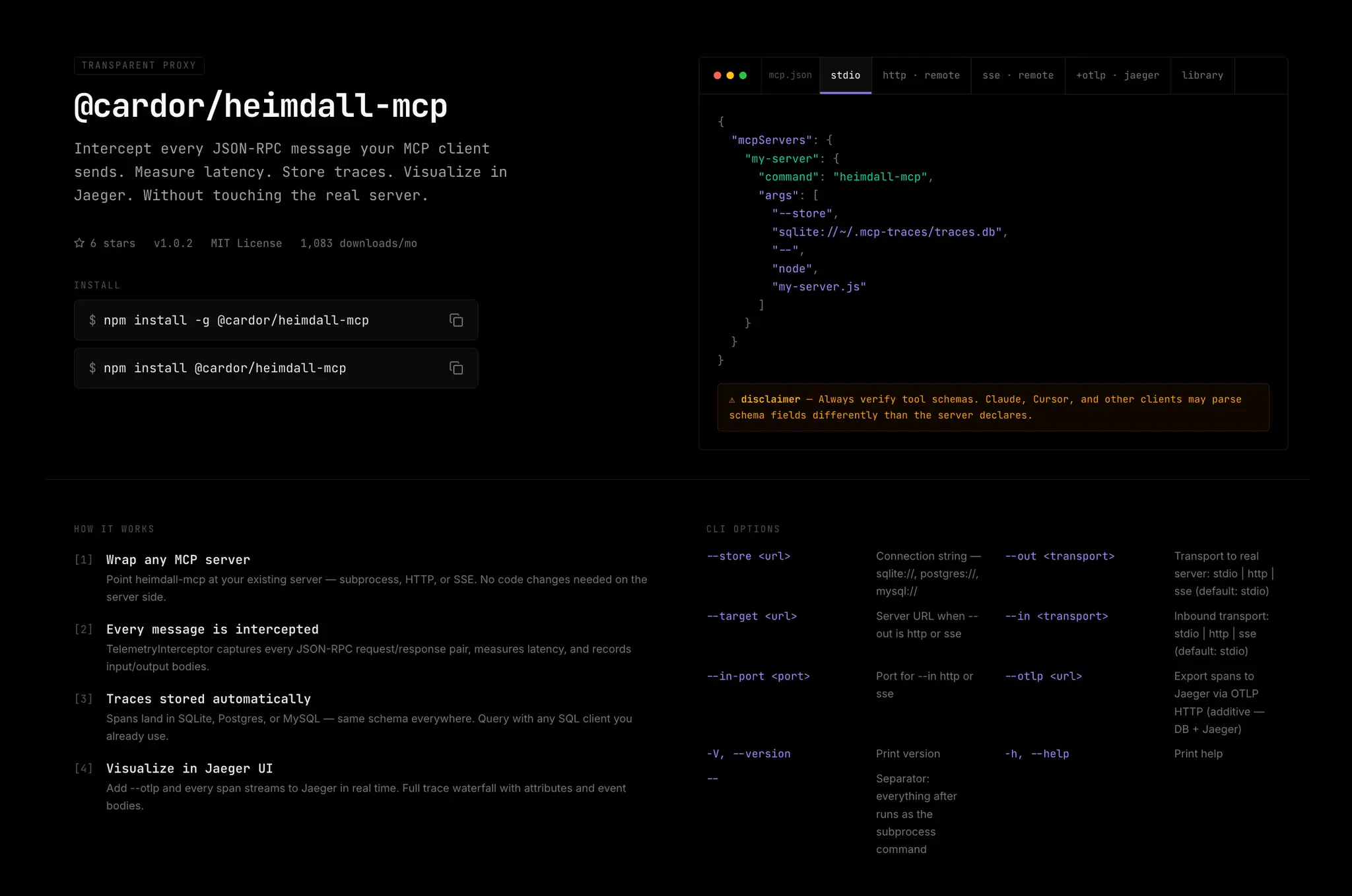
I built Heimdall MCP after getting frustrated not knowing what was actually happening inside MCP servers — which tools were slow, which failed silently, what inputs Claude was sending. The idea: a transparent proxy that sits between your MCP client (Claude Desktop, OpenCode, Cursor) and any MCP server, captures every JSON-RPC message as an OpenTelemetry span, and persists it to a storage backend you configure. No modifications to the target server required. You just wrap it in mcp.json: "command": "heimdall", "args": ["--store", "sqlite://~/.heimdall/traces.db", "--", "node", "my-server.js"] For remote servers (HTTP/SSE): "command": "heimdall", "args": ["--store", "postgres://...", "--target", "http://remote-server/sse"] Storage options: SQLite (local WASM, no native deps), Postgres, MySQL, or any OTLP-compatible backend. Also ships as a TypeScript library with a fluent builder API if you want to embed it directly. Why I think this is useful: - LLM agents are increasingly orchestrating MCP tools, but observability tooling hasn't caught up - Existing proxies (mcpwall, Airlock, MetaMCP) focus on security/policy enforcement, not persistence of traces - IBM's ContextForge does something similar but it's a heavy Python gateway — this is meant to be a lightweight npm package Schema design note: the DB schema stores spans in native OTel format — Unix nanosecond timestamps (`BIGINT` in Postgres/MySQL), integer SpanKind and SpanStatusCode, and `resource_attributes` set via official `@opentelemetry/semantic-conventions`. This means you can point any OTel-compatible UI (Jaeger, Grafana Tempo, SigNoz) at the data without transformation. The `--otlp` flag also exports spans to a live OTLP HTTP endpoint in real time, additive to DB storage. Still early (v0.1), but the core proxy + all three stores + OTLP export are working. Looking for feedback on the interceptor API design and whether the OTel semantic conventions mapping makes sense. GitHub: https://github.com/enmanuelmag/heimdall-mcp
Screenshots
Reviews (1)
Average 5.0 out of 5
Based on 1 review

Great open source tool to trace every MCP tool call without any code changes!
Comments (1)
Tiny proxy that sits between your MCP client and server, captures every tool call as an OTel span, persists to SQLite/Postgres/MySQL or Open Telemtry backends. Zero code changes to target server.