Metaport
Website maintenance agencies can actually schedule

Details
- Follow on
- Target Audience
- Platforms
Discovery signals
How AI and people discover Metaport on PeerPush
- ChatGPT
- Perplexity
- Claude
- +3 other AI crawlers
Reads by these AI engines
Crawlers behind these engines read this listing on PeerPush.About Metaport
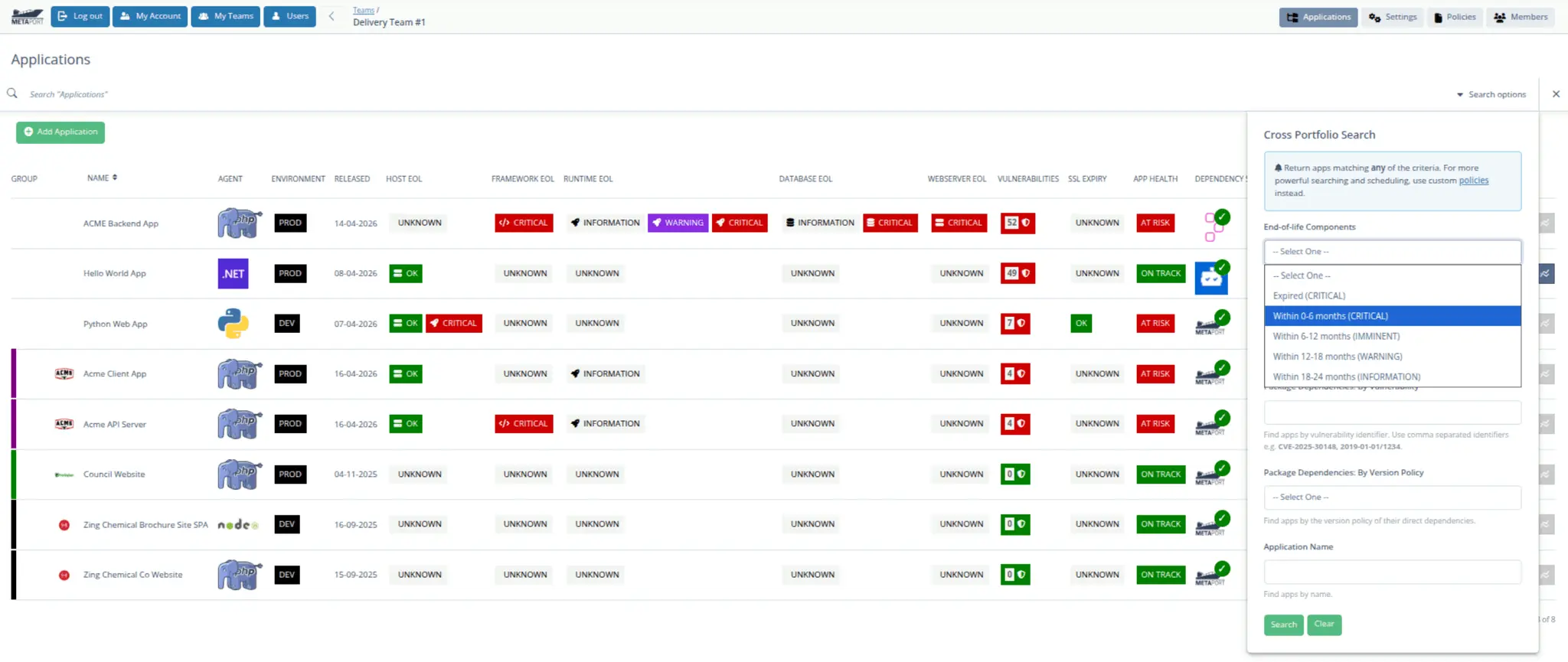
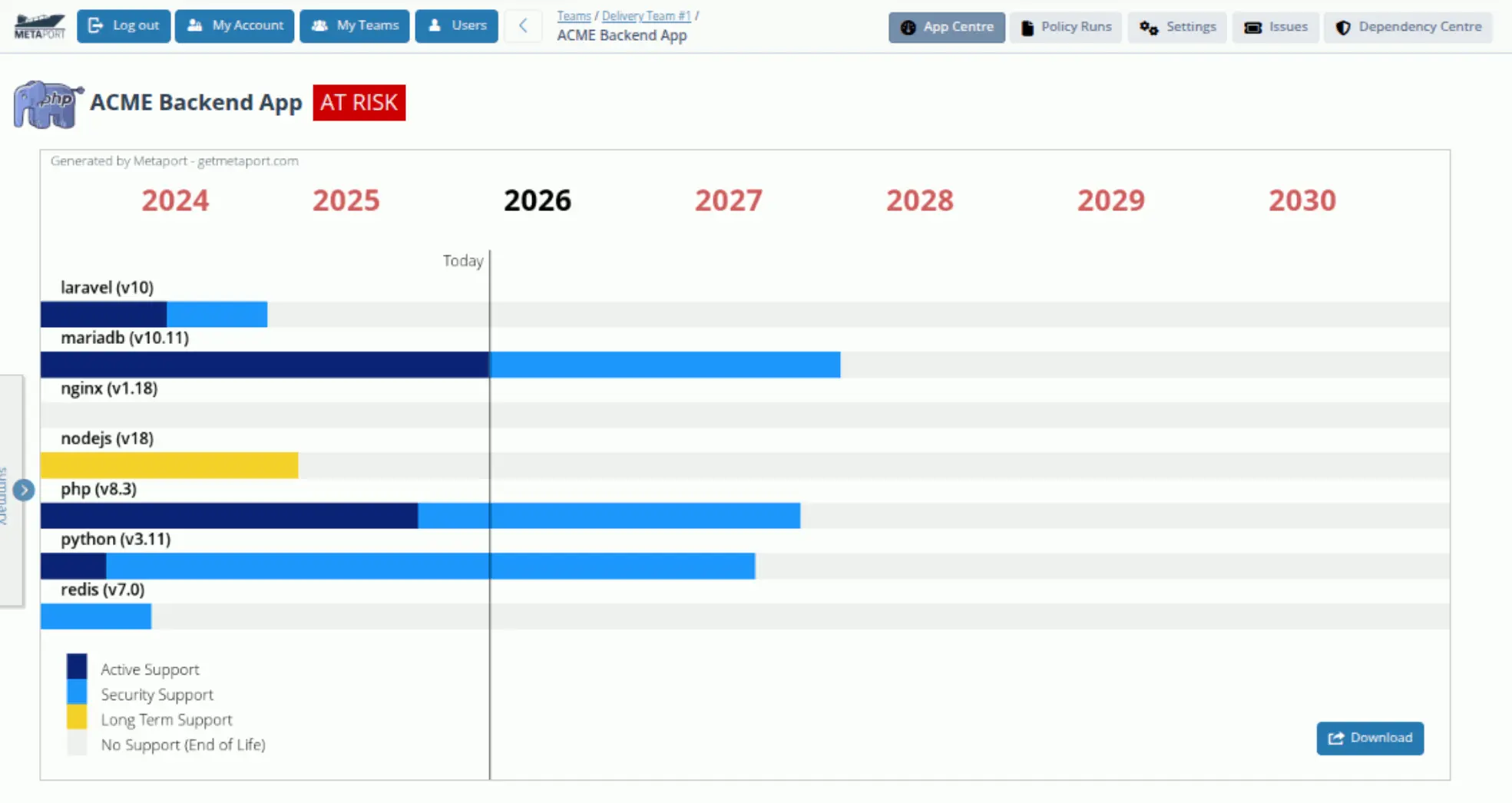
Metaport gives agency teams a macro view of their managed application portfolio - for proactive planning and effective ongoing support. Turn siloed security and end-of-life (EOL) data into clear maintenance insights across portfolios. When agencies can see what's outdated, insecure, or at risk, they plan with greater confidence.
Screenshots
Product Updates (23)
Is AI-assisted development insecure because of a lack of data?
Trust is engendered between devs each time they reach for their AI tools; Whether you use Claude, Codex, or Pi, you trust much of what is produces. Sure, you plan first and review after - but how much do you know about the dependencies it installs on your behalf and how much of a view do you have over the infra it's hosted on? What if you agency devs and their PMs could query their entire portfolio of app security and code? "Hey Claude, we once built a CRM addon for customer X, find the source code for me." "How many of our applications contain EOL components?" "Which of our apps is also affected by that CVE?" How useful would that be to you and your team?
Comments (0)
No comments yet. Be the first to share your thoughts!
New promo video published!
If you work in a dev-shop, or you're a customer of one, you could spend 30s of your life doing other things less valuable than watching! https://youtu.be/4dnj4jm1uI8
Comments (0)
No comments yet. Be the first to share your thoughts!
Software spends most of its life in maintenance mode...
I spoke at Stripecon EU 26 last week (Sept 17th, '26) and had some things to say on the subject of how maintenance works vs how it should work in a digital delivery team context. Watch the video here: https://www.youtube.com/watch?v=V8a_QbmlA7A&t=4530s
Comments (0)
No comments yet. Be the first to share your thoughts!
Metaport SaaS Goes Live!
Announcement here: https://metaport.kit.com/posts/metaport-saas-the-metaport-report
Comments (0)
No comments yet. Be the first to share your thoughts!
Can agency delivery teams do more?
The answer is of course always "yes"! The question to ask though is: Is maintenance best defined jut as keeping the lights on or would it better be defined as proactive stewardship? Regardless, it's a Maintenance Problem Web Development Doesn’t Talk About Enough. https://blog.metaport.sh/p/keeping-the-lights-on-or-proactive
Comments (0)
No comments yet. Be the first to share your thoughts!
Open Source vs Proprietary?
I've been working with the former exclusively, for almost 30 years. I built my career on it, but shouting about its advantages to those firmly ensconced in the latter isn't the best way to convince people of anything. Lead by example instead. https://www.linkedin.com/feed/update/urn:li:activity:7487959390495592449/
Comments (0)
No comments yet. Be the first to share your thoughts!
Pricing Models
I just dropped the 4th installment of my LinkedIn musings for this week, this time about SaaS pricing. I'd love to know what folks think. https://www.linkedin.com/posts/theruss_home-share-7485788130776780800-53yq
Comments (0)
No comments yet. Be the first to share your thoughts!
1.0.0-rc2
Late last week we launched RC2. The penultimate planned release before 1.0.0-stable which the SaaS will be built on later this year. RC2 squashes many bugs as you'd expect in any software release, but it also provides new features including smoother on-boarding and the Executive Health Report. The latter feature builds upon the Application Health Report and is arguably more important. Metaport has always been about teams, not just the individual silos of engineering, operations, and security. The Executive Health Report is therefore designed to be read by leaders and managers. It provides charts and graphs which provide an at-a-glance summary of the entire organisation's websites and apps and where they're at from a maintenance perspective. An early prototype can be seen here if you're interested: https://getmetaport.com/doc/resources/executive-health-report.png
Comments (0)
No comments yet. Be the first to share your thoughts!
1.0.0-rc1
Releasing a semi-stable version is always a little nerve-wracking, but it's out there now! Here's May's edition of the Metaport Report: https://metaport.kit.com/posts/are-you-ready-for-metaport-1-0-0-rc1-2
Comments (0)
No comments yet. Be the first to share your thoughts!
New Data Sources
Metaport was originally conceived of in agent-based scenarios: Developers install a language-specific plugin; .Net, PHP, Python, or NodeJS, and the agent reports end-of-life and security vulnerabilities to the Metaport Server. However, after talking to several agencies about their own needs, it seems many stumbled on agent use citing C&A and network security hurdles. Therefore, as of last week, Metaport supports data ingest from Github and Gitlab which allows software components to be discovered from Terraform and Helm config files. The full range of software components able to be analysed in Metaport is over 5000 and comprises; Frameworks, Databases, Webservers, Hosts (OS), and Runtimes.
Comments (0)
No comments yet. Be the first to share your thoughts!
April Newsletter - News from the website maintenance trenches
This morning (New Zealand time!) we sent out this month's newsletter which you can read here: https://createsend.com/t/y-9E4E16EFCAE117452540EF23F30FEDED which asks "Are your customers' websites any better maintained than last month? How about last year?" It features: * The scourge of AI-produced ShadowIT (and what to do about it *cough* try Metaport *cough*) * Progress on agent-less data ingest * Changing our messaging - a bit
Comments (0)
No comments yet. Be the first to share your thoughts!
What does it mean when teams manage multiple websites?
It means struggle, that's what! When does end-of-support (EOS) meet end-of-life (EOL)? What do both mean for businesses and for customers? https://blog.metaport.sh/p/software-end-of-life-vs-end-of-support
Comments (1)
How does the data get in there!?
As an agency, having a birds-eye view of your managed apps and sites is gold. The ability to search them for insecure and EOL components is the icing on the cake. But how does data "get in there"? Similar to traditional AppSec tools, Metaport was designed around agents. But we've discovered from our prospects that there's internal pushback on network security grounds for this approach. So we're upping our game and making it even easier to connect production sites and apps to Metaport by pointing it at your Github, Gitlab, and Bitbucket instances. Agents aren't going away, but if repos contain IaC, then that's all Metaport needs.
Comments (0)
No comments yet. Be the first to share your thoughts!
Why digital agencies shouldn't be building their own Alpaca Management Systems!
Having talked to digital agencies extensively, our research tells us that agencies really want to level-up their maintenance reporting and planning. Many are in the fourth and fifth stages of awareness (Solution Awareness and Product Awareness), which means one of two things: 1. Agencies are going to market for products which fill a need. 2. Agencies are rolling their own and calling it a day. In this piece, we explain why in doing 2, agencies will ultimately end up back at 1 in a year or so. In other words, managing your own is a false economy. We'd love to know what you think. https://blog.metaport.sh/p/should-agencies-build-their-own-website
Comments (2)
So true. Agencies should focus on client work, not building internal tools from scratch. Smart positioning.
Health checks are integral to website maintenance programmes
You're on a customer call armed with metrics and stats. But who needed to prep the data for you and how long did it take them? As an account or project manager, what if you just clicked a button to generate a report for you? It would: * Show health standing: "On Track", "Needs Attention", and "At Risk" * Use executive language: Frames website health in customer's terms * Present recommendations: Next steps, when issues are discovered The latest Metaport blog post describes how agencies win by bringing customers with them on the maintenance journey, using website health reports to do it. https://blog.metaport.sh/p/why-health-checks-arent-negotiable
Comments (2)
Having health data ready on demand is huge. No more scrambling before client calls.
Do you work at a digital agency?
How proactive is your maintenance? Take the agency survey and tell us how you do it: https://getmetaport.com/survey.
Comments (2)
Love the idea of surveying how agencies handle maintenance. Bet most are way more reactive than they'd admit.
New Application Health Report
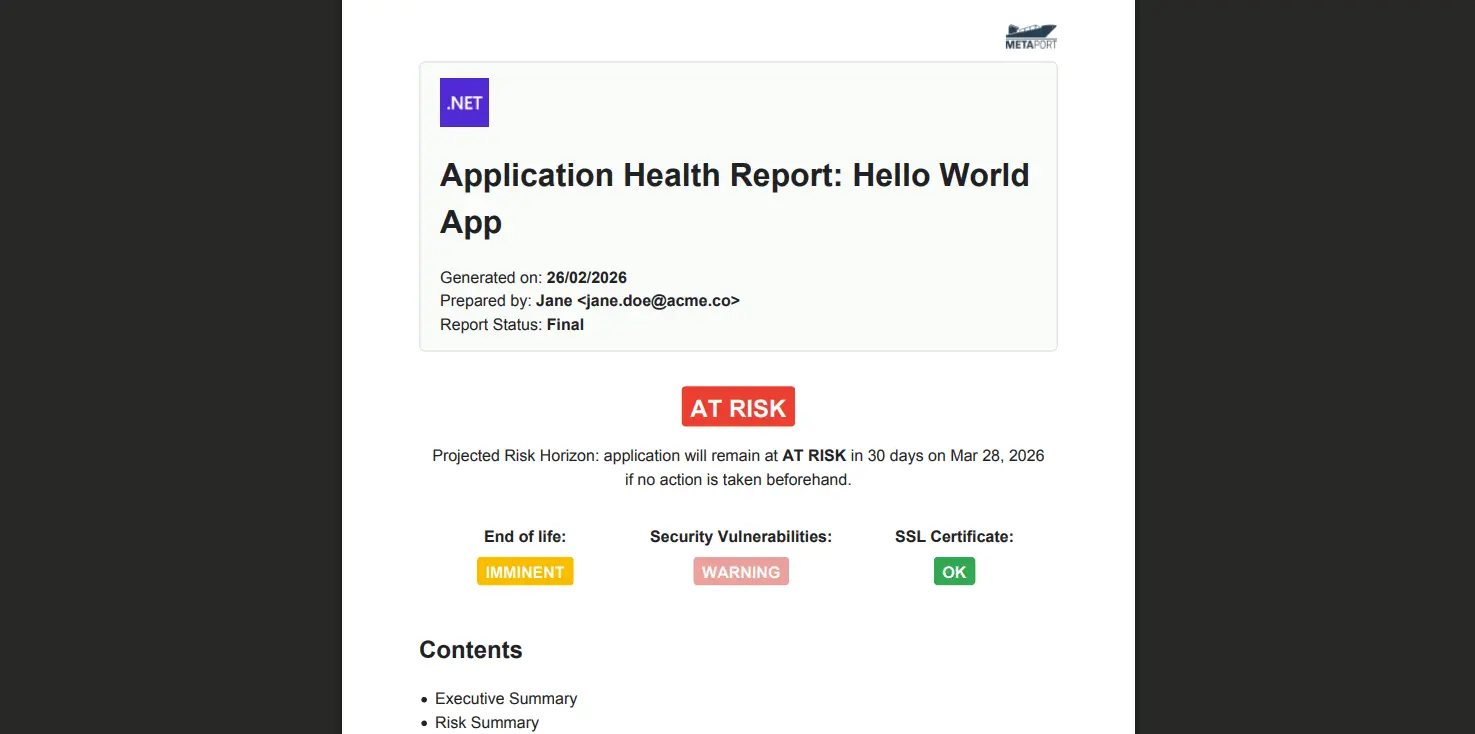
We're proud to announce Metaport's new Application Health Report feature! The report is intended for agencies to make informed maintenance decisions about their customers' managed applications. The report shows EOL component expiry dates, SSL certificate expiry dates, and security vulnerability severities. It also shows how the application will be rated in the near future - a real boon for those responsible for planning in your agency. Download an example here: http://getmetaport.com/doc/resources/metaport-health-report-example.pdf See at-a-glance: A health rating (guides urgency/prioritization) Executive summary Maintenance Summary Recommendations Summary
Comments (3)
SSL and EOL tracking in one report is really practical. That's the stuff that sneaks up on you.

Whitepaper: The Case for Metaport
In today's digital age, it’s a given that software and web development agencies of all sizes can deliver valuable solutions to their customers. However, even with the latest technology - AI driven or human - agencies still struggle with what happens after a project is completed. This leads to serious and hidden problems, unexpected costs, and a higher risk of customer churn. The maintenance phase of a software project is cited as being the longest and most expensive part of its lifecycle, with maintenance costs rising, the older the software. But when agencies are similar in terms of quality and price, what sets them apart? This paper looks at the business side of software development in an agency context. It explores how a reactive approach to maintenance hurts agency bottom lines and its relationships with customers. It presents a data-driven approach to turning maintenance into a strength rather than leaving it as a weakness. https://getmetaport.com/doc/resources/the-case-for-metaport.pdf
Comments (3)
Good whitepaper topic. A lot of agencies don't realize how much visibility they're missing until something breaks.

Blog Post: What's an application portfolio and how do you manage one?
Web-development agencies suffer problems like any other org. But how many stem from poor portfolio visibility? In this post we argue that without good portfolio visibility, agencies are hampering their own success. https://blog.metaport.sh/p/whats-an-application-portfolio-and
Comments (2)
Portfolio visibility is underrated. Most agencies are flying blind across their client base until they centralize this stuff.
Blog Post: Why do agencies find it so hard to sell support contracts?
Back in 2021, Chrome browser began defaulting to HTTPS connections. In 2022 opt-in "Always Use Secure Connection" was introduced. Now, in October 2026, that same setting becomes the default. Chrome has the power to change behaviour and there are parallels for software delivery agencies: By expending just a little more effort to engage customers in security & maintenance conversations - earlier. https://blog.metaport.sh/p/why-do-agencies-find-it-so-hard-to
Comments (2)
Selling support is tough when clients don't see the value until something goes wrong. Making the risk visible is key.
Blog Post: Traditional Security Tooling isn't designed for the agency business model
Why SCA, SAST, and SBOMs don't equal EOL planning for digital agencies: https://blog.metaport.sh/p/why-sca-sast-and-sboms-dont-equal
Comments (2)
Great point about SCA/SAST not fitting the agency model. Agencies need portfolio-level views, not per-repo reports.
.Net Support
As at January 2026, Metaport now supports .Net apps in addition to Python, PHP, and NodeJS. Take a look at the official agent docs for how to send telemetry to Metaport from an agent: Coming soon is the ability to streamline application on-boarding by removing the need for installing an agent into production apps altogether. We're also producing some great content for digital agencies. So until our next feature announcement, have a squiz at these great resources: > The Agency EOL Guide: https://getmetaport.com/doc/resources/metaport-eol-survival-guide.pdf > EOL Agency Best Practice: https://blog.metaport.sh/p/end-of-life-software-best-practices > The Metaport Report: News from the website maintenance trenches: https://confirmsubscription.com/h/y/C8098BBB7726E89E
Comments (4)

Nice to see .Net support added. Covering more stacks means more agencies can actually use this.

Dependabot Integration
Our survey data tells us dev-shops make solid use of developer tools like Renovate and Dependabot. Well, besides going through the backlog and nailing a ton of issues, we've also added Dependabot support. Metaport can now source its dependency and vulnerability data from agents, an instance of DependencyTrack and now Dependabot. Dependabot is only available to SaaS customers once the SaaS is live. Do you want to know when the SaaS will be available? Just head to the pricing section at https://getmetaport.com/ and hit the "Get Started" button.
Comments (2)
Reviews (0)
No reviews yet. Be the first to rate this product!
Comments (2)
Nice idea, its interesting how this will build up further!
intresting idea!