
Orgabot
Orchestrate AI agents and human workflows

Details
- Categories
- Use Cases
- Target Audience
- Pricing
- Freemium
Discovery signals
How AI and people discover Orgabot on PeerPush
About Orgabot
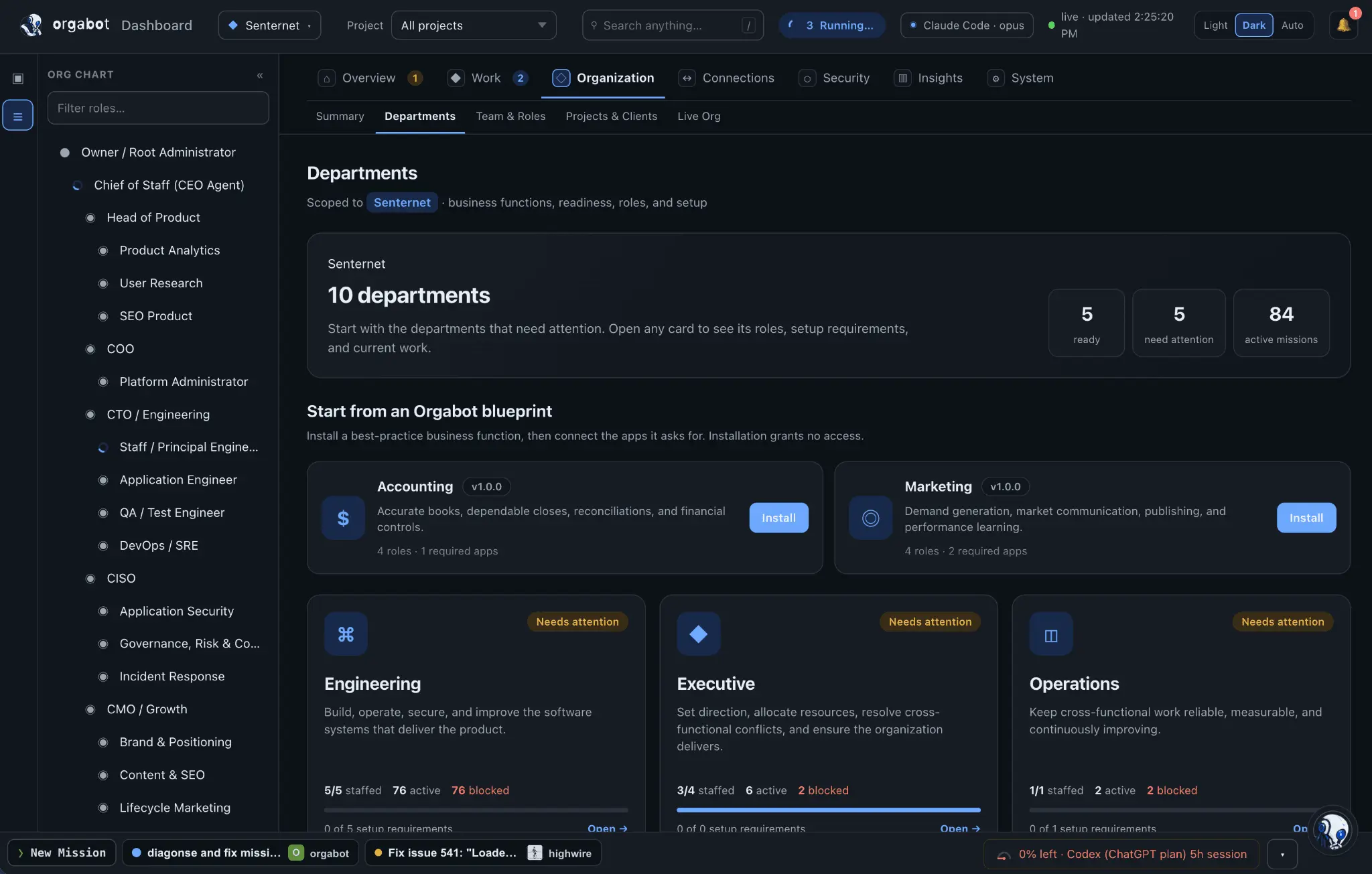
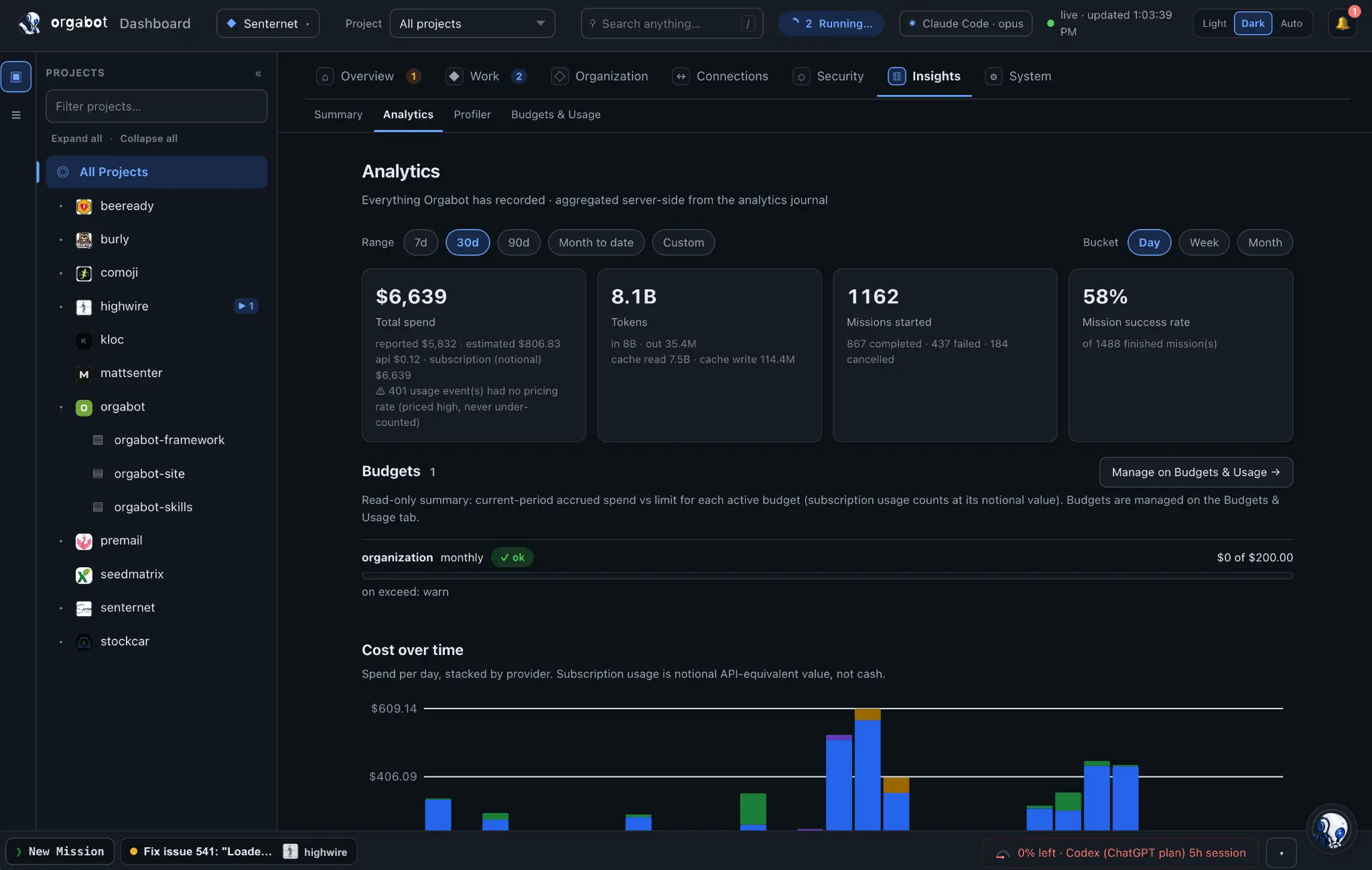
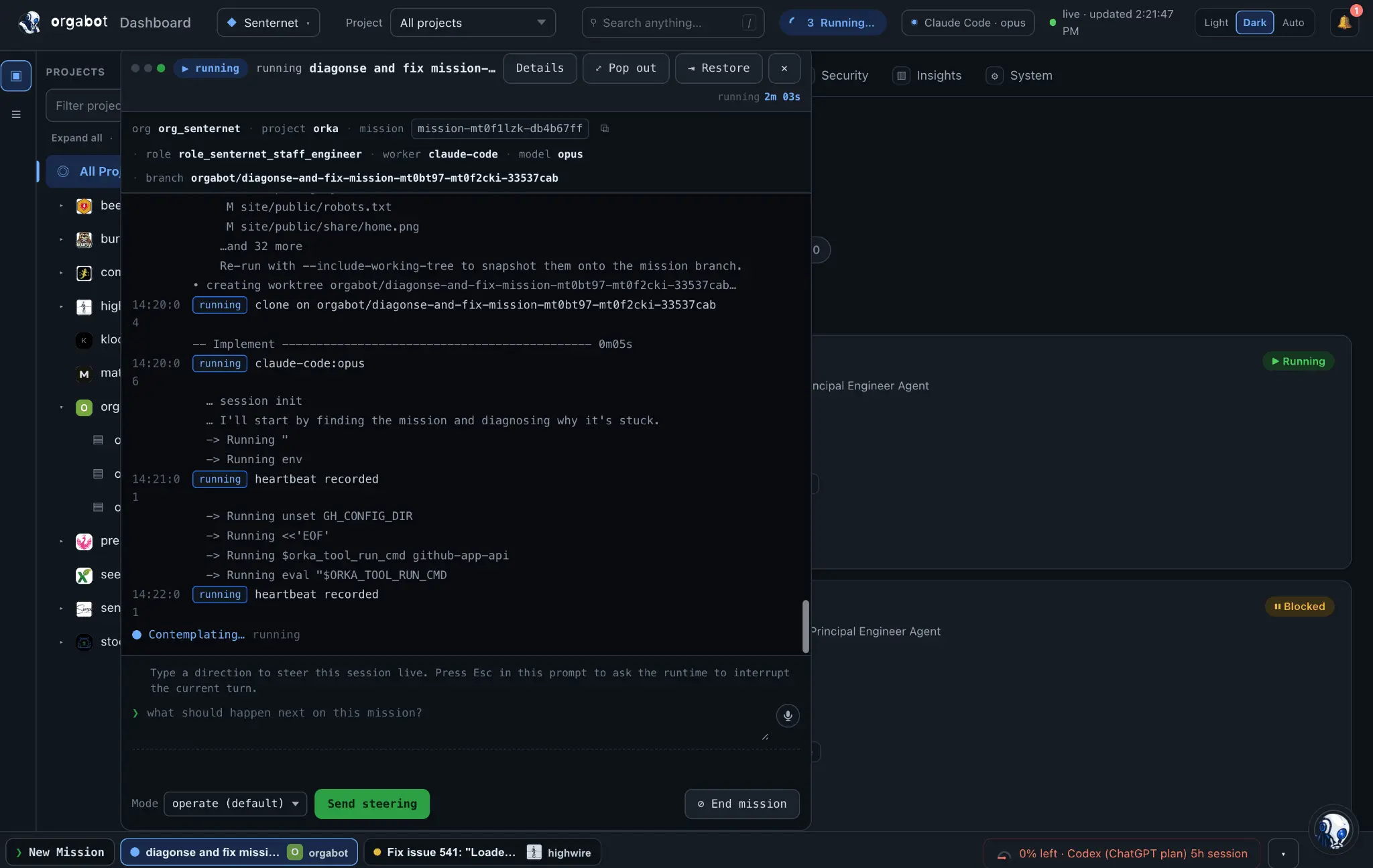
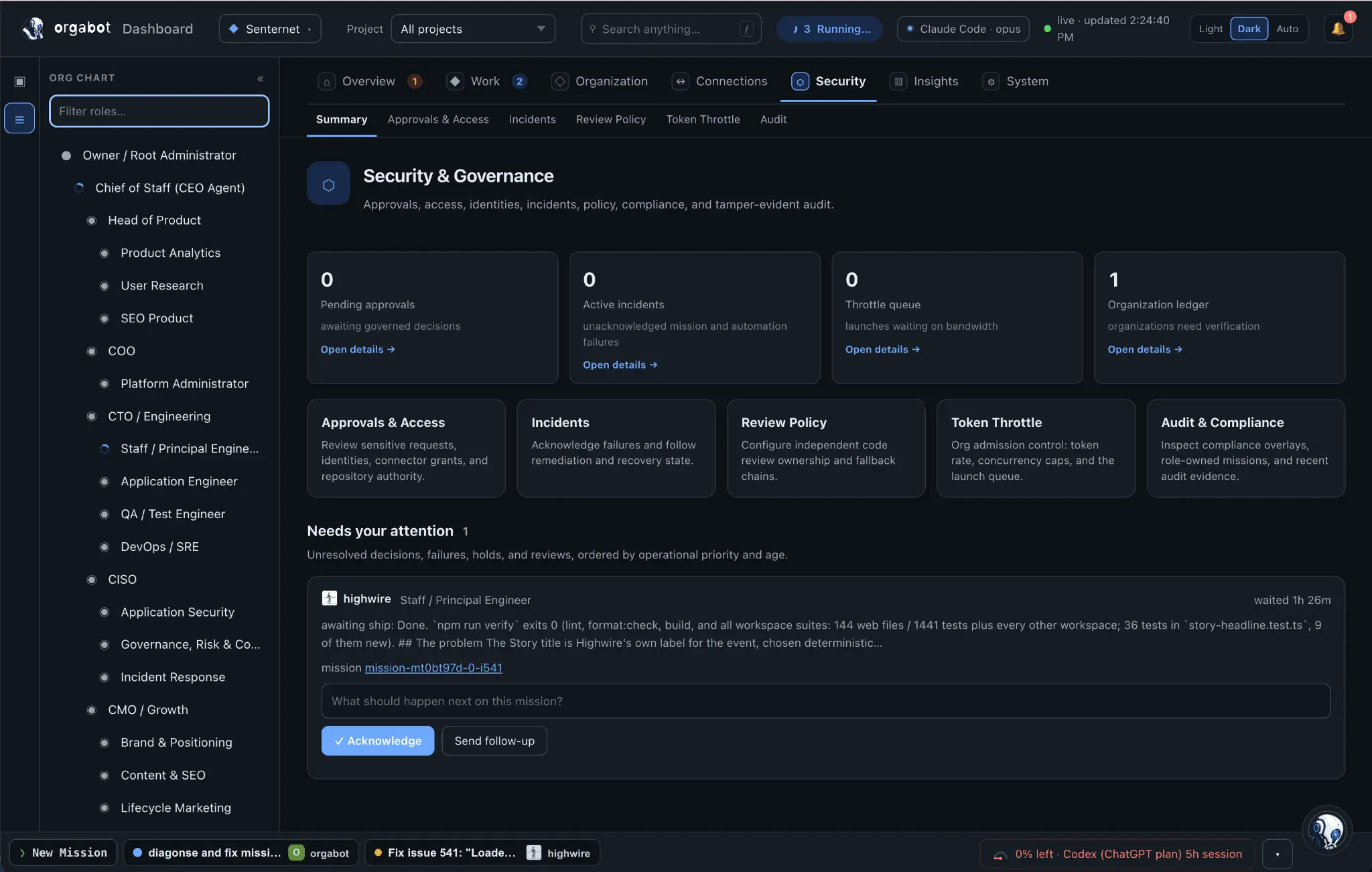
Orgabot is an AI-native organizational operating system that lets individuals and teams build, configure, and run a virtual workforce of specialized agents. Instead of treating AI as a single chatbot or coding assistant, Orgabot models AI work more like an organization. Users can define roles such as CTO, Staff Engineer, Chief of Staff, Product Manager, Security Engineer, researcher, marketer, or any custom role they need. Each role can have its own responsibilities, instructions, permissions, tools, model preferences, and executor chain. Roles can be grouped into departments, but the structure is intentionally flexible: a solo founder can operate with a handful of broad generalists, while a larger organization can create a detailed hierarchy of specialized teams. Orgabot’s core unit of work is a mission. A user describes an objective, and Orgabot coordinates the agents, tools, workflows, approvals, and execution required to accomplish it. Missions can involve software development, research, planning, content creation, operations, or other knowledge work. Rather than simply generating an answer, agents can perform real work using connected systems such as GitHub, cloud services, databases, MCP servers, local development tools, and other external services. The platform is designed to orchestrate multiple AI execution environments rather than locking users into one model provider. Different roles can use different models based on their strengths, cost, latency, context requirements, or available quota. A coding role might use a coding-optimized model, while an orchestration role uses a model better suited to decomposition, reasoning, and delegation. Executor chains provide resilience when a provider becomes unavailable or a quota is exhausted. Orgabot combines autonomous execution with deterministic controls. Agents can act independently where appropriate, while important actions can be protected by approval gates, policy checks, security controls, or other organizational rules. The goal is to capture the speed of autonomous agents without giving them unrestricted access to sensitive systems. Security and least privilege are fundamental to the architecture. Roles receive only the tools, credentials, repositories, services, and capabilities required for their responsibilities. Sensitive credentials can remain on the user’s own infrastructure rather than being exposed unnecessarily to remote models or services. Orgabot is being designed to support environments ranging from a developer laptop to enterprise and cloud deployments. Durability is another core principle. Long-running missions should survive failures, interruptions, and restarts. Orgabot tracks mission state and coordinates durable execution so work can recover rather than simply disappearing when a process crashes. Critical dependencies such as workflow infrastructure and connectors are monitored and recovered when possible. Because autonomous agents can consume substantial compute and money, Orgabot also treats resource management as an organizational concern. The system monitors CPU, memory, concurrency, service health, model usage, and cloud resource consumption. Missions can be queued, throttled, or paused when resources become constrained, helping prevent a swarm of agents from overwhelming a local machine or unexpectedly generating large cloud bills. The dashboard provides a real-time operational view of the organization. Users can launch missions, watch agents work through terminal-style interfaces, inspect logs and diagnostics, see resource utilization, identify degraded services, respond to approval requests, and understand what each part of the organization is doing. Orgabot is intentionally infrastructure-agnostic. It can run locally for privacy and control, use remote models and cloud services when useful, or combine both approaches. Databases, execution environments, connectors, models, tunnels, sandboxes, and other infrastructure components are designed around abstractions so deployments can evolve without forcing the organization itself to be redesigned. Ultimately, Orgabot is an attempt to move beyond “AI assistants” toward programmable organizations. Instead of asking one AI to do everything, users define the organization they want: its people, responsibilities, tools, policies, workflows, and operating constraints. Orgabot then provides the orchestration layer that lets that organization actually work.
Screenshots
Reviews (0)
No reviews yet. Be the first to rate this product!
Comments (1)
Meet Orgabot: an AI-native operating system for building and running a virtual organization of specialized agents. Define your org, launch missions, and put your AI workforce to work.