
Web Dubbing
AI video translation with lip sync and voice cloning

Details
- Categories
- AIVideo & Audio Tools
- Target Audience
- Content CreatorsSocial Media ManagersVideographers
- Platforms
- Web
Discovery signals
How AI and people discover Web Dubbing on PeerPush
By AI reads among AI tools
1,052 AI reads in the last 30 days, ranked against every AI tool listed.About Web Dubbing
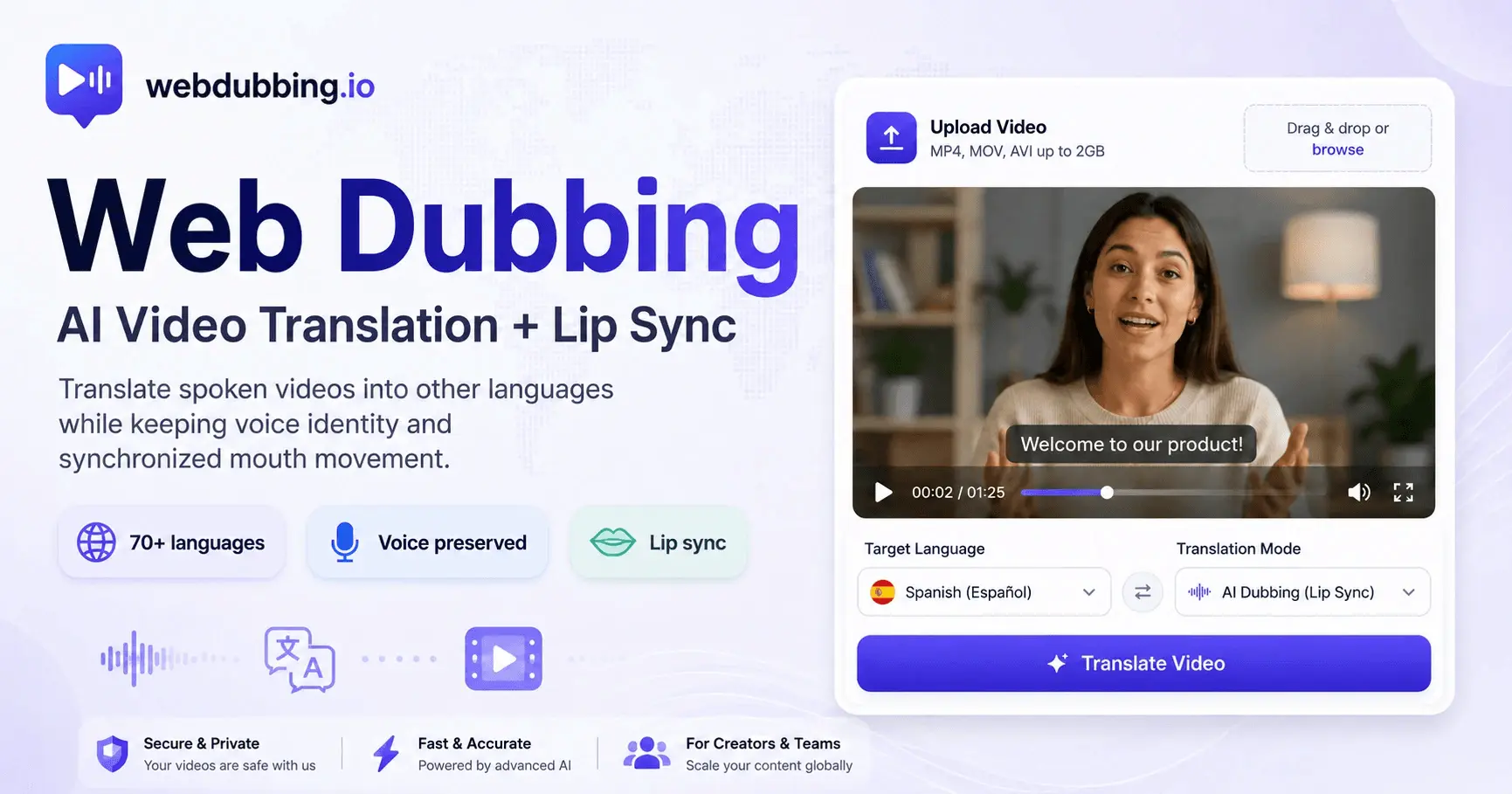
Web Dubbing is an AI-powered video localization platform that helps creators and teams translate spoken video, generate target-language dubbing, and synchronize the new speech with visible mouth movement. It is built for people who want to reach viewers in another language without rebuilding the entire production, hiring separate voice actors for every market, or manually coordinating transcription, translation, voice generation, timing, and lip sync across multiple tools. The primary workflow begins with an existing video. Web Dubbing analyzes the spoken content, creates a translated version for the selected target language, generates new speech, and produces a localized video while aiming to preserve recognizable characteristics of the original speakers. When people are visible on screen, lip-sync processing can align mouth movement with the generated dialogue so the final result feels more natural than simply placing a translated audio track over the original footage. The platform is designed for real video workflows rather than single-sentence demos. It can support videos with multiple speakers and maintain separate speaker treatment through the localization process. It also accounts for the fact that translated dialogue often becomes longer or shorter than the original. Timing-aware processing helps fit the new speech to the available scene duration, reducing awkward gaps, rushed delivery, or dialogue that continues after the visible speaker has stopped talking. Web Dubbing is useful for YouTube videos, short-form social content, product demonstrations, online courses, tutorials, marketing campaigns, ecommerce videos, internal training, explainers, interviews, and customer education. A creator can publish the same video for a new audience. An education team can localize lessons without recording each version from scratch. A brand can adapt product videos for regional campaigns, while an agency can prepare multilingual deliverables from a single source asset. In addition to full video translation and dubbing, the product includes a focused AI lip-sync workflow. Users can provide custom text, upload an audio track, or use recorded speech to drive the visible speaker in a video. This makes the platform relevant not only for translation, but also for corrected dialogue, revised messaging, localized ads, updated product information, and other cases where the visuals are still useful but the speech needs to change. The interface is designed to make a technically complex media pipeline easier to manage. Users can estimate credit usage from video duration before generation, track processing tasks, and choose between available processing modes when they need a different balance between speed and output detail. The browser-based workflow reduces the need to install editing software or move files between transcription, translation, voice, and lip-sync applications. Web Dubbing is intended for creators, marketers, educators, ecommerce teams, agencies, startups, and localization professionals who need a practical way to adapt existing video content. It is particularly useful when subtitles alone are not enough and the audience benefits from hearing the content in the target language. Because translated speech and synthetic voice can change the apparent words of a real person, users should only upload content they own or are authorized to modify. The output should be reviewed before publication, especially for names, numbers, specialist terminology, brand language, and sensitive statements. Web Dubbing reduces the repetitive production work involved in multilingual video, while the creator remains responsible for final linguistic accuracy, consent, and appropriate use.
Screenshots
Reviews (0)
No reviews yet. Be the first to rate this product!
Comments (2)
Lip-sync is what makes this stand out. Translating the audio is one thing, but keeping the speaker’s expressions and mouth movement in sync makes localized videos feel much more natural. A useful step forward for multilingual content.
We built Web Dubbing to simplify video localization across translation, voice, timing, and lip sync. We are improving difficult cases, so feedback on accuracy and naturalness is welcome.