
Aurora
Verification Layer for Machine-Produced Quantitative Claims
https://glama.ai/mcp/servers/FantasyLab-ai/auroraDetails
- Follow on
- @fantasylabaiLinkedIn
- Categories
- AIDeveloper ToolsData Science
- Use Cases
- Data AnalysisAI AgentsAI Integration
- Target Audience
- DevelopersData ScientistsDevOps Engineers
- Pricing
- Free
Discovery signals
How AI and people discover Aurora on PeerPush
By AI reads among AI tools
1,524 AI reads in the last 30 days, ranked against every AI tool listed.About Aurora
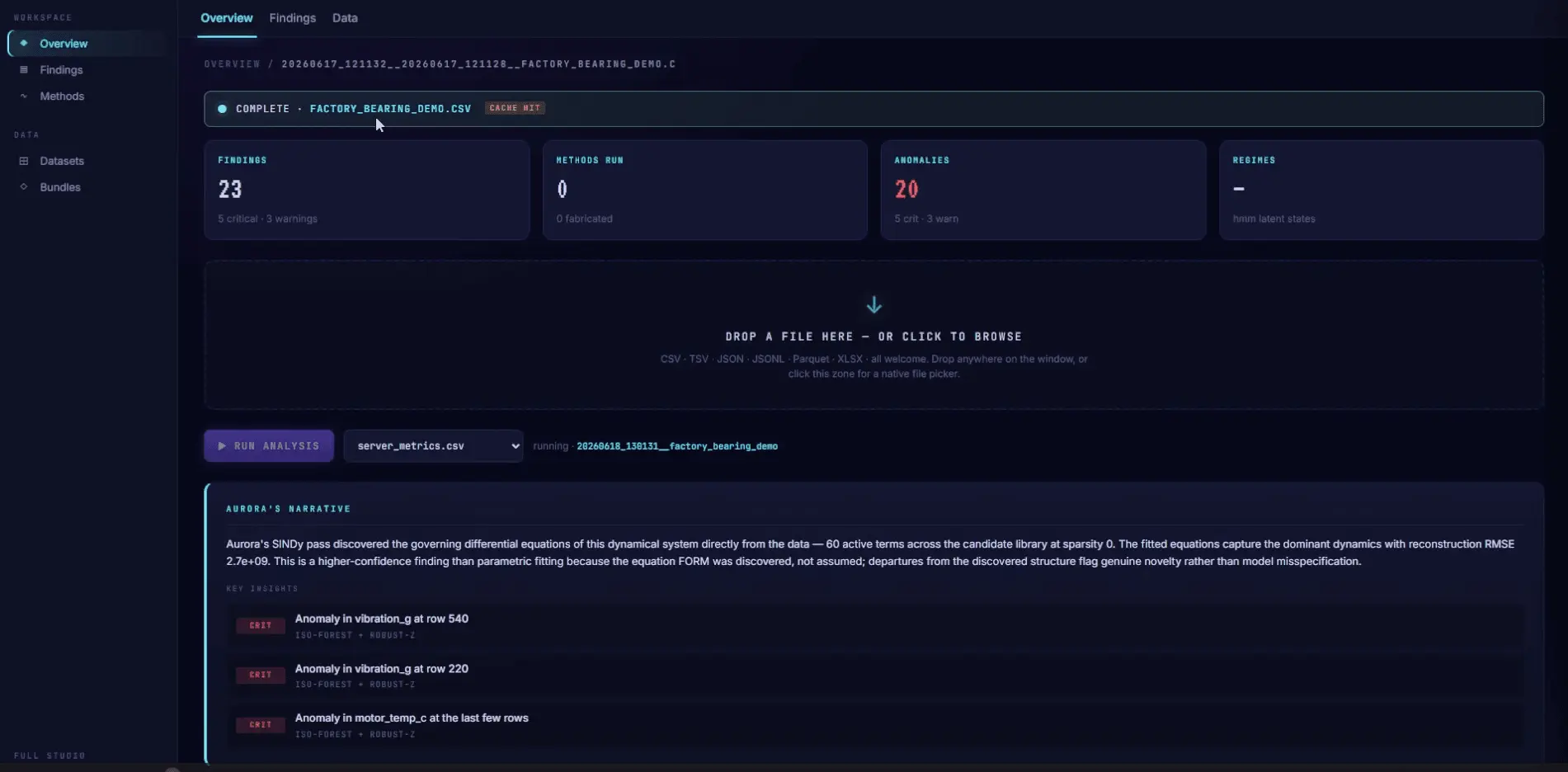
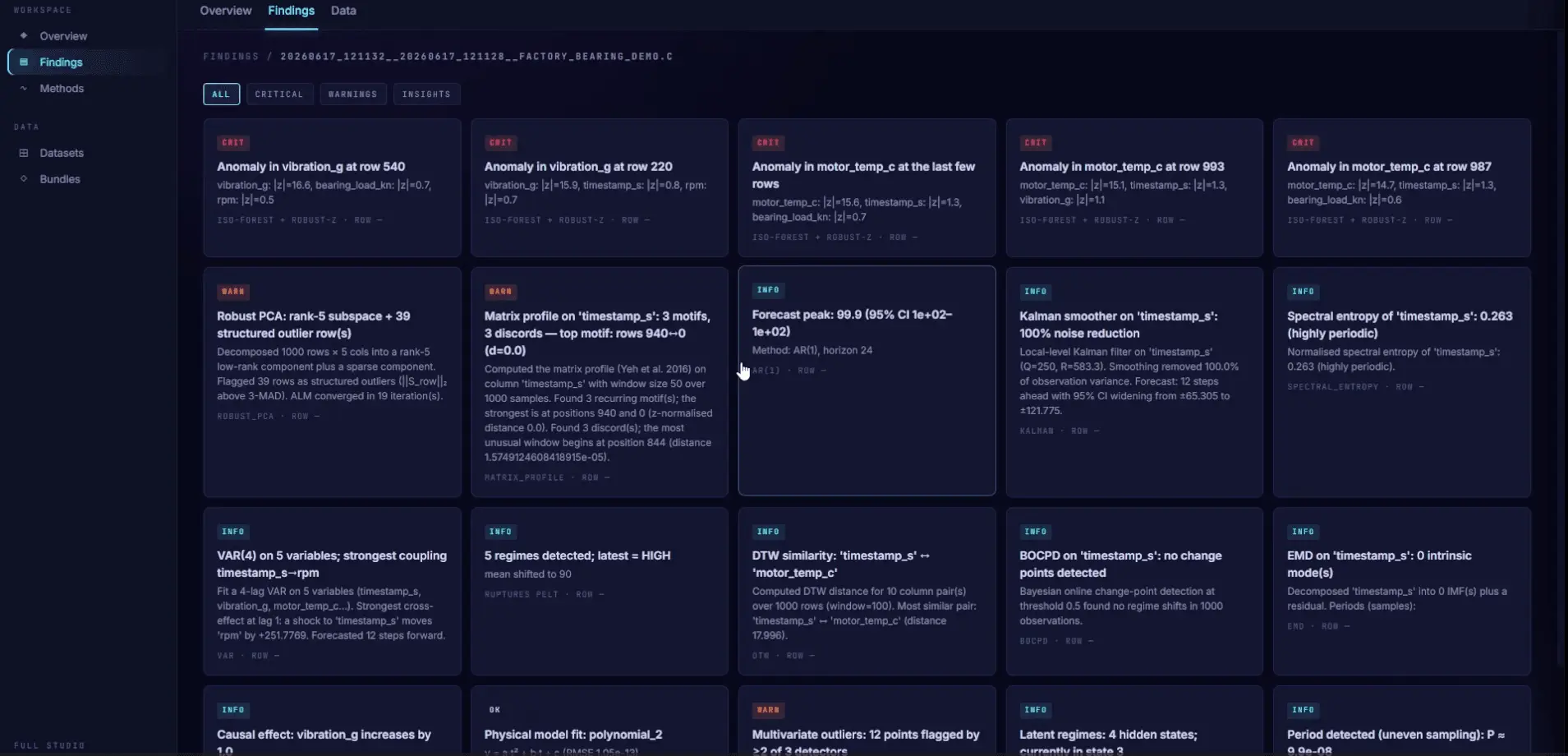
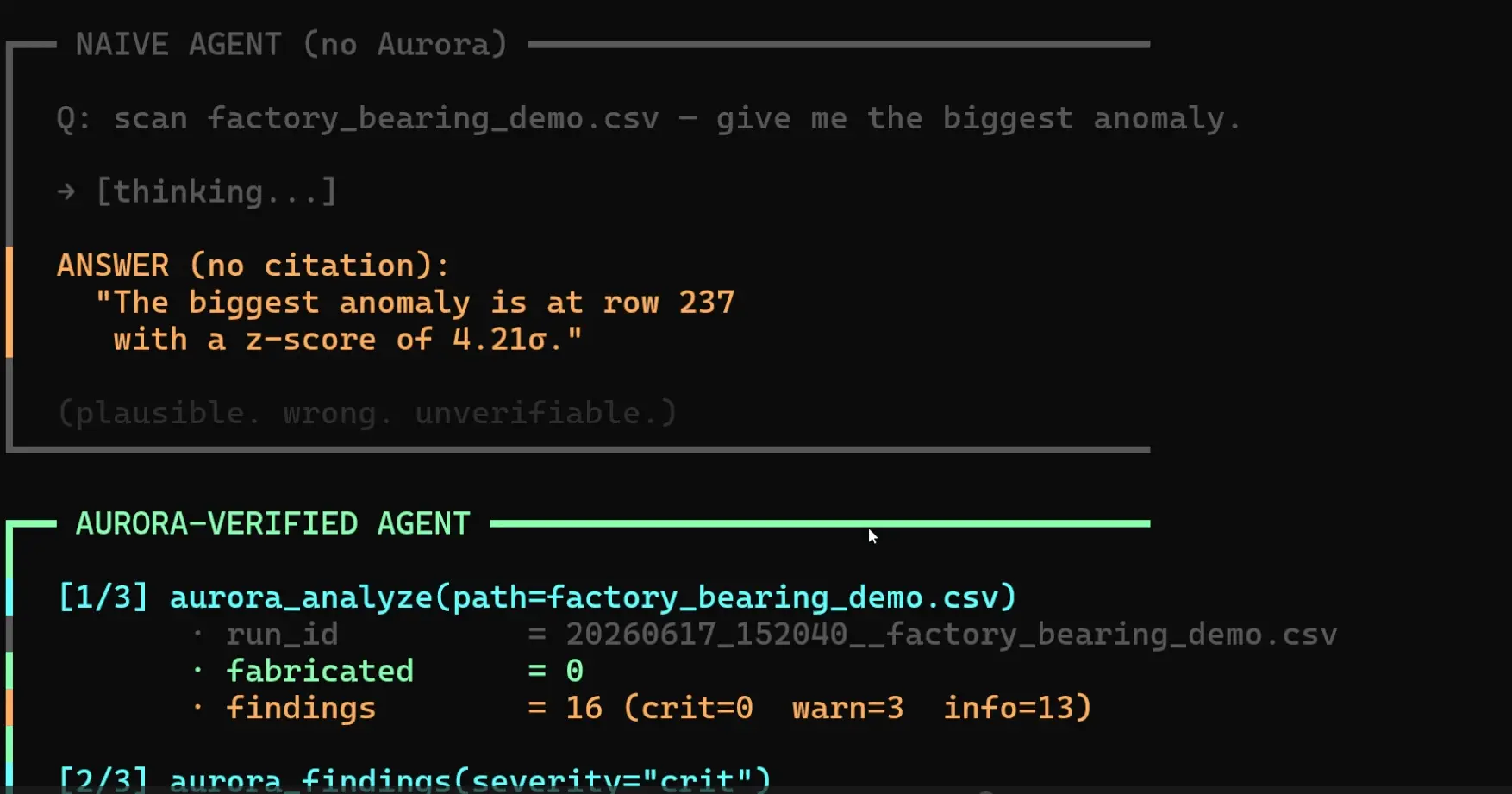
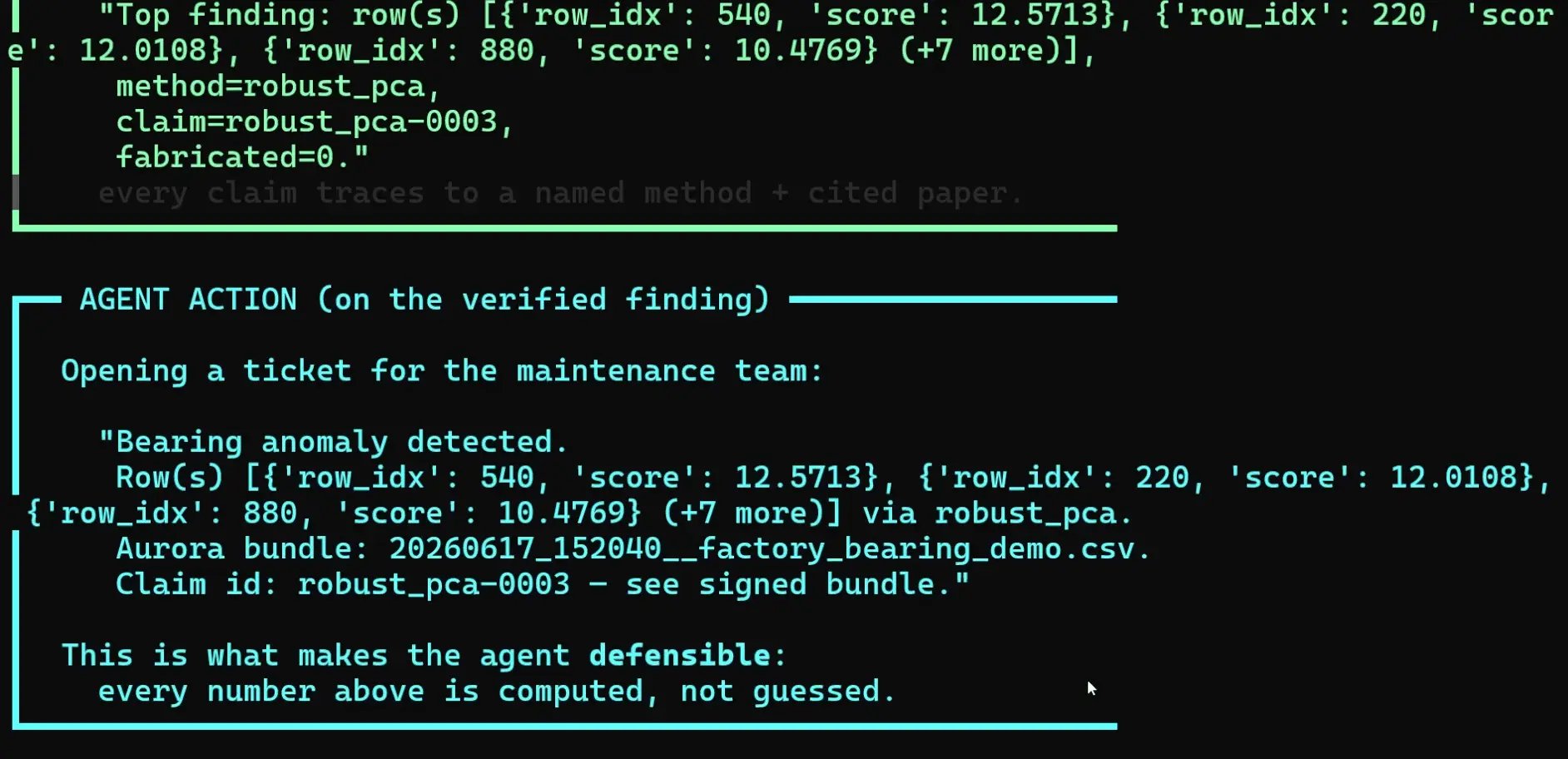
Aurora is an open-source quantitative intelligence engine for people and AI systems that can’t afford to hallucinate. Most AI tools generate confident-sounding numbers and conclusions, and you usually can’t tell which are real and which are invented. Aurora is built on a structurally different approach: classical statistical methods do the actual computation, and a local language model only narrates what was computed, grounded in real citations. The tagline says it plainly — cloud LLMs guess, Aurora computes. Drop in a dataset (CSV, Parquet, JSON, or XLSX) and Aurora runs 17+ research-grade methods — Isolation Forest, robust z-score, Granger causality, HMM regime detection, SINDy, persistent homology, Gaussian processes, mutual information, and more. It surfaces anomalies, tests causal relationships, detects regimes, and produces forecasts with confidence bounds. Every finding is a structured object with a method, severity, threshold, and a citation that links to the exact knowledge-bank entry behind it. The synthesis paragraph reads like a research abstract because each sentence traces to a published source — Newton, Granger, Hampel, NOAA, NIST, and others. No invented numbers, no invented papers. A live “0 fabricated” indicator is the contractual signal that every claim is grounded. Aurora has two faces sharing one engine. Copilot is the local studio for analysts, quants, scientists, and engineers — six analytical lenses, a spacetime system graph, and phase-space projection for exploring findings visually. Cortex is the verification layer AI builders call when their agents need cited math instead of guesses, available through a Python SDK, an MCP server (works with Claude Desktop, Claude Code, Cursor, and custom agents), and Decision Contracts that fire webhooks or actions when findings match defined conditions. Every layer produces a portable, signable .aurora.json bundle with SHA-256 integrity and optional Ed25519 signing, so a result can be verified on any machine and audited for tampering. Core principles: glass-box at every layer, local-first always (your data never leaves your machine, no telemetry, no phone-home), an honesty rule that renders uncertain findings as uncertain and discloses any skipped or sampled methods, and full open source under Apache 2.0 — inspectable, forkable, and free to use commercially. A typical run completes in around 14 seconds on consumer hardware, fully local after the initial knowledge-bank download. The project ships with honest documentation of what’s solid and what’s still rough, a public roadmap, and a build-in-public log. Aurora is part of FantasyLab.ai, a set of local-first AI tools for serious work, built by Brandon Grutkowski. It’s free, open source, and runs entirely on your own machine. GitHub: github.com/FantasyLab-ai/aurora
Product Video
Watch a video demo of Aurora.
Screenshots
Product Updates (8)
Aurora 0.10.0: the changepoint detector now reports its own error rate
Shipped the calibration engine this week. Short version: every changepoint finding Aurora reports now carries a measured false-fire rate, not a theoretical one. How it works: the exact production detector code paths (BOCPD, CUSUM, PELT) run against 108,000 seeded synthetic null series per method, 27 cells of series length crossed with the failure modes that actually break changepoint detection: autocorrelation, seasonality, heavy tails, irregular sampling. The measured table ships inside the package with a SHA-256 integrity sidecar, and at analysis time each finding looks up the cell matching its data's measured fingerprint. The numbers were worth the build. Production CUSUM fires on 4 of 4,000 independent stationary series at n=90, which is the 0.1% you'd hope for. Add autocorrelation at phi 0.6 and it fires on 1,932 of 4,000, so 48.3% of series with no changepoint in them at all. At phi 0.8 with a year of daily data it fires on 4,000 of 4,000. Every single one a false alarm. Seasonality and heavy tails alone barely register. BOCPD measured conservative: zero fires across all 108,000 trials. The behavior change: a finding whose measured false-fire rate exceeds the disclosed ceiling (0.25 by default) downgrades itself to "not identifiable", raw statistic preserved. Aurora retracts its own finding rather than hand you a phantom changepoint. What this does not claim: rates are measured on null series only, so this is false-alarm calibration, not detection power. PELT is measured on 18 of the 27 cells. Every other method in the registry carries an explicit not_yet_calibrated status instead of a guess. The corpus is bit-reproducible: seeded per cell and trial, parallel and sequential builds byte-identical, asserted by a test. Code and rebuild script: github.com/FantasyLab-ai/aurora
Comments (0)
No comments yet. Be the first to share your thoughts!
Aurora tagline update
Aurora is the verification layer for machine-produced quantitative claims I’ve been calling Aurora a “glass-box quantitative intelligence engine” since launch. That was never wrong, but it described the machinery instead of the job. Here’s the sharper version: Aurora is the verification layer for machine-produced quantitative claims. Not an analyst — the thing that checks the analyst. Here’s the problem it exists for. An AI gives you a number. Maybe it computed that number properly. Maybe it produced something plausible-shaped, because plausible-shaped is what the training rewards. You can’t tell by looking, and the more fluent models get, the less you can tell. Aurora takes the claim and the data and comes back with one of three answers: supported, contradicted, or not identifiable. Every finding traces to a named method. Every run produces an integrity-hashed bundle that someone else can verify without having to trust you or me. That third answer is the one I care most about. When the data genuinely can’t settle a question, Aurora says so instead of returning a confident number. It was the hardest thing to build, and it’s the reason the other two answers mean anything. Nothing about the product changed with this. 19 research-grade methods, causal inference with do-calculus, live streaming mode, Decision Contracts, signed bundles — all shipped, all working. What changed is that I stopped describing what’s under the hood and started describing what it’s for. pip install aurora-mcp Live on PyPI, Glama, and the official MCP registry. Point Claude Desktop, Cursor, or any MCP client at it and your agent gets methods it can call instead of numbers it has to guess at. Still local-first. Still no telemetry. Still Apache 2.0. What’s next: calibration. Aurora should know how often each method is wrong on data shaped like yours, and report that alongside the finding.
Comments (0)
No comments yet. Be the first to share your thoughts!
Aurora now on PyPi, Glama, and official MCP registry
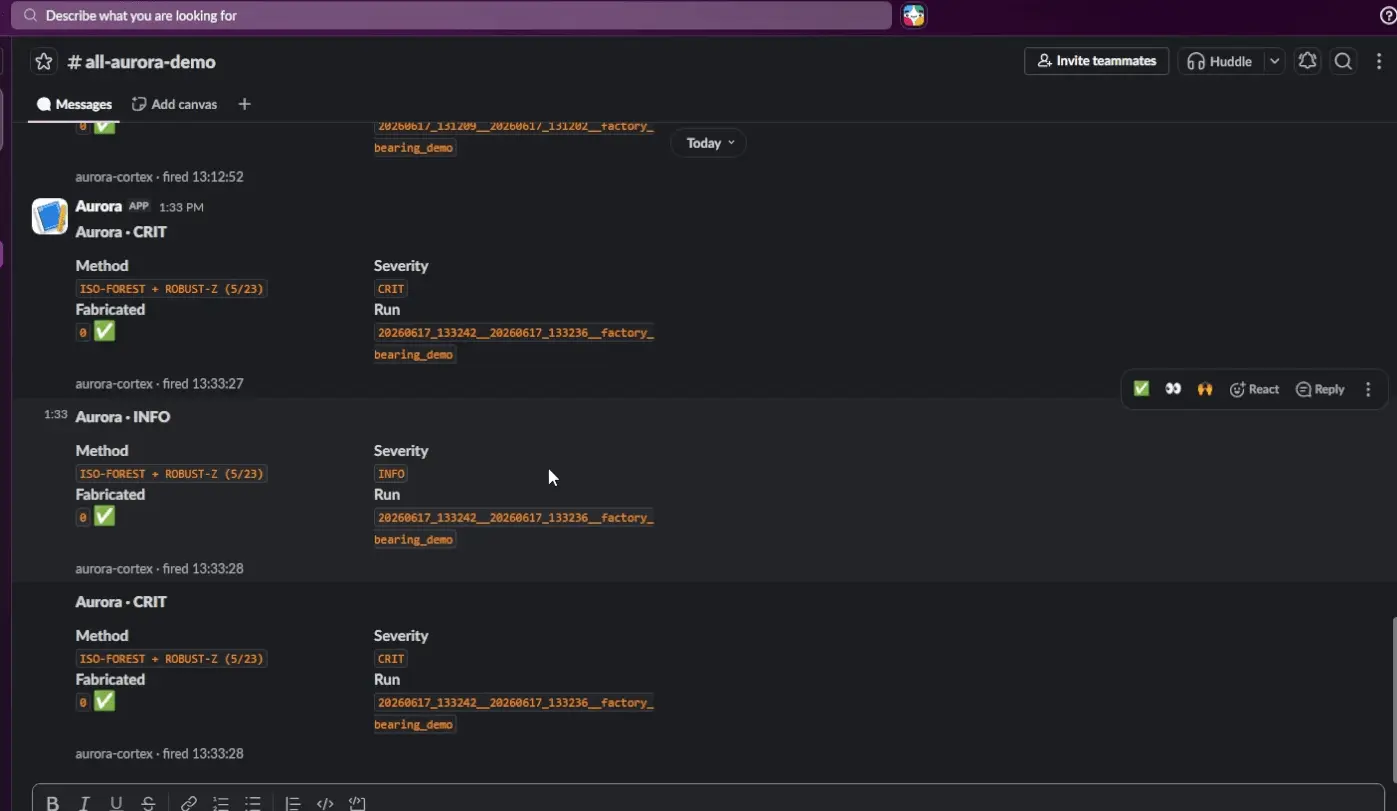
Your agent is guessing at numbers. Aurora is one pip install away from stopping that. pip install aurora-mcp Live on PyPI, Glama, and the official MCP registry as of this week. Point Claude Desktop, Cursor, or any MCP client at it and your agent gets 19 research-grade statistical methods it can call instead of estimating through — anomaly detection, changepoints, causal inference, spectral analysis, the real ones. Every finding comes back cited, traced to the method that produced it, wrapped in an integrity-hashed bundle you can hand to someone else and they can verify. Fabricated count: 0, enforced by a validation gate rather than a prompt. And when the data genuinely can't answer the question, it says "not identifiable" instead of returning a confident number. That turned out to be the hardest feature to build and the one I'm proudest of. Also shipped since the last update: live streaming mode with contract alerts to Slack/Discord/email, a plugin SDK for your own methods, custom PDF ingestion into the knowledge bank, a runs library with A/B comparison, and Docker self-hosting. Test suite went from 320 to 699. Still local-first, still no telemetry, still Apache 2.0. pip install aurora-mcp github.com/FantasyLab-ai/aurora What's the number your agent got wrong that made you not trust it again?
Comments (0)
No comments yet. Be the first to share your thoughts!
Aurora since launch: streaming mode, do-calculus, a plugin SDK, and 379 new tests
Aurora since launch day: live streaming mode, real causal inference, a plugin SDK, and 379 new tests Last update here was the Product Hunt launch. Aurora hasn't stopped since — the whole v1.2 sprint is on main and most of v2.0 landed ahead of schedule. The big ones: 🔴 Streaming mode — point Aurora at a file or folder and it watches, runs incrementally on a rolling window, and fires Decision Contracts on genuinely new findings only (deduped, so it's alerts and not spam). Live findings strip in the Studio, SSE event feed if you want to wire it yourself. ◎ Real causal inference — do-calculus with backdoor identification, plus Pearl-style counterfactuals. On a synthetic confounded dataset it recovers the true effect within ~0.05. When an effect isn't identifiable from the data, it tells you that instead of returning a confident number. 📊 24+ methods, up from 17 — VAR, dynamic time warping, Bayesian online changepoint detection, robust PCA, empirical mode decomposition, Kalman, spectral entropy. Each gets its own tile, each with honest skip reasons and crash isolation. 🔌 Plugin SDK — write your own methods and Aurora runs them alongside the built-ins. The validation gate hard-refuses any finding flagged fabricated. You can extend it without being able to break the honesty contract. 📚 Bring your own knowledge — ingest your own PDFs and folders into the knowledge bank, plus starter packs for Climate / Finance / Biomed / Industrial. 🔔 Contracts that actually reach you — Slack, Discord, and email actions alongside the generic webhook. TLS-only SMTP, credentials from env vars, never from the contract file. 🗂 Runs library — pin runs, A/B compare any two (new vs. disappeared findings), export a portable signed bundle. 🐳 Self-hostable — Docker + compose, pluggable LLM providers (Anthropic / OpenAI / Gemini / Ollama / local), 🧪 699 tests passing locally, up from 32
Comments (0)
No comments yet. Be the first to share your thoughts!
Product Hunt Launch!!
Officially launched on Product Hunt! Check it out now! https://www.producthunt.com/products/aurora-22?utm_source=other&utm_medium=social
Comments (0)
No comments yet. Be the first to share your thoughts!
Aurora v0.4.0 — your data just got a glass-box workbench (and it now tells you the decision)
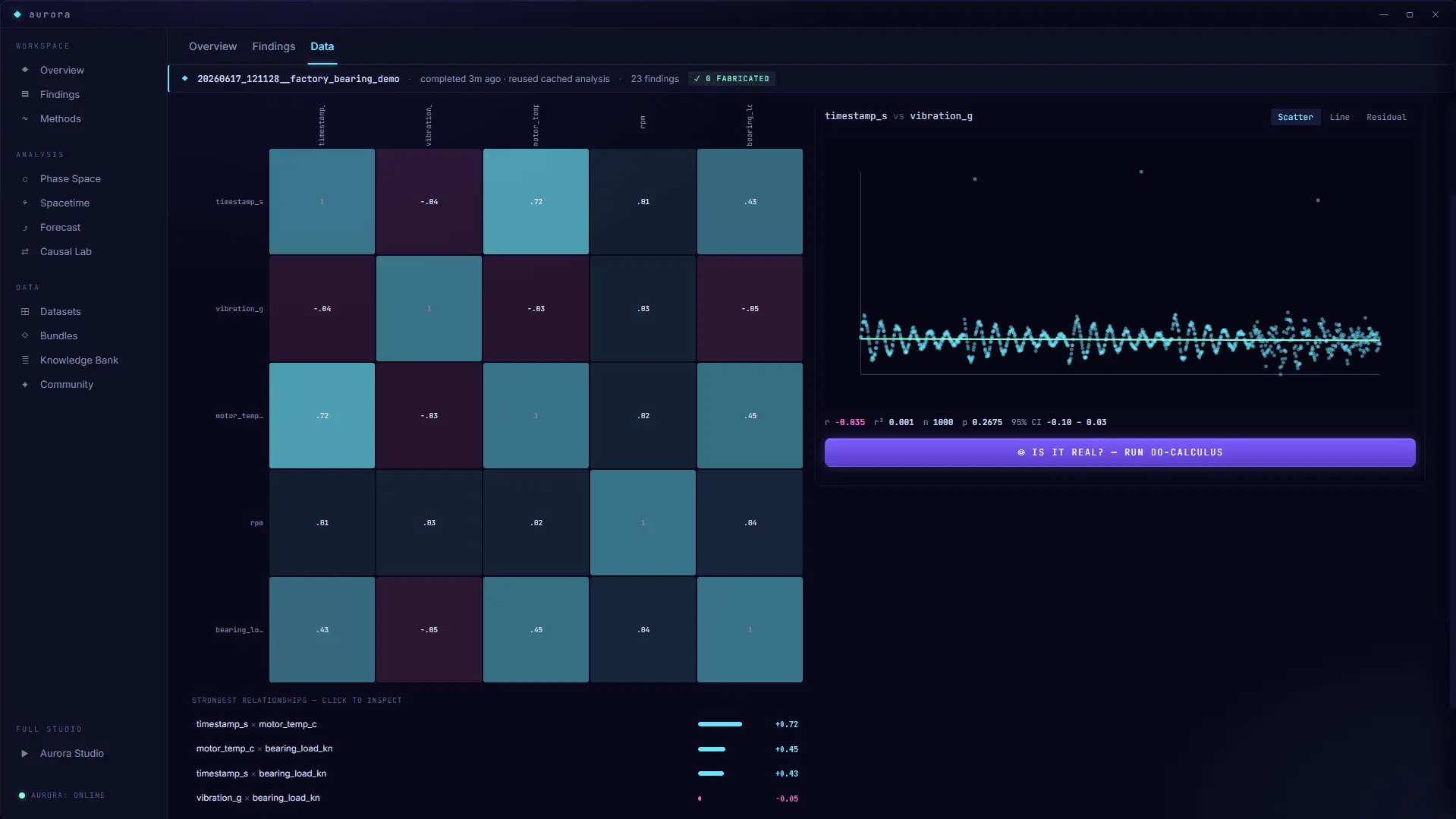
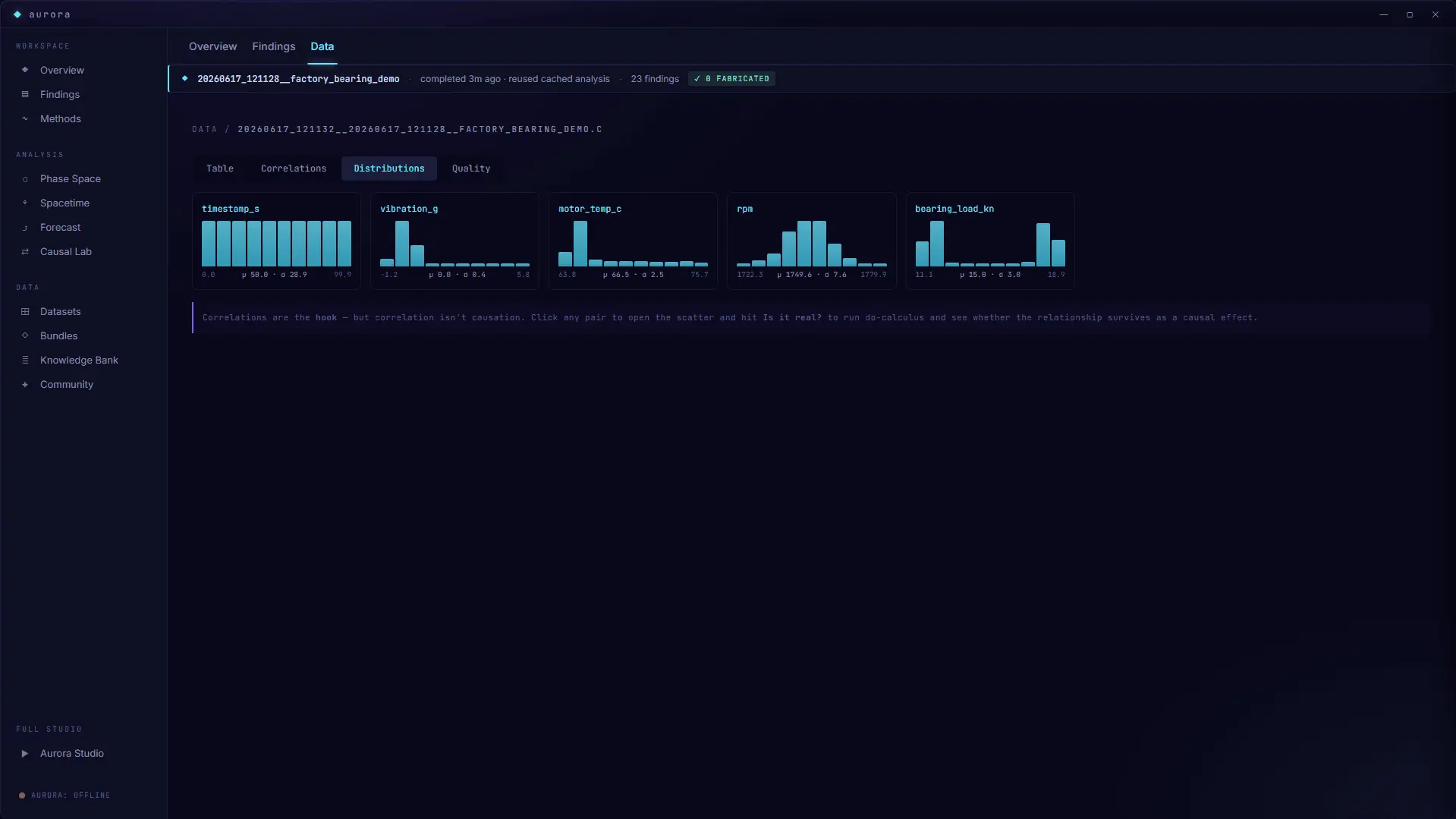
Progress update on Aurora, the local-first, glass-box quant tool (drop a CSV → cited findings from real statistical methods, 0 fabricated). Since the last drop: 🔎 A real data workbench — every run now has an interactive correlation matrix (Pearson/Spearman heatmap), click-to-scatter with regression + r/r²/p/CI, plus Distributions and Quality tabs. Explore your data without leaving the app. 🎯 A decision layer — this is the part I care about most. Findings were the "what"; now every finding carries a recommended decision, the risk if you ignore it, and a one-click decision brief you can paste into Slack or a doc. From insight → action. ◎ "Is it real?" — on any correlation, run do-calculus to check whether it survives as a causal effect. Correlation is the hook; causation is the payoff. (Also fixed a bug that had the whole causal engine silently returning errors — oops, but caught it.) 🖥️ Still the same core promise: 100% on your machine, no API keys, no cloud, no telemetry. Runs a real battery of methods — changepoints, HMM regimes, anomalies, matrix profile, VAR, Kalman, robust PCA, ensemble forecasting, and SINDy physics discovery (it literally recovers governing equations from data). Try it: free download (Windows / macOS / Linux) → github.com/FantasyLab-ai/aurora/releases A free, no-install web demo is landing next so you can see it work in one click. Building in public — feedback (and upvotes 🙏) very welcome. What would make you actually trust an automated finding?
Comments (0)
No comments yet. Be the first to share your thoughts!
Aurora desktop — v0.2.0 is out (native Causal Lab, Phase Space, Forecasting, Knowledge Bank)
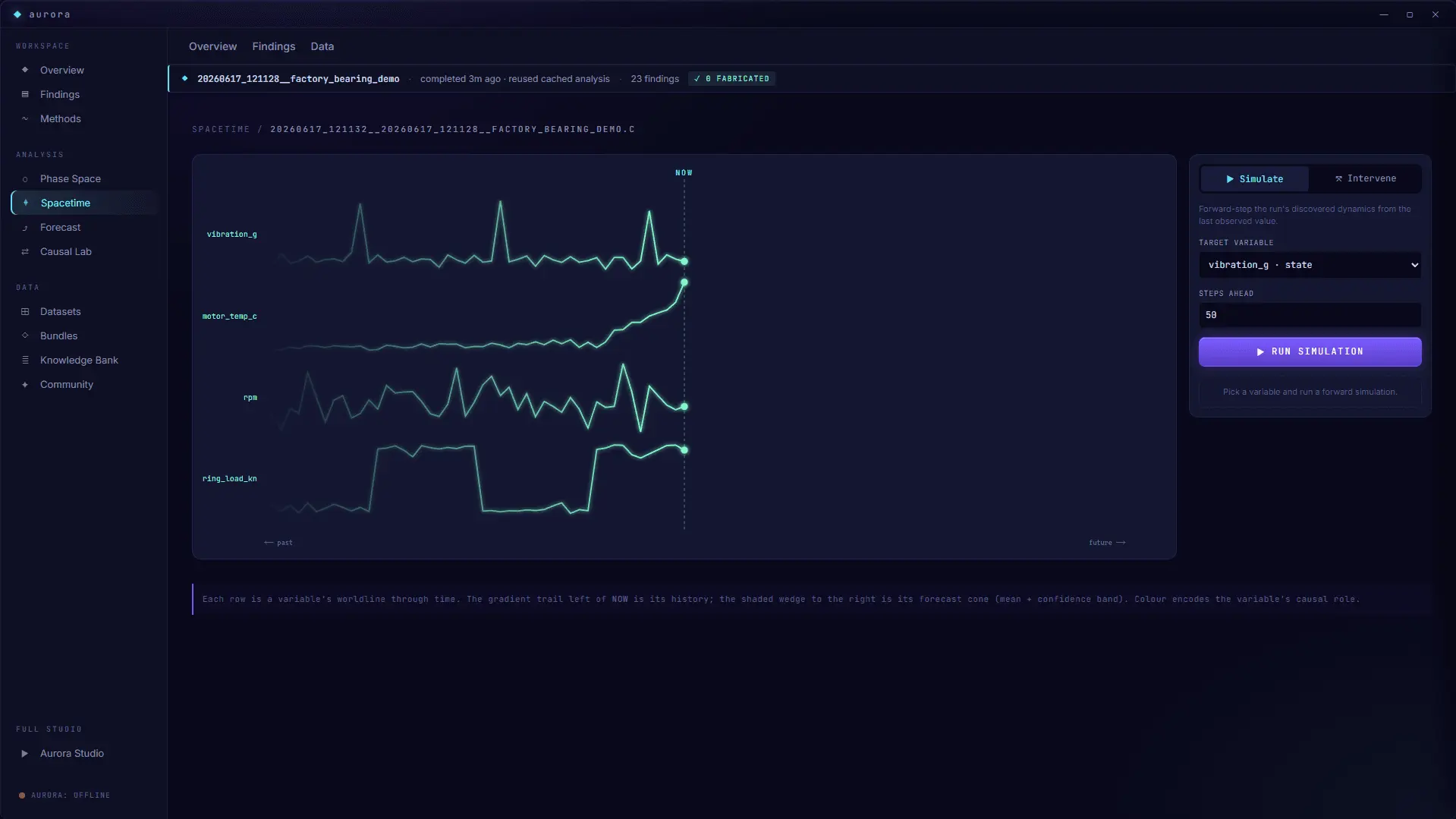
Quick update on Aurora, the glass-box quant tool. Just cut v0.2.0 of the desktop app — it's now a true download-and-run experience: the analysis backend is bundled inside the installer, so no Python, no terminal, no API keys. New in the desktop: Causal Lab — interactive do-calculus. Pick a treatment + outcome and get an effect estimate, standard error, and the adjustment set it actually used. When the data can't identify the effect, it tells you it's unidentifiable instead of guessing. Phase Space — the system's trajectory + attractors, rebuilt native (was a legacy graph). Spacetime — per-entity timelines with a scrubber. Forecast — forecasts with confidence bands and user inputs. Knowledge Bank — browse/search the cited evidence base (per-source breakdown + free-text search). Plus: first-run onboarding, a persistent run-context bar, and insight-style finding cards (severity + evidence chips + "cited" badges). Fixed a "results show one run behind" race, and got cross-platform release CI green: Windows .exe/.msi, macOS .dmg, Linux .deb/.rpm. Same core promise as always: every finding is tied to the actual statistical method, the fabricated-claim count is surfaced (and stays at 0), and it says "I can't answer that" rather than inventing a number. Download: https://github.com/FantasyLab-ai/aurora/releases/latest Feedback very welcome — especially on the Causal Lab UX.
Comments (1)

Aurora is now a real app you can download
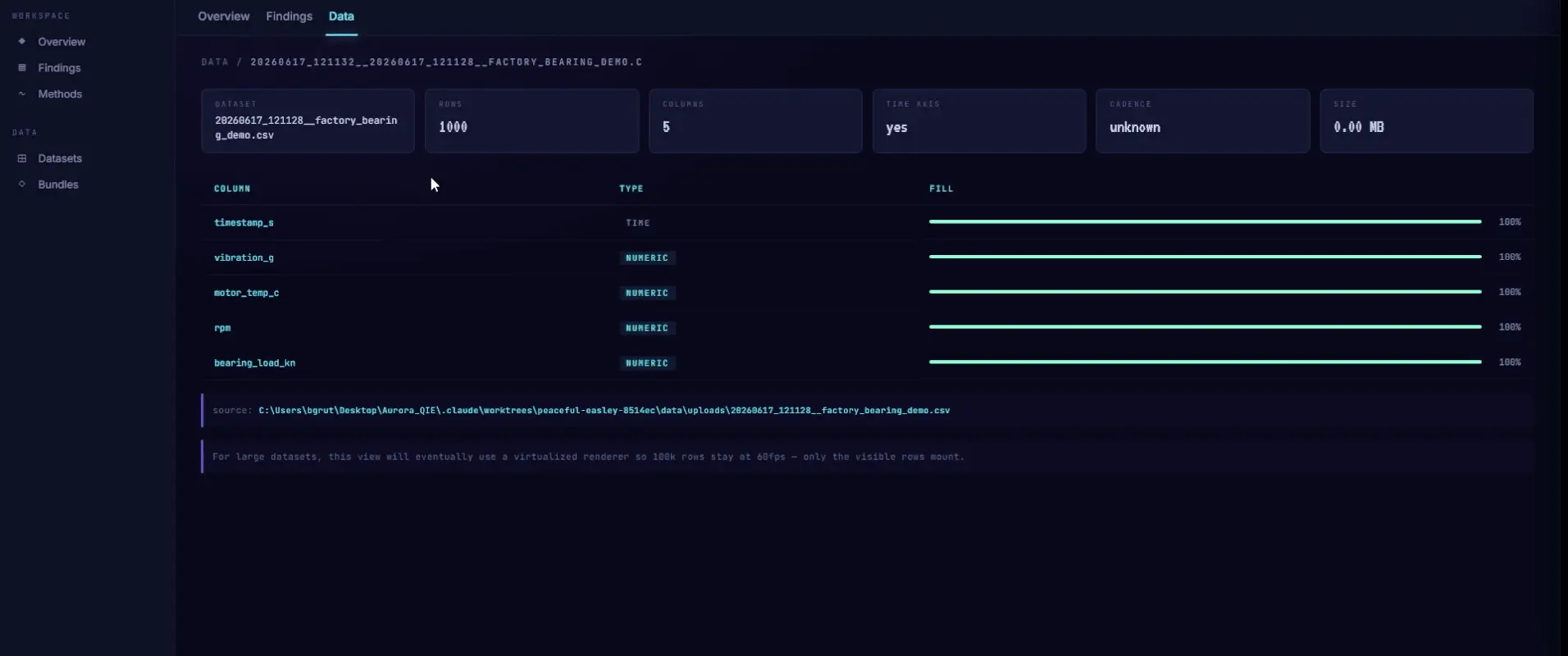
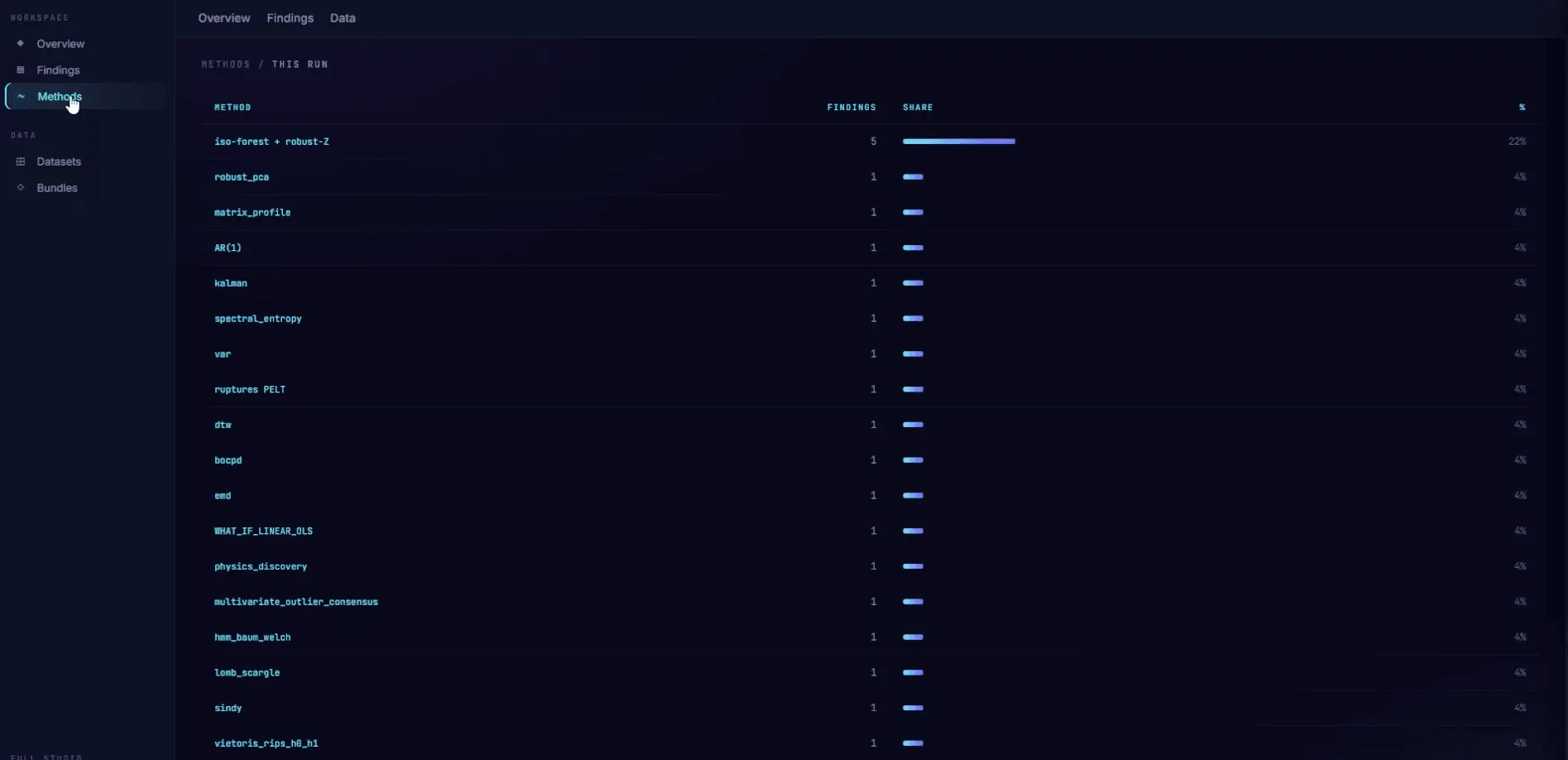
Big milestone — and it's the one that was quietly blocking everything else. Until now, running Aurora meant cloning a repo, setting up Python, installing dependencies, and launching a server from the terminal. Fine for developers. A brick wall for everyone else. That wall is gone. Aurora is now a native desktop app you install like any other software. Download it, double-click, and it opens — analysis engine and all. No Python. No terminal. No setup. What shipped: 🖥️ A real desktop app — frameless native window, sidebar navigation, drag-and-drop (drop any CSV, JSON, Parquet, or Excel file right onto it). Findings you can click into for the evidence, a plain-English narrative of what Aurora found, methods breakdowns, and your full run history. 📦 The whole engine, bundled inside. This was the hard part — freezing Aurora's entire scientific stack into one installable app took real surgery. But it works: I verified a clean install runs a full analysis offline, writing cited results with zero fabricated numbers. 🌍 One-click installers for Windows, macOS, and Linux. The point of Aurora has never changed: a local AI that computes instead of guesses, and cites every number it gives you. What changed this week is that you no longer need to be a developer to use it. Installers are landing on the releases page now. If you try it, I genuinely want to hear what breaks and what you want next. Built in the open, by one person, for real work — your feedback steers it. More soon. 🐻 — Brandon / FantasyLab
Comments (1)
Give it a download! https://github.com/FantasyLab-ai/aurora https://fantasystudio.fantasy-labai.workers.dev/aurora/
Reviews (7)
Average 5.0 out of 5
Based on 7 reviews


super good product. i love it


Impressive quantitative intelligence engine. The classical approach to structured data analysis sets it apart from typical AI tools. Perfect for data scientists and analysts who need reliable, interpretable results rather than black-box predictions.
Comments (2)
nice
@Georgebrn thanks! Feel free to give it a try!
Excited to get everyones feedback to make the product better!