
Incidentary
Site offlineDeterministic incident trace, before the war room
Details
- Follow on
- @incidentaryLinkedIn
- Categories
- Developer ToolsAnalytics & Monitoring
- Target Audience
- DevelopersDevOps EngineersBackend Developers
- Pricing
- Freemium from $60
- Platforms
- Web
Discovery signals
How AI and people discover Incidentary on PeerPush
- Perplexity
- ChatGPT
- +2 other AI crawlers
Reads by these AI engines
Crawlers behind these engines read this listing on PeerPush.About Incidentary
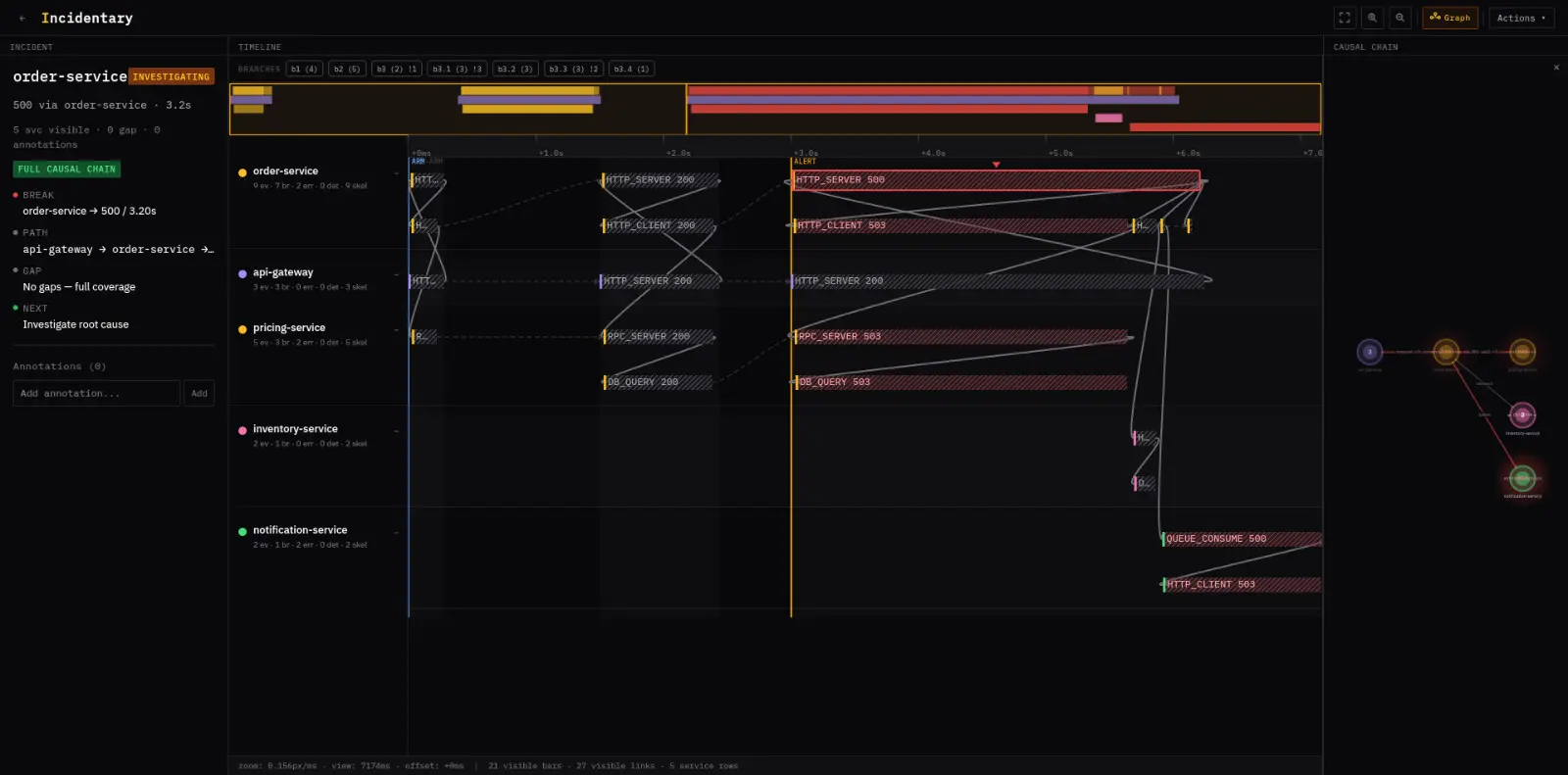
When an alert fires across multiple services, the room splits before the investigation begins. Engineers open different dashboards, come up with different theories, and the first chunk of every incident is spent converging on a shared story instead of fixing anything. Incidentary removes that alignment phase. How it works: an open-source SDK records events continuously across your services, before any alert fires. When one arrives — via PagerDuty, a webhook, or a Slack command — Incidentary assembles the causal chain from data already captured in that window. By the time the war room opens, the artifact is ready. Everyone reads the same thing. The artifact is deterministic. Each step names its predecessor explicitly. Every event was recorded at runtime by the SDK. No inference, no probabilistic correlation, no AI slop. If a service wasn't instrumented, the gap appears honestly in the chain, labelled and explained. A few things worth knowing: - Installing the SDK on one service immediately surfaces your ghost services — dependencies that aren't instrumented — ranked by call volume. - For Kubernetes, there's a cluster operator (one Helm install, read-only ClusterRole) that maps pod crashes, OOMs, evictions, and deploy rollouts into the same causal chain as application traces. - It's not a replacement for Datadog or Grafana. It's a precursor. You read Incidentary first, then go to your existing tools knowing what you're looking for. - SDKs for Node.js, Python, Go, and .NET. OTLP ingest supported if you're on OpenTelemetry. Free plan: 200K causal events a month. Demo without signup at https://incidentary.com/demo.
Screenshots

Reviews (0)
No reviews yet. Be the first to rate this product!
Comments (0)
No comments yet. Be the first to share your thoughts!