
Mnemosyne OS
Your memory, your agents, your machine: one local AI OS

npm install -g @mnemosyne_os/mcpDetails
- Follow on
- Categories
- Target Audience
- Pricing
- One-time
Discovery signals
How AI and people discover Mnemosyne OS on PeerPush
By AI reads among AI tools
44,749 AI reads in the last 30 days, ranked against every AI tool listed.About Mnemosyne OS
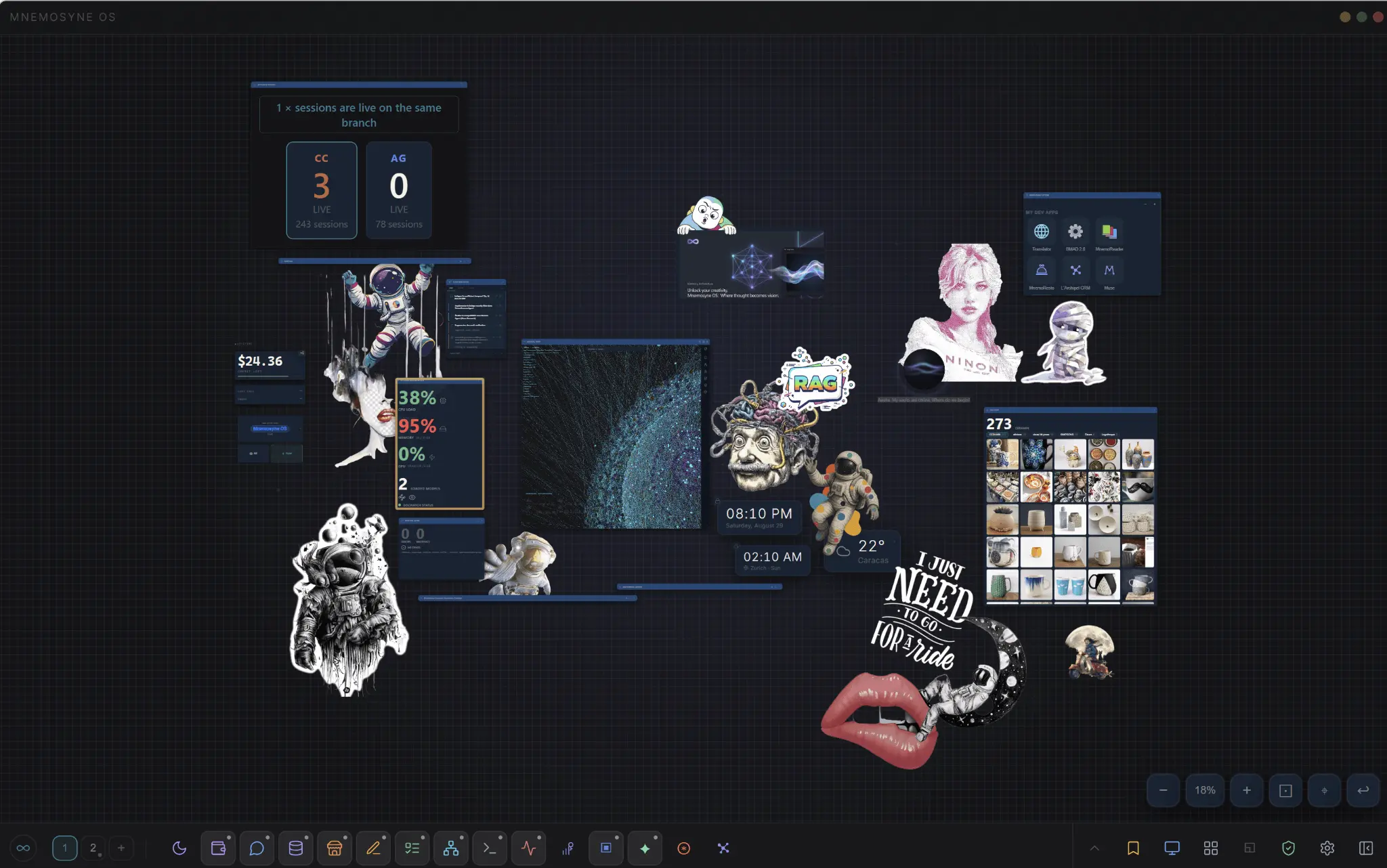
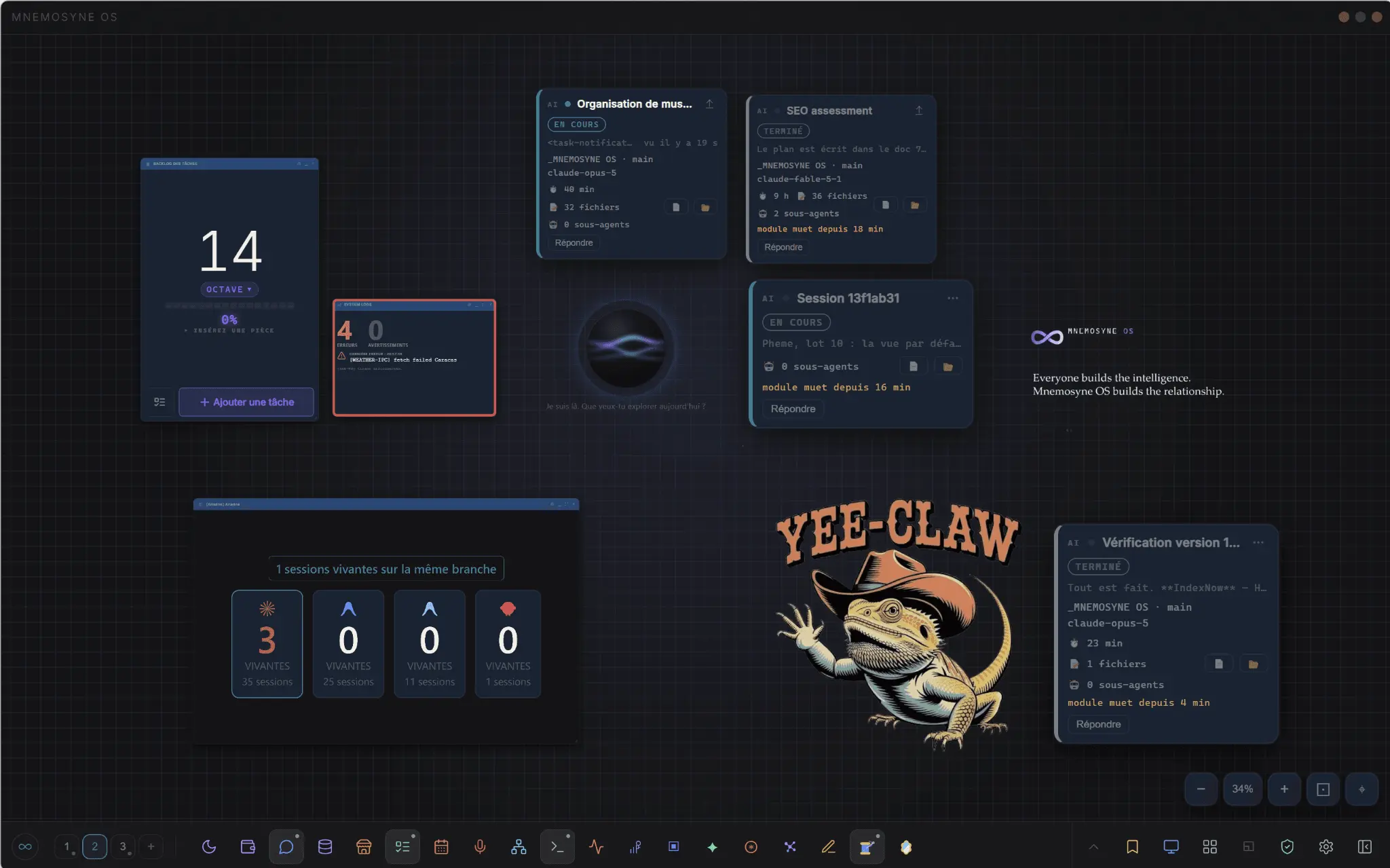
# Mnemosyne OS remembers you. An ordinary assistant treats you as a stranger in every conversation, and forgets everything when the window closes. Mnemosyne OS starts from the opposite idea. **Memory is the operating system, and the assistant runs on top of it.** It lives on your machine. It reads **only the folders and vaults you choose** to open to it. It remembers what you tell it, write and read, six months later and from one model to the next. Over time it learns how you work and adapts to you. The goal is simple: a real relationship with a human, and a companion for each of their projects. ## A different way of answering A word of warning. The way Mnemosyne OS answers you may surprise you. Its harness is the result of months of research. It pushes back on your ideas and your projects, like a partner who challenges you. The way it answers, and the way it is with a human, are its own. We call this **the relationship layer**. One user told us its answers unsettled her, in a good way. We are curious to read about your experience. ## The control room for your agents - Your coding agents show up as cards on your desktop. You see which one is working and which one is waiting, and you reply from its card. - Your Hermes assistant installs in one click. It reads your memory and answers you on Telegram, in text or by voice note. - Before a risky command, the agent asks for your approval on a card. You answer once, for the session, or for good. ## JARVIS mode You drive Mnemosyne OS with your voice and your hands, like JARVIS. - You talk to the orb. It listens, answers out loud and runs your commands: "open my agenda", "full screen". - Through your webcam, you move a window by pinching its corner and zoom with two hands (beta). - Speech recognition, the orb's voice and hand tracking run on your machine. With a local model, everything runs **100% locally**, and every exchange costs **$0 in tokens**. ## Use cases by profile Drop in a PDF, a folder of notes or a codebase. Six weeks later, your question gets an answer grounded in your documents, with its sources. ### Developers Connect your memory to Claude Code, Cursor or any other MCP client. Your agents find your code, your git history, your decisions and your notes. They start with the context instead of starting from zero. ### Students Import a course as a PDF, a Word file or a photo of the lecture screen. The Melete cartridge turns it into a mind map, flashcards and a quiz. Then you ask your course questions in the chat. ### Researchers Every answer cites its sources. A second pass checks each sentence against the documents it found, and flags a sentence with no support. ### Lawyers You cross-check laws against the documents in a case. Switch to 100% local mode, cut the internet and question your documents with the best local models. Your client's file **stays on your machine**. ## Memory cartridges A memory cartridge fetches public knowledge from its official source and stores it in your memory, where you question it from the chat. The first ones cover laws, medicine, science, world history, known vulnerabilities in your code and registered trademarks. Every text keeps its source, its date and its licence. Many more are on the way. ## Technology and sovereignty ### Separate vaults Your memory is organised into vaults, one per domain: code, research, journal, clients. A MAXIMUM vault stays out of ordinary searches, so your journal never ends up in a work answer. ### Search by meaning and by words The engine combines a search by meaning with a search by exact words, and it decides what the model is allowed to see. At night, a background pass links related topics in recent memory. The engine is measured in public: 77.1% (37/48) on LongMemEval-M with the official judge. ### Local first Models, embeddings and search can run entirely on your machine: unplug the cable and keep questioning your documents. Cloud models remain available, with your own keys or in-app credits. Encryption at rest is yours to turn on. No account is needed. ### Several machines, one network P2P connects your Mnemosyne OS installs on your local network, with no server in between, and brings everything together on one desktop. - Each machine's agents appear on your board, through herdr. - You give each computer a role. For example, the PC with the graphics card draws the images the others ask for. - You share a vault read-only, or you keep one together. ### Hardware Mnemosyne OS runs from **8 GB of RAM**, on Windows, macOS and Linux, and adapts its models to your hardware at install time. With **32 GB of RAM** you can comfortably run everything locally, with the largest models. ### For your tools The MCP server runs locally (`npm install -g @mnemosyne_os/mcp`, or one click in Claude Desktop). Your agents search your vaults and follow the same protection rules as you. An agent never reads a vault you did not open to it.
Product Video
Watch a video demo of Mnemosyne OS.
Screenshots
Product Updates (7)
Mnemosyne OS 1.9: the orb becomes your assistant, and your notes find their topics
hank you: Mnemosyne OS was Product of the Month on PeerPush in October. Two releases since our last update, both free, no account, on Windows, macOS and Linux. 1.9.0 “The Orb”. The orb is now the assistant. You ask it in your language, and it opens an app, moves to the view you named and runs the command. It understands seven languages. It also prepares your day: a morning briefing, a journal, routines, your Google calendar, your mail and your meetings. 1.9.1 “The Topics”. Your memory now sorts itself by subject. It starts from your Obsidian tags and folders. When you move a note to the right topic, it learns from that move and proposes the next ones, and you decide. PowerPoint and OpenDocument files now enter your memory too. An acronym glossary helps the search find what a short form stands for. The orb also drives the views inside an app. One more first this week: SplitShift is the first cartridge built by an outside developer. Download: https://mnemosyne-os.io/download
Comments (0)
No comments yet. Be the first to share your thoughts!
The Mnemosyne OS MCP server: your memory in your IDE, and several IDEs at once
Thank you all: Mnemosyne OS is 3rd in this month's race on PeerPush, with 7 days to go. This update is about our MCP server. It connects your memory to Claude Code, Cursor, Antigravity or Claude Desktop. Where to get it: Claude Desktop: one-click install with the .mcpb bundle. Glama and the official MCP Registry: the listing is live. Context7: the docs are indexed, so your coding agent reads them directly. npm: npm install -g @mnemosyne_os/mcp Three levels, depending on what you install. The MCP server alone. Before committing, your agent checks whether another session is working on the same branch. It runs with the app closed and costs nothing. With the Mnemosyne OS app. Your agent searches your vaults, writes new memories, and manages your to-do list and your agenda. It reads only the vaults you opened to it. With Ariadne. You see every session of your coding agents on one board: Claude Code, Antigravity and OpenClaw. For each one you get the project, the branch, the files it wrote and when it was last seen. Several IDEs at once. Two live sessions on the same branch of the same folder raise an alert. Otherwise a commit from one picks up the other's work. Run Claude Code in a terminal and Antigravity next to it, and you know when they step on each other. Ariadne is free. In MnemoHub: Add an external cartridge, A repository, then paste https://github.com/Mnemosyne-OS/Ariadne Download Mnemosyne OS: https://mnemosyne-os.io/download
Comments (1)

Keeping memory, agents, and the machine in one local OS is a stronger pitch than another chat wrapper. I would want to see how agents stay scoped so they do not wander the whole machine.
Version 1.5.0 "The Synapse" is out on Windows, macOS and Linux. Free, no account.
Synaptic, our peer to peer (beta). Two Mnemosyne OS installs connect directly. You give someone one vault to read. You send mail to another install. You share a vault that several people write, and every machine keeps its own copy. Your wallet is your identity. The node stays offline until you switch it on. Talk to the app, the jarvis part (beta). Say "open my agenda" to the orb, or type it in the chat. Commands work on any window, cartridges included, in your language. Settings > Commands stores the phrases you teach it, and a taught phrase can launch a program on your computer. What a command touches is declared, and you see it before it runs. The recorder transcribes. Your microphone on one track, the room on the other, so a call comes back as a conversation with a time on every line. An enrolled voice names you as the speaker, and the summary knows who said what. Save the transcript as Markdown in a watched folder and it joins your memory like any other document. More than 500 commits since 1.4.5, more than 200 of them fixes. The rest is yours to find. Agent cards pinned on the board. A browsable atlas of your vaults. An Ask panel that reaches your memory while you browse. MCP 2.0, installed in Claude Desktop in one click. Downloads : https://mnemosyne-os.io/download
Comments (0)
No comments yet. Be the first to share your thoughts!
BEAM benchmark: our scores, both judges, and the script that recomputes them
BEAM is a public benchmark for long conversational memory (ICLR 2026). It asks 2,000 questions over 100 conversations, across ten abilities: abstaining when the memory holds no answer, flagging a contradiction, ordering events, keeping an instruction over thousands of turns. We ran it on the shipped engine, unmodified. Two sizes: 100K tokens per conversation, then 10M. Mnemosyne OS scores 61.7% at 100K and 49.2% at 10M, with the benchmark's official judge. From 100K to 10M is 76 times more text. Our score drops 20%. The paper's own baselines drop 60% on the same step. At 10M, each answer was written from about 14,000 tokens of retrieved context. The number that surprised us is the judge. The same 400 answers score 57.6% with one judge model and 61.7% with another. 136 verdicts out of 400 change. A benchmark score measures the judge as much as the memory. So we published the run logs, both judgments of the same 400 answers, and verify.js, which recomputes every score from the raw files. The summary lists what is still unproven. Everything is in the Mnemosyne-OS/MnemosyneOS---benchmarks repository, folder beam-2026-09.
Comments (0)
No comments yet. Be the first to share your thoughts!
Ariadne 0.6.0: every session your coding agents ran, on one board
Ariadne is on GitHub today. It is a free cartridge for Mnemosyne OS that reads the session transcripts your coding agents already write on your disk, and turns them into something you can steer. One board for your agents and your IDEs. Claude Code, Antigravity and OpenClaw in one list: which agent, what the session was called, the project, the git branch, the last action, the files it wrote, and when it was last seen. A collision alarm. Two live sessions on the same branch of the same working tree raise a warning, because a commit from one picks up the other's staged work. Agents can run that check themselves through our MCP server with the app closed, so it costs nothing to ask before committing. Every file a session produced, including the ones written through a shell command. On this machine, 98 sessions out of 211 had written files only that way, and a tool-call-only list showed zero for them. Keep the drafts worth keeping. Send any of those files into the vault you name, one file, one press. There is no watcher and no standing import. New in 0.6.0: the documents your agents write (plans, walkthroughs, notes) open inside Mnemosyne, and a session's whole conversation can be written as one readable document beside its transcript. New in 0.5.0: pin a live session to your board as a small card, and a line telling you whether those agents are reaching this app or a background process still holding the port. It never says an agent is "working". A crashed agent and an idle one produce the same silence, so it shows "last seen 3 s ago" and lets you conclude. Getting it: Ariadne is not in the store. Open MnemoHub, Add an external cartridge, A repository, paste https://github.com/Mnemosyne-OS/Ariadne, and the app shows you the name, the version and the permissions before anything is installed. It fits in the free external-cartridge slot every install has, so there is nothing
Comments (0)
No comments yet. Be the first to share your thoughts!
Built for a syllabus: Mnemosyne OS for students and teachers
The last update mentioned a student who loaded all his course PDFs and just asks the chat. Here is that use case in full, for students and for the people teaching them. Everything below is already in 1.4.5. Free, no account. The whole course goes in. A 300-page textbook comes in whole and is cut at its own headings, so a chapter stays with its chapter. PDF, Word and Excel up to 50 MB each. The diagrams count as content. With image memory on, the pictures pasted inside a .docx are extracted and indexed next to the text. We measured 386 of them in a single 900-page course, and the definition being looked for was inside one. Drop the course folder on the board. It is watched where it sits, your files stay where you put them. Next week's lecture lands in the folder and it is in memory. One vault per subject. You pick which ones the chat reads: one, several, or Auto, where the model chooses per question. The boundary is structural, so a statistics question is answered from statistics. Every answer cites the file it used. You open the page and check it yourself. It finds the exact word. 1.4.5 put the word channel on the chat: on a real lecture vault it serves 28 of the 30 right passages. A theorem name, a course code or a supervisor's surname is found as a word. Indexing and search run on your machine. A cloud model sees only the passages sent to it, and a vault marked MAXIMUM is sent only if you confirm, every time. Students: https://mnemosyne-os.io/students Teachers: https://mnemosyne-os.io/teachers Also in beta: a conversation recorder, your microphone on one track and the room on the other (verified on Windows, transcription comes later), and reading a document out loud to revise.
Comments (0)
No comments yet. Be the first to share your thoughts!
v1.4.5 "The Locked Door" is out, on Windows, macOS and Linux.
v1.4.5 "The Locked Door" is out, on Windows, macOS and Linux. A student told us this week he loaded all his course PDFs and just asks the chat questions on them. That is the product: your documents stay on your machine, and since 1.4.4 a long document comes in whole, cut at its headings, not truncated after six pages. What 1.4.5 adds: - Security: only a cartridge you linked yourself can run a script on your machine. If you are on 1.4.4, install this one. - Chat answers in under a second instead of a minute, and finds by words again, not only by meaning. - Neural Map rebuilt: one settings drawer instead of seven popovers, a graph-only mode, and a "Cerebral Cortex" layout with one lobe per vault. - Beta: drive the board by hand. Settings › Gestures: pinch, drag, two-hand zoom, swipe. Camera stays off until you turn it on. - Agents get the To-do and the Agenda: 8 new MCP tools read, change and remove, even with the app closed. - New: a conversation recorder, a portable cartridge (beta), and "ask your memory about this web page". Release notes and downloads: https://github.com/Mnemosyne-OS/Mnemosyne-Neural-OS/releases/tag/v1.4.5-infinity macOS users: sorry for the Gatekeeper warning on first launch. The build is not notarized yet: our Apple Developer enrollment is in progress, at the D-U-N-S number step. Until then, right-click › Open works, and the download page has the one-line fix.
Comments (0)
No comments yet. Be the first to share your thoughts!
Reviews (28)
Average 4.9 out of 5
Based on 28 reviews

perfect human assistant with the best ai
Keeping memory, agents, and the machine in one local OS is a stronger pitch than another chat wrapper. I would want to see how agents stay scoped so they do not wander the whole machine.

Very cool

Very cool

It's very helpful
Je suis extrêmement satisfaite, cela me permet d’apprendre beaucoup et ce chaque jour de manière intuitive et simplifiée au meilleur des capacités possibles. Je recommande fortement ! Cela a changé ma vie concernant les IA auxquelles je n’arrivais pas à accéder au mieux!

Very interesting concept, I will for sure have it a try. Realy like the idea of putting some order into that!
Eccezionale , ottimo sistema per organizzare i mie file

Me gustaría poder tener un aplicativo móvil, es muy útil para mí trabajo

Precioso software me ahorra mucho
Comments (8)
Does memory get stored per agent or in one shared store? If one agent writes a bad fact, I would want to see where it came from and roll it back.
@stackshortlist Separate vaults, not one store. An agent can be confined to its own sandbox vault until you unlock it. Each agent write carries an origin line, and you can reject a single bad entry. No version rollback yet.
Running a local AI OS that remembers you on your own machine is an appealing privacy-minded take. Good luck with the launch!
@TSUTSU It really is exciting to build; the launch took place last month. Now I'm going to prepare the launches for each cartridge that connects to the memory.
@nckbrz Thanks! Each agent only sees the vaults you grant it, the rest returns SCOPE_DENIED. A shell command from the assistant shows up as a card on your canvas with the full command, and you approve it.
Cool concept, will take a look at this in more detail.
@tibi thanks and wait the next version,in 2/3 days, nobody is ready on whats comming...
Excelente idea, gran app.
@montechitodesign gracias amigo, vamos a ver donde vamos con este programma
Great idea!
@bgrutkowski13 thanks new version comming today with a lot of new feature to connect IDE
i will try it i need something like this for my obsidian notes
@xpacegems let me know on discord if you need more features for your notes
Great!
@ask thanks, new version comming and nobody are ready on whats comming on 1.4.5