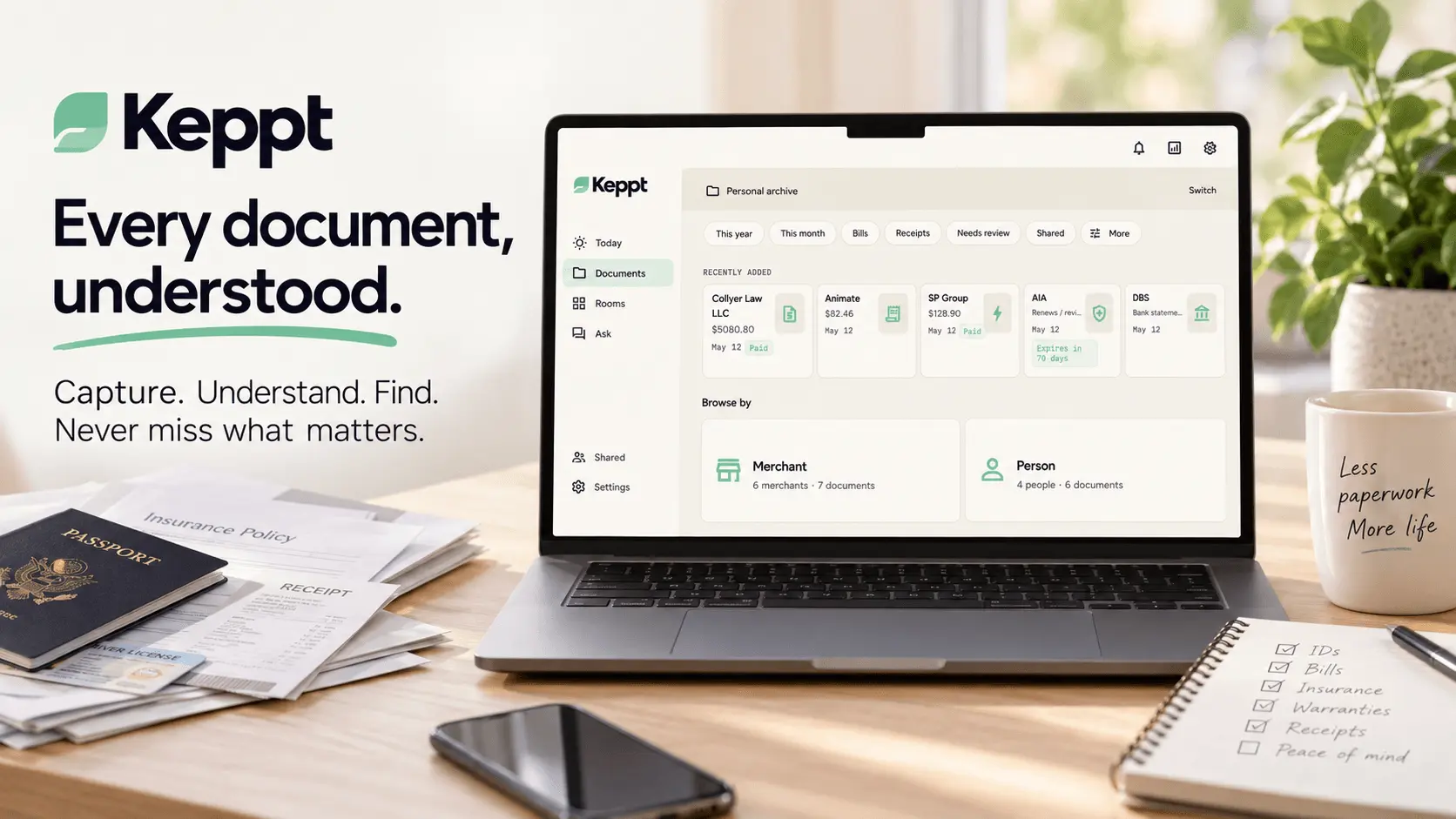
We Solved Document Storage. Now We Need to Solve Document Understanding.

We Solved Document Storage. Now We Need to Solve Document Understanding.
We don't really have a document storage problem anymore.
Between cloud drives, email inboxes, phones, laptops and scanning apps, there are plenty of places to put a PDF, receipt or photograph of an important document.
The problem comes later.
Where is the warranty for the dishwasher? When does the passport expire? What did the insurance policy actually say about coverage? How much was that medical bill? When is the next payment due?
The information exists. We just have to remember where we put it, find the right document, open it and hunt for the answer.
That's a surprisingly outdated experience for something that takes up so much of everyday life.
From storing documents to understanding them
AI creates an opportunity to rethink what a personal document library should actually do.
Instead of treating a document as a file with a name and a folder, software can begin to understand what the document is and identify the useful information inside it.
That's the idea behind Keppt.
Add a receipt, invoice, ID, insurance policy, statement, warranty or other document and Keppt reads it, identifies what it is and organises it automatically.
The goal isn't to create another place where people have to carefully build folders and filing systems. It's to make the information they already have easier to use.
Your paperwork has answers
Once documents are understood rather than simply stored, finding information changes too.
Instead of remembering a filename or digging through folders, you can search your library or ask Keppt a question in plain language.
When does my passport expire?
How much was that clinic visit?
When does this warranty end?
The answer is drawn from the documents in your own library, with the source available so you can go back to the original.
That turns a document archive into something much more useful: a source of answers about your own life.
The things you shouldn't have to remember
Some of the most useful information hidden inside paperwork isn't something you need today.
It's something you'll need three months from now.
Passports expire. Policies renew. Warranties end. Bills come due. Memberships and contracts have important dates buried in the fine print.
Keppt identifies dates like these and surfaces them when they matter.
It's a small shift, but an important one: your document library shouldn't depend entirely on you remembering what's inside it.
AI for personal documents requires trust
There's an obvious question that comes with putting AI and personal documents together: what happens to the information?
A document catalogue can contain some of the most private information a person owns. Privacy therefore can't be an extra feature added after the product is built.
Keppt has no ads or tracking and doesn't sell user data. Documents added to Keppt are not used to train general AI models.
The principle is straightforward: your documents stay yours.
A quieter use for AI
Much of the conversation around consumer AI has focused on generating something new: more text, more images, more content.
There's another opportunity that's less flashy but potentially just as useful: helping people make sense of information they already have.
Keppt is available across iPhone, iPad, Android, Mac and the web, with a free plan for up to 10 documents. The intelligence isn't reserved for a premium tier; free users can experience Ask, smart organisation and reminders from their first document.
Every document, understood.
Learn more at https://keppt.me.