
AI Content Detector
Detect AI text, deepfake video, images and cloned audio
Details
- Categories
- AICybersecurity & Privacy
- Target Audience
- Content CreatorsEducatorsJournalists
- Pricing
- Freemium
- Platforms
- Web
- Featured in
- Best Detect plagiarism in texts Tools
Discovery signals
How AI and people discover AI Content Detector on PeerPush
- ChatGPT
- Perplexity
- Claude
- +2 other AI crawlers
Reads by these AI engines
Crawlers behind these engines read this listing on PeerPush.About AI Content Detector
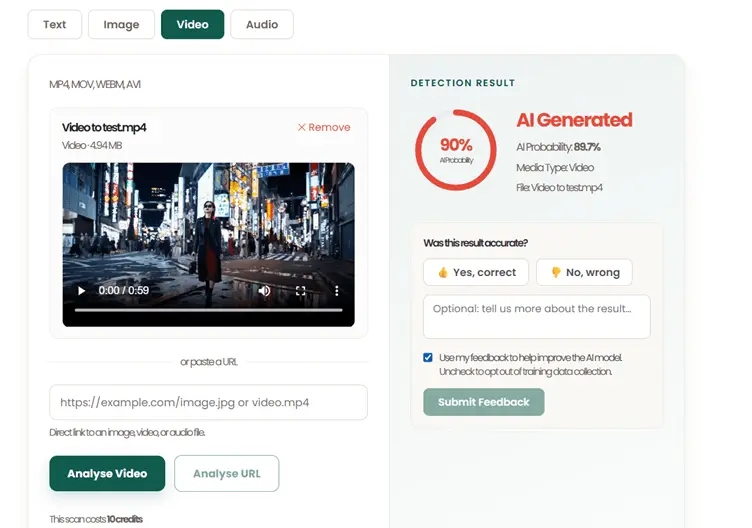
AI Aware provides an AI detector designed to identify AI-generated text, deepfake video, AI images, and cloned audio. You can use this tool to verify content authenticity with industry-leading accuracy. It helps you stay ahead of generative AI by providing specialized detection capabilities across multiple media types, including text, video, image, and voice. You can try the detection services for free to ensure the integrity of your digital assets. AI Aware is built around a premise most detection tools ignore. AI-driven deception rarely arrives through a single channel. A fraudster might send a cloned voice note, a deepfake video, and an AI-written message as part of the same attack. That is why the platform covers four content types (text, video, images, and audio) rather than specialising in just one. The text detector goes beyond surface-level pattern matching. It analyses writing structure, sentence-level statistical fingerprints, and semantic signals that are characteristic of machine-generated prose, covering every major model including ChatGPT, Claude, Gemini, Grok, and LLaMA. Crucially, it does not return a single percentage and leave the user to interpret it. It produces a paragraph-level visualisation showing exactly which sections of a document are driving the result, so the person reviewing it can make a contextual judgement rather than accepting a number at face value. The deepfake video detector analyses facial inconsistencies, unnatural blinking patterns, lighting artefacts, and temporal anomalies across frames. It is trained on output from tools like Synthesia, Sora, Runway, and HeyGen, and is built to catch novel deepfake methods that single-model detectors miss. The image detector works at the pixel level, examining texture repetition and metadata inconsistencies to identify synthetic or manipulated imagery. Applications range from insurance fraud and legal evidence review to editorial verification at news organisations. The audio detector is arguably the most urgent of the four. Voice cloning tools can now replicate a person's voice from just a few seconds of sample audio. AI Aware analyses speech patterns, prosody, background noise signatures, and spectral characteristics to determine whether audio has been synthesised or manipulated. This is directly relevant to vishing attacks, CEO fraud calls, and any scenario where a voice needs to be authenticated before it is acted on. What separates AI Aware technically is its ensemble detection architecture. Rather than relying on a single model trained on a fixed dataset, the platform combines multiple detection models, each with different training data and analytical approaches, aggregating their outputs to produce a more robust result. This is particularly important as AI generators evolve. A single-model detector trained on last year's outputs will struggle with this year's tools. AI Aware's architecture is designed to handle out-of-distribution inputs, including hybrid content that mixes human and AI writing in ways that simpler tools consistently fail on. The platform has also been trained specifically on humanised content, meaning AI-generated material that has been paraphrased or edited using tools designed to defeat basic detectors. Most detection tools rely heavily on perplexity scores, which humaniser tools are built to manipulate. AI Aware looks for deeper structural and linguistic patterns that those tools do not fully erase. In practical terms, the false positive rate for document-level text detection sits below one in one thousand. Results come back in seconds. A recruiter screening a high volume of applications, a legal team authenticating submitted documents, or a fraud investigator reviewing a suspicious call can all work at pace without waiting on processing queues.
Screenshots
Reviews (0)
No reviews yet. Be the first to rate this product!
Comments (1)
Pleased to be launching the initial version of AI text, audio, image and video checker.