
schemafit
Lint JSON schemas against LLM provider constraints
Details
- Follow on
- @danmercedeLinkedIn
- Categories
- AIDeveloper ToolsDevOps
- Use Cases
- Testing & QAAI AgentsAI Automation
- Target Audience
- DevelopersAI DevelopersAI Engineers
- Pricing
- Free
- Platforms
- CLI
Discovery signals
How AI and people discover schemafit on PeerPush
- ChatGPT
- Perplexity
- Claude
- +4 other AI crawlers
Reads by these AI engines
Crawlers behind these engines read this listing on PeerPush.About schemafit
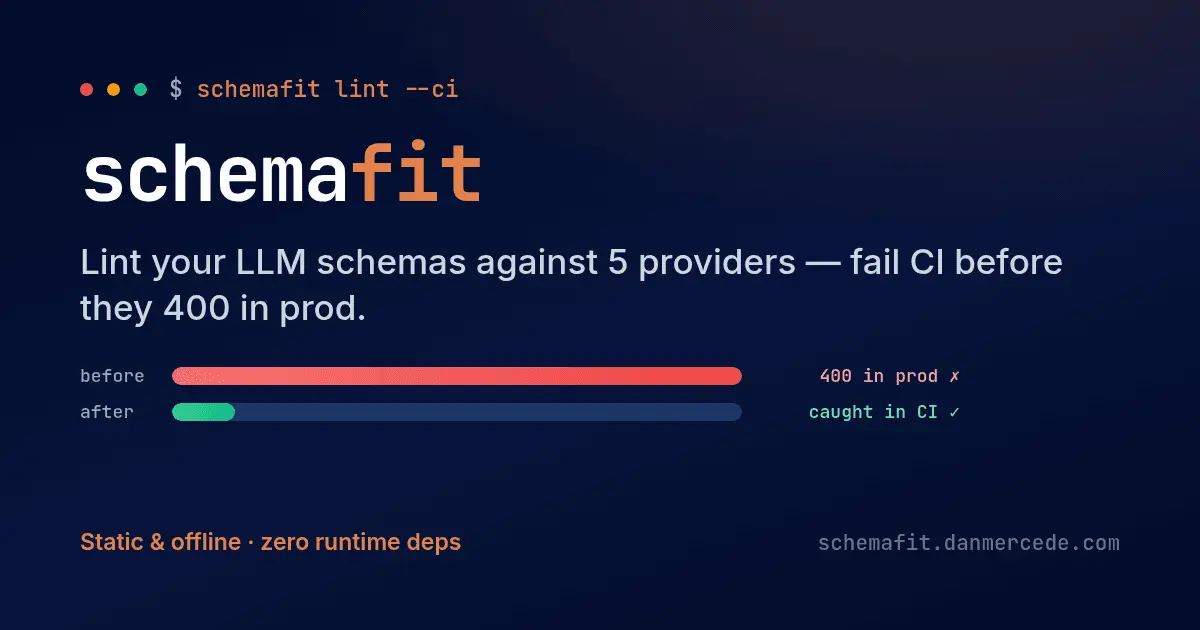
01 // THE PROBLEM A JSON Schema / tool definition / response_format that works on OpenAI can 400 on Anthropic or Gemini (and vice-versa): nested oneOf, a missing additionalProperties: false, a default in a property, Anthropic-rejected keywords (minLength, format, pattern), Gemini’s lack of anyOf. The API tells you it failed — not which constraint — so teams hand-port schemas and debug by trial-and-error at runtime. schemafit encodes each provider’s documented constraint surface as a versioned, declarative rule pack and lints your schema statically — pointing at the exact JSON-Pointer path, the keyword, and why — with a non-zero exit code so CI fails the PR instead of prod. A repair pass emits a best-effort provider-valid variant. It makes no model calls, needs no API key, and has zero runtime dependencies. 02 // DEMO lint statically checks your schema against each provider’s rule pack, names the exact violation, and exits non-zero so CI blocks the PR. repair emits a provider-valid variant. (Illustrative schema; the output format is the tool’s real one.) terminal # 1. Lint a schema against all three providers schemafit lint order.schema.json --provider openai,anthropic,gemini openai PASS anthropic FAIL /properties/email keyword: format → Anthropic rejects `format` in tool input schemas gemini FAIL /properties/items keyword: anyOf → Gemini does not support anyOf / union types SCHEMAFIT_STATUS=FAIL (exit 1 — build blocked) # 2. Auto-repair to a provider-valid variant schemafit repair order.schema.json --provider anthropic --out fixed.json wrote fixed.json (1 keyword rewritten, intent preserved) 03 // QUICKSTART On PyPI — pip install and lint your schema. No API key, no model calls; the core has zero runtime dependencies. Install Static, offline CLI pip install schemafit COPY Lint a schema against the providers you ship to schemafit lint my-schema.json \ --provider openai,anthropic,gemini,mistral,cohere COPY Prove the spine (hermetic, no config required) schemafit demo COPY 04 // COMMAND SURFACE lint Lint one or more schemas against one or more providers; reports each violation’s JSON-Pointer, keyword, and reason, and exits non-zero so CI fails the build. repair Emit a best-effort provider-valid variant of a schema — stripping or rewriting the offending keywords while preserving intent. providers List the supported providers and the versioned rule pack backing each (OpenAI, Anthropic, Gemini, Mistral, Cohere). demo Run a hermetic, end-to-end proof from a fresh clone — no API key, no network, deterministic output. 05 // WHY IT IS DIFFERENT Static, pre-ship CI lint Instructor, BAML, LiteLLM and the Vercel AI SDK are excellent runtime clients — they normalize or repair at call-time. schemafit fills the gap they leave: a static lint that fails the build before the schema ever reaches a provider, over the raw schemas you already ship, with no DSL or codegen buy-in. Zero runtime deps, no API key It makes no model calls and needs no key — easy to vendor, audit, and trust in a build pipeline. Runs from a fresh clone or a single pip install, fully offline. Grounded, versioned rule packs — with drift detection Every rule is grounded in a real, cited provider issue. Provider constraints are encoded as declarative, versioned rule packs — so the lint stays honest and reviewable as provider APIs change. New in v0.5: automatic rule-pack drift detection — an opt-in --live-verify run that rejects a schema the static pack passed flags the pack as lagging the provider’s docs, so the packs stay honest as the APIs move. CI-enforceable, with SARIF A non-zero exit fails the PR; lint --format sarif feeds GitHub code-scanning / the Security tab. An opt-in --live-verify can confirm against a real provider, but it is mock-default and never required in CI.
Screenshots
Comments (1)
SchemaFit is my attempt to make structured-output schemas behave more like production contracts.